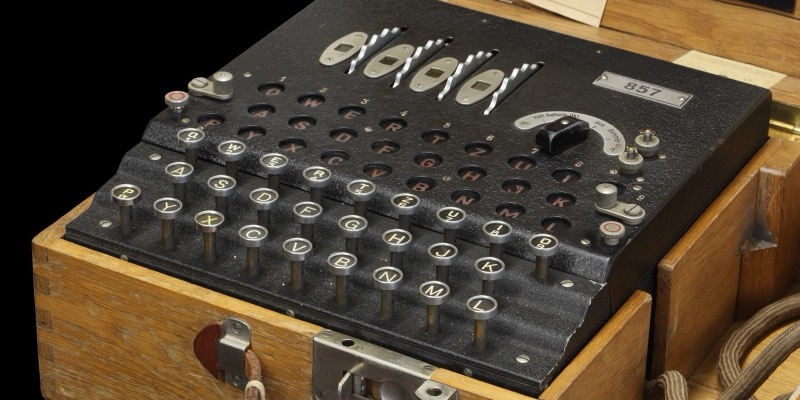
An Enigma cipher machine from the Swiss Army’s cryptography collection (illustrative). Image: Rama / Wikimedia Commons, CC BY-SA 2.0 FR, cropped

Alan Turing’s most famous puzzle has a new set of solvers. Two frontier AI models, OpenAI’s GPT-6 Astra and Anthropic’s Claude Opus 5, have each cracked a German Enigma message from the Second World War that had resisted every attempt to break it for decades, TechCrunch reports. Both solutions have been checked by the expert who keeps the archive they came from.
An 83-year-old radio message
The first came from Carter Leffen, a developer, who asked GPT-6 Astra to search a database of Enigma messages for one that had never been broken and decode it. It picked an 82-character radio message a German soldier encrypted on July 10, 1941, which had been listed as unsolved since 2005.
Astra cracked it in roughly ten hours, The Decoder reports. It did its own archive research for clues, built a simulator of the Enigma machine, and used a famous weakness of the design: Enigma never encrypts a letter as itself. A message decrypted from the same day mentioned the town of Rosenow, and when the model lined that word up in the right place, the rest came out as readable German. The message asked for marching orders and an immediate radio reply.
Claude breaks a second one
On September 21, Jack Willis, a cybersecurity executive who works with Anthropic, used Claude Opus 5 to break a different unsolved message. According to TechCrunch, Willis gave the model much more guidance than Leffen did, and Claude used the known signature of a particular German officer’s name to get in.
That leaves seven unbroken Enigma messages in the collection, plus one where the plaintext is known but the code itself still hasn’t been cracked.
‘Weeks or even months’
Both solutions were checked by Frode Weierud, a retired electrical engineer who runs Crypto Cellar, the archive of intercepted wartime messages that the unsolved ones came from. He told TechCrunch he was in “awe”:
GPT–6 Astra is behaving like a very professional cryptanalyst and archive researcher. What it achieved in two days would take a human researcher weeks or even months.
Frode Weierud, Crypto Cellar
He added that he had personally “spent several weeks researching the Bundesarchiv files GPT–6 Astra refers to.” Leffen, meanwhile, says he spent far more effort building a website explaining the puzzle than on cracking it, with AI agents doing the analysis, coding and checking while he steered.
Why it matters
These messages won’t change the history of the war, but they show AI doing the slow, careful detective work of a specialist, from archive research to building its own tools, in hours rather than months. It’s the same pattern as Claude’s physics record this week: problems that looked out of reach mostly needed patience and effort, which AI now supplies cheaply.
Sources: TechCrunch, The Decoder.
Related