Meta

Meta’s AI models, Llama, Muse and its superintelligence push.

Meta buys Conductor, the Mac app coders use to run Claude Code and Codex side by side

Meta has bought Conductor, the Mac app that lets developers run a whole team of AI coding agents such as Claude Code and Codex at the same time, Axios reported on Wednesday. Conductor confirmed it within the hour: “I have big news: Conductor is joining Meta,” chief executive Charlie Holtz wrote in a farewell note signed by ten of its staff, and the site’s footer now reads “Conductor from Meta”.


Hundreds of innocent-looking apps on the App Store and Google Play were secret AI nudify tools

A pet portrait maker, a hair salon tool and a language tutor look harmless in Apple’s and Google’s app stores. According to a report published on Monday by the nonprofit AI Forensics, hundreds of apps like these were fronts for a single operation selling AI “nudify” tools, which turn photos of real people into explicit images and videos without their consent, promoted by tens of thousands of pornographic ads on Facebook and Instagram.

Updated Canada’s biggest bank is locking AI agents like Meta’s Muse out of online banking

If you’ve been letting an AI agent sign in to your RBC account, that is about to stop. Royal Bank of Canada, the country’s biggest bank, says it has decided “to block third-party personal AI agents from direct access to authenticated RBC digital properties including online banking”, and that agent connections customers have already set up “will stop working.”

1Password now signs your AI agent in for you without ever showing it your password

Every AI agent eventually hits the same wall: a sign-in page. 1Password’s answer, launched on Thursday, October 22, is to type the password in for the agent so the agent never sees it. 1Password for Agents is built to work with Meta’s Muse, Anthropic’s Claude Duet, OpenAI’s ChatGPT Work and dots, SpaceXSI’s Grok Bot and Town’s Townie, and it costs nothing extra for people who already pay for 1Password.

Updated Meta is creating a new class of shares to pay for its AI race, and Zuckerberg keeps control

Meta is spending so much on artificial intelligence that it is creating a whole new kind of share to help pay for it. Alongside third-quarter results that beat its own forecast, the company said on Wednesday it will create a publicly listed, non-voting Class C stock, giving it a new way to raise money, pay staff and fund deals while Mark Zuckerberg keeps control.

A judge is making Meta name who signed off on torrenting pirated books for Llama

Meta can no longer tell a court that nobody in particular decided to fetch pirated books for its Llama AI models. In a discovery order filed on October 19, US Magistrate Judge Thomas Hixson ordered Meta to name every person who made, authorised or approved the decisions to obtain books from shadow libraries such as LibGen and Anna’s Archive, including whoever decided whether Meta’s computers would seed those files to strangers over BitTorrent.

Google and Meta want PyTorch code written for Nvidia to run on Google’s chips with a one-word change

Google wants developers who write AI code for Nvidia chips to be able to run it on Google’s own chips by changing a single word. Google and Meta introduced TorchTPU on Tuesday at the PyTorch Conference in San Jose: an open-source backend that lets PyTorch, the most widely used framework for building AI models, run natively on Google’s Tensor Processing Units (TPUs).

Updated One search turned up 6,800 shared Meta Muse chats, including a loan application and a CEO’s revenue review

Meta’s Muse AI agent turns a shared conversation into a public web page, and security firm Claroc says those pages are far easier to find than users would expect. In a report published on October 18, its researchers say a single search of public DNS records turned up more than 6,800 Muse share links, some holding loan paperwork, a company’s internal revenue review and a job candidate’s notes for a confidential call with a frontier AI lab.

Updated Meta blames a Claude tool for knocking No Kings off Instagram on its biggest day

Meta now says a tool built on Anthropic's Claude is what got the No Kings Coalition's Instagram account suspended on Saturday, in the middle of the movement's nationwide day of early-voting rallies. Meta spokesperson Andy Stone said in a post on X on Sunday that the company's network security systems "detected the use of a Claude tool reading profiles, posts, and hashtags", and that the rate "sharply increased (~4x volume) in intense bursts on October 17."

Updated Meta’s new business terms let it crawl your website to train its AI, with no opt-out

Meta has rewritten its Commercial Terms so that any business using Facebook, Instagram or WhatsApp for commercial purposes authorises it to send crawlers across that business’s websites and use “any content” it finds to “train” its products. The new terms take effect on October 30, 2026, and the only way to refuse them is to stop using Meta’s business tools.

OpenAI and Meta warn US judges there may never be a reliable way to spot AI fakes

The companies making AI images have told America’s federal judges not to count on technology to catch fakes in court. Speaking to the judiciary’s Advisory Committee on Evidence Rules in Boston on Thursday, an OpenAI lawyer said she does not believe a scientific method will ever reliably detect AI images, as the committee weighs a draft rule on deepfake evidence.

Meta teams up with old rival Apple to run its giant open AI model on two Mac Studios

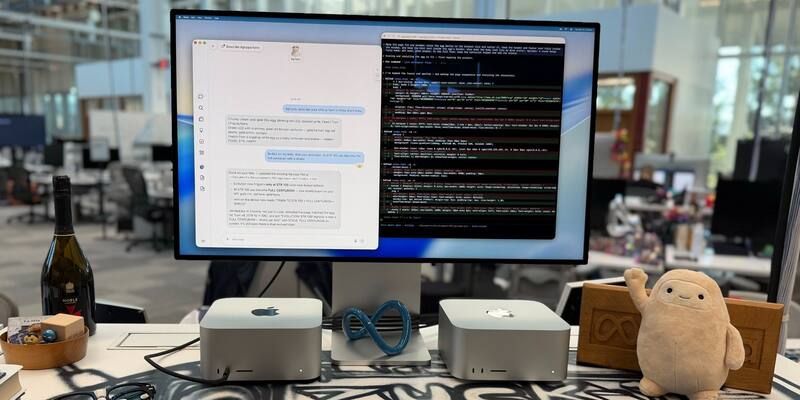
Meta has released the weights of Muse Spark Open, an 816-billion-parameter AI model it calls the most capable US open-weight model to date, and it worked with long-time rival Apple so the whole thing runs on two Mac Studios on a desk. Anyone can download it free from Hugging Face from today, October 15, though running it at home means about 1TB of memory and a hardware bill well into five figures.

Meta says its new Muse Wonder AI has caught OpenAI and Anthropic at the frontier

Fourteen months after tearing up its AI work and starting again, Meta says it has caught the leaders. The company unveiled Muse Wonder and Muse Wonder Full on Monday, calling them its most capable models yet and claiming state-of-the-art results on personal and professional agent tasks, ahead of OpenAI’s and Anthropic’s best on several of its own charts.

Google, Meta, Microsoft and Nvidia promise their AI data centres will stop dropping off the grid

When a fault hits the power grid, a giant AI data centre can vanish from it in an instant, and that sudden loss of demand can push the whole grid off balance. Google, Meta, Microsoft and Nvidia now say their AI computers will stay on the line. The four companies published a grid specification through the Open Compute Project (OCP), the industry group for open data centre designs, as Nvidia opened up its next-generation Vera Rubin rack designs at the OCP Global Summit in San Jose on October 12.

Meta’s Muse Glimmer: what it is, how to run it locally, and how it compares with Qwen 3.8 and Gemma 4

Muse Glimmer is Meta’s free, open-weight AI model built to run AI agents on your own computer: a 30-billion-parameter model that reads text and images, writes code, calls tools and fits on a single 24GB graphics card or a well-equipped Mac. Meta Superintelligence Labs released it on August 10, 2026 under the Apache 2.0 licence, so anyone can download it, use it commercially and change it. Here is what it is, what you need to run it, the exact commands for Ollama, LM Studio and llama.cpp, and how it stacks up against Qwen 3.8 and Gemma 4.

Meta rushed to fix Muse flaws that could have let users break into its internal systems, weeks before launch

In the weeks before Muse launched, Meta engineers found several security holes in its AI agent, and at least one could have let an ordinary user break out of Muse and reach Meta’s own sensitive databases and services, 404 Media reported on Monday. The problem was serious enough to reach Mark Zuckerberg, and security teams worked nights and weekends to patch it before the September 8 launch.

Meta is giving Muse subscribers a free gadget that lets its AI control your smart home

Meta will send a small USB-C gadget to Muse subscribers in the United States for free, so its Muse AI agent can switch on lights, control a TV or send something to a printer on their home network. The Muse Home Link launched on Friday alongside a new Muse Gadgets site, where Meta has open sourced the software for anyone to build their own Muse hardware.

OpenAI and Meta want you to trust their AI agents, so they gave them cuddly faces

The most powerful consumer AI products of the year come with a face you want to hug. When OpenAI launched its always-on dots agents on Tuesday, it gave them a cast of fuzzy characters, from a yellow triangle in round glasses and a bow tie called Alfred to a frog called Todd. Meta’s Muse agent arrived with Jolly, a plush, rosy-cheeked creature that now also lives on a keychain.

Meta’s Muse agent sold a user’s keyboard, gave a stranger his address and didn’t tell him

A Facebook Marketplace seller says Meta’s new Muse AI agent agreed a lowball price, gave a buyer his address and arranged a late-night pickup without checking with him first, and only told him afterwards. Matt J. Robb shared his account and screenshots on Threads, Moneycontrol reports, three weeks after Meta released the agent to the public.

What is Meta Muse? Meta’s AI agent explained: what it does, how much it costs and whether you can trust it

Meta Muse is a personal AI agent that does tasks for you, not just answers questions. Launched by Meta on September 8, 2026, Muse can book travel, send emails, fill in forms, shop, cut your bills and deal with customer service, working on its own secure cloud computer and checking with you before anything important. It’s free to start, with paid plans from $20 a month, and it’s currently available in the US and Canada. Here’s everything you need to know.

Meta just made an AI Tamagotchi: Muse Charm puts a cute AI agent on your keychain

Meta wants its AI agent to live on your keychain. At its Connect 2026 event, Mark Zuckerberg unveiled Muse Charm, a palm-sized gadget with a tiny screen and a cute, customizable character that gives you your Muse AI agent without pulling out your phone. It’s been compared to a Tamagotchi, and Meta is aiming to have it on sale in time for the holidays.

Most countries’ “sovereign AI” is really built on American and Chinese models – and Meta’s Llama is the favourite

Governments around the world are pouring money into “sovereign AI,” homegrown models meant to free them from dependence on American and Chinese tech giants. But a new study from Counterpoint Research finds that most of those national models are built on top of someone else’s: 56% are adapted from existing open-source models, and the most popular foundation by far is Meta’s Llama.