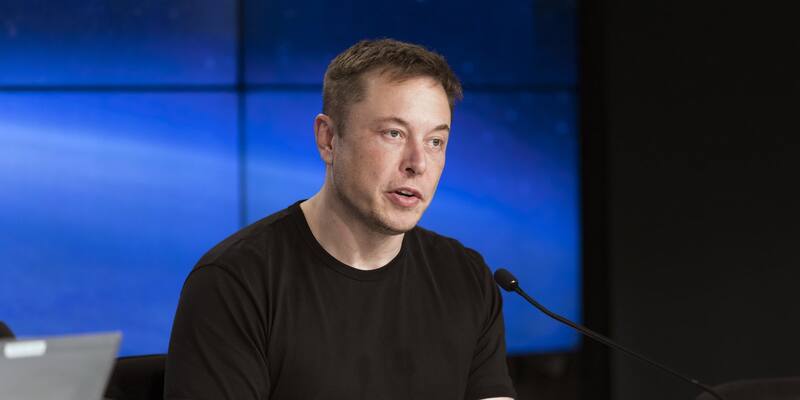
Elon Musk at a news conference at NASA’s Kennedy Space Center after the first Falcon Heavy launch in February 2018. File photo. Image: NASA/Kim Shiflett / Wikimedia Commons, Public domain, cropped
SpaceX’s AI business brought in $7.56 billion in the three months to September 30, nine times as much as a year earlier and more than Starlink, the company reported on Tuesday in its third-quarter results.
The unit, now called Super Intelligence (SI) and home to Grok, X’s advertising and the AI coding company Cursor, grew 830% year on year and 195% on the previous quarter. That made it SpaceX’s biggest segment, ahead of Connectivity (Starlink) at $5.25 billion, which was still nearly twice its size in the second quarter, and Space (launches) at $1.77 billion. Group revenue was $14.58 billion, up 161%.
The segment was renamed from “Artificial Intelligence” this quarter, weeks after Elon Musk said SpaceXAI would become “SpaceXSI”.
Cloud deals did most of the work
Almost all of the growth came from what SpaceX calls SI solutions and infrastructure, which jumped from $359 million a year ago to $7.02 billion. The company puts that down to “the activation of new cloud services agreements, the acquisition of Cursor, and increased Grok adoption across enterprise customers and consumers”. In plain terms, SpaceX is now renting large amounts of its AI computing power to other companies. It said it signed more of those cloud deals during the quarter but didn’t name the customers.
Cursor, which SpaceX bought on August 14 at an implied equity value of $60 billion, added $608 million of revenue in about seven weeks. Take that out and SI solutions revenue was still about $6.4 billion, roughly 18 times last year’s figure. The deal cost $42.5 billion in purchase consideration under accounting rules, plus $23.4 billion of SpaceX stock awards for Cursor staff that vest over time. Cursor is already being folded into SpaceX’s consumer offer: in October Grok, Cursor and X Premium became one $30 plan.
Advertising on X, which also sits in the SI segment, was a small part of the story at $538 million, up from $454 million. SpaceX also pointed to faster Grok model releases and the launch of Grok Bot, which it describes as “our always-on agentic SI system”, but gave no subscriber or user numbers for Grok.
A profit, with a big asterisk
The AI unit made an operating profit of $431 million, after losses of $1.26 billion in the second quarter and $1.72 billion a year ago. That was despite $1.2 billion of stock-based pay tied to the Cursor deal. On SpaceX’s own adjusted measure, which strips out depreciation and stock pay, SI earned $4.95 billion.
That adjusted figure leaves out the segment’s biggest cost. Depreciation and amortisation in SI reached $2.47 billion for the quarter, up from $922 million a year earlier, as data centres and chips bought over the past year start to wear out on the books. Over the first nine months of 2026 the segment still lost $3.3 billion at the operating level on $10.9 billion of revenue.
$16.4 billion spent in one quarter
SpaceX spent $16.4 billion on capital projects for the AI segment in the third quarter alone, 84% of the company’s $19.6 billion total and more than twice what SI brought in. Year to date, AI capex is $40 billion against $10.9 billion of AI revenue.
Most of that is going into compute. SpaceX said its “nameplate compute” reached 1.7 gigawatts on September 30, up from 1.4 GW in June and 0.6 GW a year ago, as it keeps building Colossus II in Memphis. Musk said last month that he wants to more than double Colossus 2’s Nvidia chips before the end of the year.
The company’s finance chief was upbeat in the release, calling the quarter “a clear inflection in our Super Intelligence business” and saying SpaceX is investing “with discipline”, focused on returns on capital and an investment-grade balance sheet.
How it compares
For scale, Anthropic’s draft IPO filing shows $16.3 billion of revenue in the first half of 2026, so SpaceX’s AI arm is still smaller than the lab whose Claude models Musk has admitted are ahead of Grok. But much of SpaceX’s new AI revenue comes from selling computing power rather than from its own models, a business that doesn’t depend on Grok winning.
Why it matters
SpaceX has turned its AI unit from a cash drain into its largest source of sales in a single quarter, mostly by renting out data centres rather than selling Grok. Whether that lasts depends on the cloud contracts holding up while it keeps spending about $16 billion a quarter on chips and power.
Sources: SpaceX third-quarter 2026 results (Form 8-K, Exhibit 99.1, SEC); SpaceX Form 8-K, October 20, 2026.
Latest SpaceXAI news