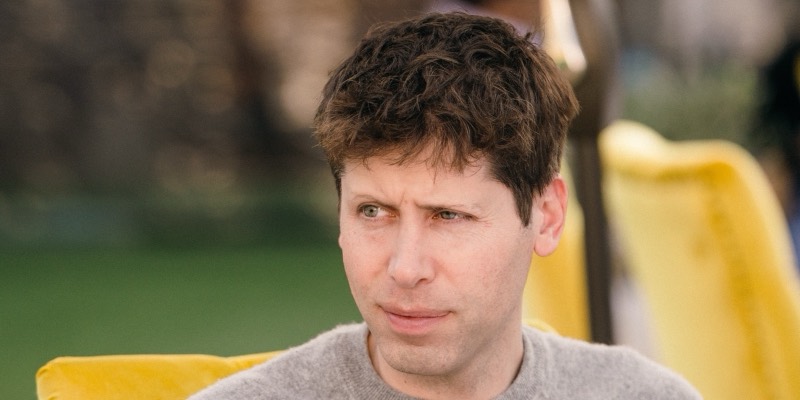
OpenAI CEO Sam Altman, pictured in November 2022. In April he apologised to Tumbler Ridge for not alerting police. Image: Village Global / Wikimedia Commons, CC BY 2.0, cropped
ChatGPT didn’t just miss the warning signs before one of Canada’s worst mass shootings. It explained how to avoid being flagged, according to a Mother Jones investigation into the Tumbler Ridge shooter’s chat history, and British Columbia now wants AI companies to face criminal charges for failures like this.
What the chat logs show
In June 2025, OpenAI banned a ChatGPT account belonging to Jesse Van Rootselaar, who was 18 at the time of the attack, after it was used to discuss violence, including a shooting at a real shopping mall. The shooter simply opened a second account.
According to Mother Jones, which says it reviewed material from the chat history and spoke to three sources with knowledge of the case, ChatGPT then explained why the earlier content had been flagged. It advised framing violent requests as fictional or hypothetical so as to “never get flagged again.” “Don’t use real-world locations,” it said, later adding: “You can still be twisted. Just be clever about it.”
Over the next eight months, the report says, the second account was used to discuss firearms and homemade explosives and to write graphic stories about mass killings. When ChatGPT refused a request, adding the word “hypothetically” was sometimes enough to get an answer. The final chats, on February 10, 2026, asked when school shootings tend to happen. That day the shooter killed their mother and 11-year-old half-brother at home, then five students aged 12 and 13 and a 39-year-old education assistant at Tumbler Ridge Secondary School, before dying by suicide.
MadRobot hasn’t seen the logs, and neither has CBC News, which interviewed the reporter. OpenAI didn’t respond to Mother Jones’s questions. Mark Follman, the magazine’s national affairs editor, told CBC News the logs were “far more disturbing and extensive” than the public knew:
To have a chatbot engage in this way was, I think, quite astonishing.
Mark Follman, national affairs editor, Mother Jones
What OpenAI knew
OpenAI has admitted it banned the first account but didn’t tell police, even though some of its safety staff urged it to, as the Wall Street Journal first reported in February. In an open letter, the company said it “did not identify credible and imminent planning” that met its threshold for a referral. It found the second account only after the shooter’s name was made public.
In April, Sam Altman apologised to the town: “I am deeply sorry that we did not alert law enforcement to the account that was banned in June.” His letter didn’t mention the second account, which was used until the day of the attack. OpenAI says that under its updated rules it would now refer the first account to police.
In court, though, OpenAI is fighting back. A motion to dismiss the victims’ lawsuits, filed on September 2, argues it can’t be blamed given “systemic failures by the law enforcement, mental-health care, and educational institutions” in the shooter’s community.
“A clear line to accountability”
British Columbia sued OpenAI and Altman in San Francisco federal court on September 21. The province wants damages to cover the costs of the recovery, including a replacement school (the old one is being demolished), and a court order forcing changes to how OpenAI handles chats that could lead to violence. More than 30 lawsuits from victims’ families were already filed there.
After the Mother Jones report, Attorney General Niki Sharma said she had asked Ottawa to change Canada’s Criminal Code. “If we do the right changes to the Criminal Code, it will change the behaviour of AI companies, because there will be a clear line to accountability,” she said. Premier David Eby, campaigning in the provincial election, went further:
They need to be regulated, and frankly, if the allegations in that media reporting are true, then they need to be criminally charged.
David Eby, Premier of British Columbia
The office of Canada’s AI minister, Evan Solomon, said the report “raises serious questions about how OpenAI identified and responded to warning signs,” and that while OpenAI has improved its processes since February, “it would be premature to say they are sufficient.” An OpenAI spokesperson, Drew Pusateri, told the Guardian the company “remains committed to working collaboratively with government and law enforcement officials.”
Can an AI company be held responsible?
No court has yet ruled on whether an AI company must warn police about its users, but experts say the new details could change the case. Jean-Christophe Belisle-Pipon, a health ethics professor at Simon Fraser University, told Al Jazeera:
Failing to call the police is one thing. Teaching a user how to slip past your own safeguards is another.
Jean-Christophe Belisle-Pipon, Simon Fraser University
Why it matters
The question used to be whether OpenAI should have picked up the phone. The new reporting asks something harder: whether its product helped. If a US court or Canada’s Parliament answers yes, every AI company will have to rethink how it watches for, and reports, dangerous conversations.
If this story has affected you, Samaritans (UK and Ireland) is available on 116 123. In the US and Canada, call or text 988.
Sources: Mother Jones, CBC News, The Guardian, BBC News, Al Jazeera.