Tim Cook (left) and John Ternus, who succeeded him as Apple CEO on September 1, meet European Parliament President Roberta Metsola at Apple Park in May 2026. Image: Amy Osborne / European Union, European Parliament
Apple finally has a smart Siri. After more than two years of promises, delays and a $250 million lawsuit settlement, “Siri AI” arrived on iPhones on September 14, and the reviews are genuinely good. There’s just one problem: while Apple spent those two years trying to make Siri read your emails, the rest of the tech industry built AI that does your job. Here’s how far behind Apple really is, why it happened, and whether it matters.
This is an analysis piece, based on company announcements, reviews and reporting as of September 25, 2026.
What everyone else is offering, and what Apple is
Look at what the biggest AI companies have put in people’s hands in just the past few weeks.
- Anthropic offers Claude Opus 5.5 and its flagship Fable 5.1, among the most capable models in the world, and Claude Code, which can now keep working on its servers after you close your laptop. This week, Claude even discovered a new CRISPR-like enzyme system largely on its own.
- OpenAI offers GPT-6 Astra, which tops the new Humanity’s Last Exam leaderboard, plus the cheaper GPT-6 Sol and Luna, and ChatGPT agents that can browse, build and carry out tasks.
- Google offers Gemini, which now phones restaurants and shops for you and sits on hold on Pixel 11 phones, with Gemini 4 due “much earlier” than the end of the year.
- Meta offers Muse, a personal agent that books travel, sends emails, shops and deals with customer service on its own cloud computer, and is even putting it on a keychain gadget.
- Microsoft offers Autopilot, a Copilot agent with a name, a role and a goal that keeps working while you sleep, plus a Code tab that builds apps from plain English.
- xAI offers Grok Bot, AI coworkers with their own cloud computers that work around the clock, and has already put the agent inside Tesla cars.
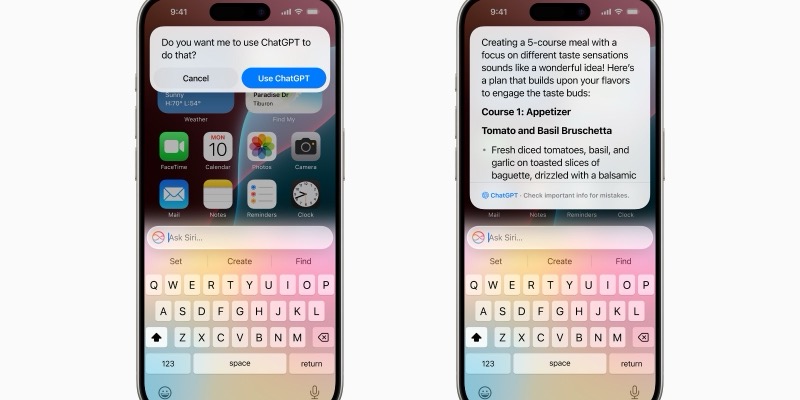
And Apple is offering a Siri that can finally understand your messages, notes, photos and emails, see what’s on your screen and take some actions inside apps. It’s in beta, it’s English-only, it isn’t on iPhones in the EU or China, and its intelligence comes largely from Google.
That’s the gap. Its rivals are selling AI that does work. Apple is selling an assistant that is, at last, good at what assistants were supposed to do in 2024.
Apple vs the AI giants at a glance
Swipe the table sideways to see every column →
| Company | Its own frontier AI model? | Flagship AI product right now | Agents that do tasks for you? | Cloud platform for building agents | 2026 capital spending |
|---|---|---|---|---|---|
| Anthropic | Yes: Claude Fable 5.1, Opus 5.5 | Claude, Claude Code | Yes: Claude Code cloud sessions | Yes: Claude Managed Agents | Not public |
| OpenAI | Yes: GPT-6 Astra, Sol, Luna | ChatGPT | Yes: ChatGPT agents | Yes: AgentKit, Agents SDK | Not public |
| Yes: Gemini (Gemini 4 due soon) | Gemini | Yes: Call for Me phones businesses | Yes: Vertex AI Agent Builder | $175–185bn | |
| Meta | Yes: Muse Spark | Muse | Yes: shops, books and emails | Partly: Muse Spark API | $115–135bn |
| Microsoft | Partly: its own plus OpenAI and Anthropic models | Copilot | Yes: Autopilot | Yes: Azure AI Foundry, Agent 365 | ~$190bn |
| xAI | Yes: Grok 4.7 | Grok | Yes: Grok Bot, also in Teslas | Yes: Agent Tools API | Not public |
| Apple | No: built with Google’s Gemini | Siri AI (beta) | Limited: actions inside your own apps | No: an app model API only | ~$14bn |
Amazon, the biggest cloud provider, is covered in the cloud section below. Capital spending figures are companies’ 2026 plans as reported by CNBC and Fast Company. Anthropic, OpenAI and xAI (now part of SpaceX) don’t publish comparable figures. As of September 25, 2026.
The cloud platforms Apple doesn’t have
The gap is even starker behind the scenes. The real business of AI agents isn’t just the apps people use; it’s the cloud platforms that let every other company build, run and govern agents of their own. That’s where the money and the future developers are, and every one of Apple’s rivals has one.
- Anthropic offers Claude Managed Agents, launched in April: a hosted platform for long-running autonomous agents, with sandboxed code execution, memory, permissions, scheduled runs and tracing built in.
- OpenAI offers AgentKit and its Agents SDK, which this year gained sandboxes so agents can safely operate their own computer environments.
- Google offers Vertex AI Agent Builder and Agent Engine, which it turned into a full agent stack in April, built around companies’ own data.
- Microsoft offers Azure AI Foundry’s Agent Service to build and run agents, Agent 365 to govern them across a company, and, from today, a Copilot Managed Runtime to host the apps and agents staff build in Copilot.
- Amazon, the world’s biggest cloud provider, offers Bedrock AgentCore, a serverless platform for running agents built on models from Anthropic, Meta, its own Nova family and more.
- xAI offers an Agent Tools API that lets Grok run as an autonomous agent on its servers, searching the web and X and running code.
- Meta offers developers access to its Muse Spark models through its model API, and Muse Code for multi-agent coding.
And Apple offers its Foundation Models framework, which lets app developers use a small, roughly 3-billion-parameter model on the device and, new in iOS 27, a larger model on its Private Cloud Compute servers, with reasoning and a longer memory. It’s free and privacy-first, but it’s built for quick requests inside apps, not for hosting agents that work for hours. Developers have to apply, it’s limited to apps with fewer than 2 million downloads, and each user gets a daily allowance tied to their iCloud account. There’s no Apple cloud where a business can build and run its own agents at all.
That matters because the AI boom is increasingly being paid for by businesses, not consumers. Microsoft, Google and Amazon are turning their clouds into agent factories, and Anthropic and OpenAI are selling directly to the companies building on them. Apple, which has never been a cloud company, has no seat at that table.
Siri AI: good news, two years late
To understand Apple’s position, you have to go back to June 2024. At that year’s WWDC, Apple showed off a new Siri that could understand your personal context, the kind that could find the podcast a friend texted you or tell you when your mum’s flight lands. It sold iPhones on the promise.
It didn’t arrive. In March 2025, Apple admitted the smarter Siri was delayed, and the fallout has been expensive. Apple agreed to a $250 million settlement with US iPhone buyers who say they were sold features that didn’t exist. And the stopgap, building ChatGPT into Siri, was a flop: OpenAI itself told a court the integration was “dramatically underperforming” within months.
Siri AI, launched on September 14 with iOS 27, is the long-awaited result, and reviewers like it. TechCrunch’s reviewer says he’s “actually using Siri again”, praising its awareness of what’s on screen and its handling of multi-step requests. The Wall Street Journal called it “a genuine upgrade”, according to MacDailyNews, but its reviewer caught it confidently getting a location wrong and advised readers to try it while keeping “Claude and ChatGPT on speed dial.”
That advice says a lot. Even at its best, Apple’s assistant is something you use alongside the real AI tools, not instead of them. And many iPhone owners can’t use it at all yet:
- It’s still a beta, in English only at first, with French, Japanese, Korean, Portuguese and Spanish due next month.
- It’s not on iPhones in the EU. Apple blames “EU regulators’ extreme interpretation” of the Digital Markets Act, which it says would force it to give rival assistants access to users’ private data. It is available in the UK.
- It’s not available in China, one of Apple’s biggest markets, while it works through regulations there.
- It needs an iPhone 15 Pro or newer; the standard iPhone 15 misses out, according to Apple.
Apple is renting its brain from Google
The most striking thing about Siri AI is who built its brain. In January, Apple and Google announced a multi-year deal for Gemini to power the new Siri, CNBC reported, a deal Bloomberg’s Mark Gurman estimates costs Apple around $1 billion a year. Apple describes Siri AI as running on “Apple Foundation Models developed with Google’s Gemini,” on your iPhone and on its own Private Cloud Compute servers, so Google doesn’t see your data.
That’s a sensible way to catch up, but it’s a remarkable admission for a company that prides itself on controlling every layer of its products, from chips to software. Apple designs its own processors because it doesn’t want to depend on Intel or Qualcomm. For the most important new technology in a generation, it depends on its biggest rival in smartphones.
The market noticed. In January, Alphabet overtook Apple to become the world’s second most valuable company, Yahoo Finance reported, on the strength of its AI.
The spending gap
AI at the frontier is expensive: it takes vast data centres full of chips to train and run the best models. Here’s what the giants plan to spend on capital projects this year, mostly on AI:
- Amazon: about $200 billion
- Microsoft: about $190 billion
- Alphabet: $175–185 billion
- Meta: $115–135 billion
- Apple: about $14 billion
Together, the other four plan to spend around $650–725 billion, according to CNBC and Fast Company. Apple is spending roughly a fiftieth of that. It’s a deliberate choice, renting AI from partners rather than building its own infrastructure, but it also means Apple has opted out of the race to build the most powerful models.
The talent drain
Apple has also been losing the people it would need to build its own. In 2025, Meta hired Ruoming Pang, who ran Apple’s foundation models team, with a pay package reportedly worth tens of millions of dollars a year, and several of his researchers followed. John Giannandrea, the Google veteran Apple hired in 2018 to lead its AI strategy, announced his retirement in December and left this spring.
His replacement, Amar Subramanya, spent 16 years at Google, eventually leading engineering for the Gemini assistant, before a brief stint at Microsoft. That’s a telling hire: Apple went to the people who built the rival products to fix its own.
And at the very top, there’s a new boss. Tim Cook handed over to John Ternus on September 1, and became executive chairman. Ternus is a hardware engineer by background, and analysts have pointed out that Apple’s AI problem is about software and data, not chips.
The products stuck waiting for Siri
Apple’s AI delays aren’t just hurting Siri. They’re holding up whole new product lines.
Apple’s first smart home display, a square iPad-like hub for the home, has been ready for months. It was expected in spring 2025, then March 2026, and was delayed again because Siri wasn’t ready. It may finally arrive as soon as next month. Apple’s smart glasses are expected in late 2027, and a tabletop robot not until 2028, according to AppleInsider.
Meanwhile, Meta is already on the third generation of its Ray-Ban smart glasses and is launching a Muse gadget for the holidays, and Google is selling Pixel 11 phones built around its Gemini features.
The case for Apple
It would be wrong to write Apple off. There’s a real argument that its slower approach is sensible.
Privacy. Apple remains the clear outlier on AI privacy. In our comparison of the six biggest AI companies, it was the only one that doesn’t train on your conversations or keep them in its cloud. Its insistence on running AI on your device, or on servers it says even it can’t access, is part of why it has been slower.
Reach. Apple doesn’t need the best model if it controls the device the model runs on. More than a billion iPhones are in use, and Siri AI will be in front of those users by default. Apple also takes a cut of the AI apps sold through its App Store, even the ones that compete with Siri.
Hardware. Apple’s chips are excellent at running AI locally; a Mac mini can run capable open models entirely offline. If AI shifts toward running on personal devices, Apple is well placed.
No bubble risk. By not spending hundreds of billions on data centres, Apple avoids the risk of overbuilding if AI demand disappoints. Ternus has framed AI as a means to better products, not a goal in itself:
We never think about shipping a technology. We always think about, “How can we leverage technology to ship amazing products and features and experiences for our users?” So that’s how we think about AI.
John Ternus, Apple CEO, speaking in April as hardware chief
Even Apple’s supporters admit the story is incomplete. Gene Munster of Deepwater Asset Management, a long-time Apple bull, put it plainly earlier this year:
Until Apple provides clearer substance or demonstrates its capabilities in market, I expect this tension to persist, even as fundamentals continue to perform.
Gene Munster, Deepwater Asset Management
MadRobot’s take
Siri AI is a good product, and Apple deserves credit for finally shipping it, carefully and with privacy intact. But it’s a good version of the wrong thing. In 2026, the AI race isn’t about assistants that answer questions about your inbox; it’s about agents that take work off your hands, and models that can reason, code and even make scientific discoveries. On that measure, Anthropic, OpenAI, Google, Meta, Microsoft and xAI are building the future, both in the apps people use and in the cloud platforms businesses build on, and Apple is renting parts of it from Google.
Apple has recovered from being late before; it wasn’t first with MP3 players, smartphones or smartwatches. But in each case it built the thing itself. This time, its most important feature runs on a rival’s brain, its best AI people have left, and it’s spending a fraction of what its competitors are. John Ternus’s first big test is whether Apple can become a real AI company again, or settle for being the world’s most beautiful place to use everyone else’s.
Sources: Apple, Apple (EU), TechCrunch, MacDailyNews (on the Wall Street Journal’s review), CNBC, CNBC (capex), Fast Company, Yahoo Finance, Apple (Giannandrea), AppleInsider, MacDailyNews (Munster), The Washington Post, Anthropic, OpenAI, xAI, Apple Developer, Tech Insider (cloud agent platforms)