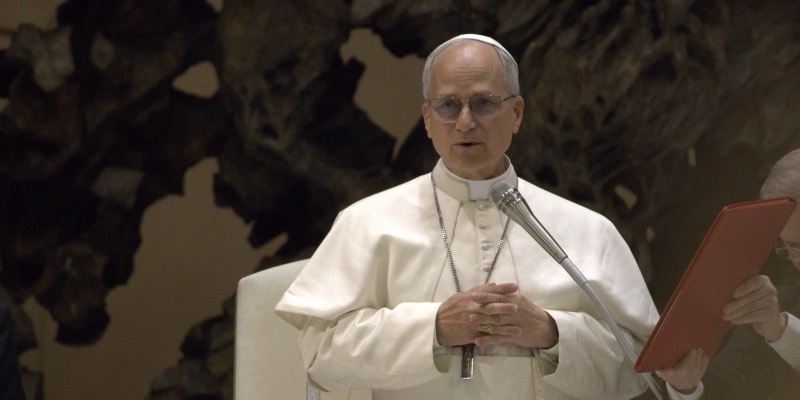
Pope Leo XIV speaking at an audience with the media in May 2025, days after his election. Image: Edgar Beltrán, The Pillar / Wikimedia Commons, CC BY-SA 4.0, cropped

Pope Leo XIV has brought his warnings about artificial intelligence to Paris. Speaking at UNESCO’s headquarters on the first day of his visit to France, he said new technologies must stay “at the service of the human person, rather than becoming yet another instrument of domination and injustice,” according to the Vatican’s text of the speech.
“Yet another instrument of domination”
At UNESCO, the UN’s agency for education, science and culture, the Pope singled out technology as one of the biggest challenges facing science and education today, and questioned the very name we give to AI:
While “intelligence” is attributed to computational systems, we struggle to recognize the inalienable dignity of human persons, whose lives are judged according to the criterion of efficiency and, when deemed no longer productive, are rejected and discarded.
Pope Leo XIV, at UNESCO in Paris
He argued that AI makes an existing problem worse. Communication is faster, he said, but “not necessarily more truthful,” and information is “not synonymous with wisdom.” AI systems “can correlate data,” but they “cannot answer questions that concern the meaning of human life.” He called for the world to pay particular attention to protecting children online, saying their vulnerability in the digital age “must never become an opportunity for exploitation.”
“A paradise of machines”
Earlier, after an hour of talks with President Emmanuel Macron, Leo spoke to officials and diplomats at the Élysée Palace. Borrowing a phrase from the French writer Georges Bernanos, he warned against “losing our humanity amid a ‘paradise of machines’ invading and conditioning our daily lives,” the Vatican’s text shows, and said there is “an urgent need for education in ethical discernment.”
It was the line most outlets picked up, including the BBC. It came at the start of a four-day trip that has drawn huge crowds, with more than half a million people expected at an open-air Mass in Paris on Saturday.
“Merely regulating it is insufficient”
None of this is new for Leo, the first pope from the United States. He made AI the focus of his first encyclical, Magnifica Humanitas, published in May, and he told the Élysée audience he had considered it “essential” to do so.
That document goes further than most politicians. It criticises “a race for ever more powerful algorithms and larger datasets, driven by the desire to secure geopolitical or commercial dominance,” and calls for AI to be freed from “monopolistic control.” Its key demand is that AI be “disarmed”:
AI is already an environment in which we are immersed, as well as a force with which we must engage. For this reason, merely regulating it is insufficient; it must be disarmed, welcoming and accessible.
Pope Leo XIV, Magnifica Humanitas
Disarming it, the encyclical explains, “does not mean rejecting technology, but preventing it from dominating humanity.” It also calls the fight against new forms of slavery “a decisive test” for how AI is used.
Why it matters
The Pope speaks to 1.4 billion Catholics and keeps taking AI straight to world leaders, this time to Macron and UNESCO. His message, that AI should be shared rather than raced for, is close to the opposite of the “whoever wins superintelligence, wins” view Donald Trump set out at the UN this week.
Sources: Vatican (UNESCO address), Vatican (Élysée address), Vatican (Magnifica Humanitas), BBC News.
Related