

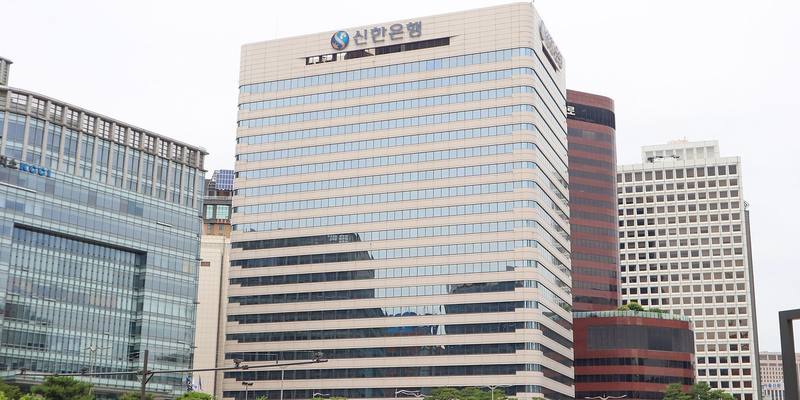
Shinhan Bank’s headquarters in Seoul, June 2019. Image: Mobius6 / Wikimedia Commons, CC BY-SA 4.0, cropped

Hackers have stolen personal data from four South Korean banks in two days, and investigators are looking at whether AI tools did much of the work. South Korea’s Financial Services Commission held an emergency meeting on Friday and ordered every bank and card company to check all of its systems that can be reached from outside its network.
The breaches hit Shinhan Bank, KB Kookmin Bank, Hana Bank and BNK Busan Bank. In each case the attackers went in through a side door, not internet banking: a loan-agent inquiry service, an employee mobile app or a sales support system.
What was taken
Shinhan said on Thursday that information on about 25,000 customers had leaked after an attacker bypassed identity checks on a mobile service loan agents use to track applications. The data included names, phone numbers, annual income and calculated loan limits, plus 66 resident registration numbers, South Korea’s national ID numbers. Shinhan confirmed the breach on Wednesday, blocked the outside IP addresses and suspended the service.
KB Kookmin said on Friday that data on 119 customers, including names, addresses and resident registration numbers, had leaked through an employee support system after it spotted a possible breach on Wednesday night. Hana said hackers got into its sales support system and exposed personal details on 89 customers, and BNK reported that 11 records on outsourced staff had leaked, according to the Korea Herald.
KB Kookmin and Hana say customers’ banking transactions were not affected and have promised to compensate any losses, and the regulators say they will make sure affected banks compensate customers.
An “AI autonomous penetration test console”
What makes this more than another data breach is the evidence pointing at AI. Moon Jong-hyun, head of the Genians Security Center at the Korean security firm Genians, wrote on LinkedIn on Friday that the string “ARTEX-” appeared in page titles on web servers used in the attacks, and that the pages described themselves, in Chinese, as an “AI autonomous penetration test console”.
ARTEX AI is an open-source, Chinese-language tool on GitHub that uses a large language model to do a penetration tester’s job on its own: gather information about a target, look for weaknesses, plan a route in, run hacking tools and check what worked. It is sold as a way to test your own defences. Moon called the traces circumstantial evidence that the tool was run on the attackers’ servers, and said multiple analysts “reasonably suspect” AI attack tools were used, according to the Kyunghyang Shinmun.
Neither the banks nor the regulators have confirmed that AI was used, and no one has said who was behind the attacks. Moon warned that the shift is already happening:
The era when attackers carried out each command themselves is passing.
Moon Jong-hyun, Genians Security Center, via the Kyunghyang Shinmun
What the regulator wants
At Friday’s emergency meeting, FSC Secretary General Shin Jin-chang told banks and card firms to list every IT system and service exposed to the outside world, check them for weaknesses and gaps in access controls, cut the amount of information they expose and close any route to internal data that doesn’t require proper authentication. The regulator will hand out a security checklist, collect the results and share attackers’ IP addresses and methods across the industry. The Financial Supervisory Service and Financial Security Institute have sent inspectors to all four banks.
“We will thoroughly analyze the causes and methods of the attacks and swiftly develop measures to strengthen the system,” Shin said.
Police are now involved too. The Korean National Police Agency’s cyber terror response unit has opened a preliminary inquiry into the attacks on all four banks, the step before a formal criminal investigation, and will decide whether to open one once it has established how far the damage goes, what kind of data was taken and how the attackers got in.
Update: South Korea’s president says AI may have been used, and police open a full investigation
President Lee Jae Myung told a Cabinet meeting on Tuesday, October 6, that “in some hacking cases, details have emerged of the possible use of artificial intelligence”, and ordered the government to put people and money into limiting the damage, Yonhap reported. The attacks have now exposed customer information at seven companies. Lee said AI-driven hacking was pushing damage to “previously unseen levels” and called for faster work on AI tools for cyber defence.
Police have moved on from their preliminary inquiry: a 28-member team is now investigating suspected breaches of the country’s information and communications network law. The Financial Supervisory Service has traced 28 IP addresses in 12 countries, including the US and Japan, that it believes were used in the “AI agent-backed” attacks, though it hasn’t located all of them, Yonhap reported, citing industry sources. Woori Bank and NH Nonghyup Bank were also targeted but blocked the attempts, and no customer data leaked from either.
Update: CrowdStrike found the attacker’s AI tooling sitting in open folders
The security firm CrowdStrike published its own analysis on Wednesday, October 7, and it backs up the ARTEX suspicion with the attacker’s own files. CrowdStrike says it found infrastructure tied to a campaign against South Korean financial organisations that ran from late September to early October, and that open directories on the attacker’s servers held Claude Code session histories, ARTEX configuration files and Claude memory files.
One server hosted an ARTEX instance whose open folder contained a Chinese-language Claude Code instruction file telling the model how to run penetration tests. CrowdStrike says the ARTEX instance used DeepSeek v4.1-flash as its main language model, and that the attacker added GLM-5.3 from Zhipu AI and Grok 4.6 in extra Claude Code sessions. The sessions also show the attacker asking Claude where hackers usually sell Korean breach data and for help finding Korean Telegram groups that trade it.
CrowdStrike hasn't tied the activity to a named group. It assesses with moderate confidence that the attacker is a Chinese speaker and financially motivated, based on the Chinese-made tool and Chinese-language prompts. In one session the user asked Claude to write a security researcher's résumé and supplied personal details that included an age of 26 and a location in Maoming, Guangdong. CrowdStrike says those details likely belong to the person behind the attacks but that the information available can't definitively link them. It also says the overall number of organisations affected remains unconfirmed.
On October 19, a Tokyo security firm said ARTEX had also turned up on servers attacking Japanese companies. On October 21, Microsoft tied ARTEX to a China-aligned group it calls Storm-0940, which it says used the tool against hundreds of organisations and ConnectWise’s customers.
Why it matters
Banks spend heavily on protecting their front doors, and these attacks went through the forgotten back rooms instead, the kind of small, exposed systems an automated tool can find and probe far faster than a person. Central banks have started warning about AI-powered cyberattacks, including the Bank of England on Wednesday; if the ARTEX traces hold up, South Korea is an early real-world example, and defenders are already reaching for AI of their own, as Palo Alto Networks’ round-the-clock Mythos service shows.
Correction: an earlier version of this story said all four banks leaked customer data and promised compensation; BNK’s leaked records belonged to outsourced staff, and only KB Kookmin and Hana have been reported as promising compensation.
Sources: Korea Herald (FSC emergency meeting, Oct 2); Korea Herald (Hana and BNK breaches, Oct 2); Kyunghyang Shinmun (Genians analysis of ARTEX AI, Oct 2); Financial News (police inquiry, Oct 2); Yonhap (Lee and police investigation, Oct 6); Yonhap (FSS IP addresses, Oct 6); CrowdStrike (ARTEX infrastructure analysis, Oct 7).
Latest Business news