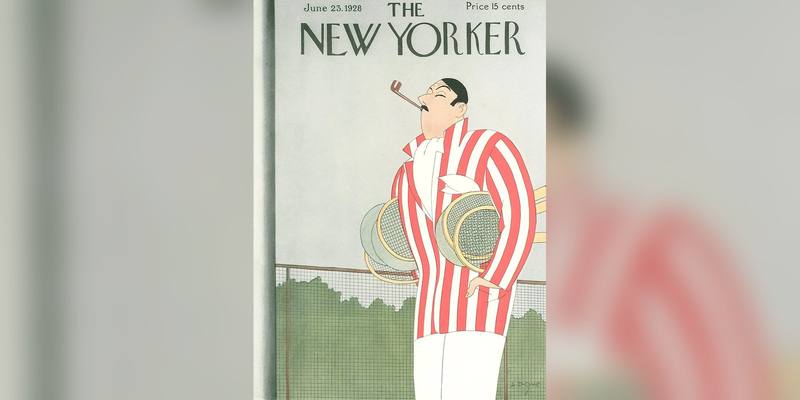
A New Yorker cover from June 23, 1928, by Julian de Miskey (illustrative). Image: Julian de Miskey / Wikimedia Commons, Public domain, cropped

Ask ChatGPT for “a New Yorker-style cartoon” and it may sign the result with a real artist’s name. An investigation by Nieman Lab, published on Tuesday, documented more than 15 New Yorker cartoonists whose signatures have turned up on cartoons made by OpenAI’s image generator, without their permission or any payment.
The clearest case went viral after the deaths of Dolly Parton and Tim Curry in late August. A cartoon showing the pair arriving at the pearly gates, which drew 25,000 likes in one post on X alone and spread on Facebook, Instagram and Bluesky, carried the pen name “BLOPER”, the signature of New Yorker cartoonist Brendan Loper. He didn’t draw it. A fan had asked ChatGPT for a New Yorker-style cartoon and posted what came back.
“My name is my name”
Loper told Nieman Lab that friends and strangers wrote to ask whether the cartoon was his, and that it was not the first time: someone had warned him in May, and he later found more examples on a Reddit forum about ChatGPT. He said he already knew his work was being used to train AI, but a faked signature felt different:
I’m not a territorial person, but my name is my name. It felt very much like a violation of my personhood.
Brendan Loper, New Yorker cartoonist, to Nieman Lab
Others named include Harry Bliss, Emily Flake, Joe Dator, Pat Byrnes and Jason Adam Katzenstein, and Nieman Lab’s own tests produced the signatures of veterans such as George Booth, Liza Donnelly and Saul Steinberg. Flake said seeing hers was “like somebody attributed a quote to me that I didn’t say.” Dator went further:
I’ve had people hack my credit card. That feels like less of a violation than this. When they hacked my credit card, they didn’t dress up like me.
Joe Dator, New Yorker cartoonist, to Nieman Lab
What OpenAI and The New Yorker say
OpenAI told Nieman Lab that it believes “the future of creativity is one that is fundamentally human”, and thanked people for flagging “bugs and unintended behavior by our models”. After it was contacted, ChatGPT began warning that such prompts “may violate our guardrails concerning similarity to third-party content”, but it was still signing some cartoons with real names when the story was published. OpenAI declined to say how its models learned the signatures.
Condé Nast, The New Yorker’s owner, signed a licensing deal with OpenAI in 2024, but a New Yorker spokesperson said the company has never allowed any AI developer to train on its cartoons, or to use its logo, which also appeared on some of the fakes. The magazine’s cartoonists keep the copyright in their work, and the contracts Nieman Lab reviewed don’t allow licensing for AI training.
A hard case to win in court
Copying a style is hard to challenge under copyright law, and Cornell law professor James Grimmelmann told Nieman Lab that attribution is “a very small part of the fair use inquiry”. He said the cartoonists might have a better case under state right of publicity laws, which protect a person’s name and identity, but only if the cartoons were used commercially. Where OpenAI got its training data is already a live question: court filings last month showed OpenAI knew it was training on pirated books.
Why it matters
A signature is how a cartoonist proves a drawing is theirs, and ChatGPT is now putting real names on work those artists never made, at a scale they can’t police. It is a sharper problem than style copying, and it comes as OpenAI is promoting watermarks to show where AI content came from.
Sources: Nieman Lab.
Latest OpenAI news