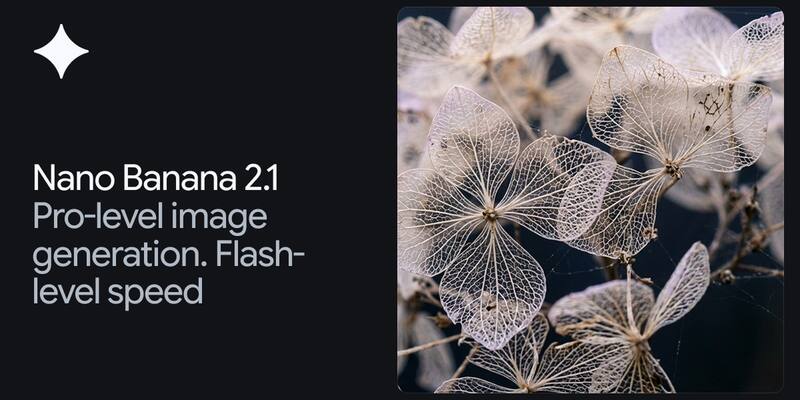
Google DeepMind’s launch artwork for Nano Banana 2.1. Image: Google DeepMind
Google has released Nano Banana 2.1, a new version of its everyday image generation and editing model, and for developers the headline is the price: a standard 1K image in the Gemini API now costs about $0.034, half what Nano Banana 2 charged. The model went on general availability on October 6 and is built on Gemini 3.6 Flash, according to its model card.
It replaces Nano Banana 2 (Gemini 3.1 Flash Image), which Google has now marked as deprecated in the API. Google did not publish a launch blog post; the details come from its developer changelog, pricing page, model card and the Nano Banana page on Google DeepMind's site.
What Google says is better
Google says Nano Banana 2.1 outperforms earlier Nano Banana models, with better "visual design, mask-based editing, subject consistency, and more natural-looking images". The API changelog adds improved prompt adherence, text rendering and character consistency across a multi-turn conversation, plus new wide and tall aspect ratios (1:4, 4:1, 1:8 and 8:1) at 1K, 2K and 4K.
The model card backs this up with Google's own human preference tests, scored on an Elo scale. With its thinking mode on, Nano Banana 2.1 scored 1050 overall against 990 for Nano Banana 2 and 935 for the more expensive Nano Banana Pro. The biggest gap is in infographics: on Google's automated factuality score it reached 0.521, against 0.179 for Nano Banana 2. These are Google's figures and have not been independently checked.
The card is also frank about what still goes wrong: small text that is "often blurry" at 1K, trouble with long paragraphs, imperfect character consistency between input and output images, and "occasional confusion" over left and right. Google's developer docs say Nano Banana models can mix up to 14 reference images into one picture, and that every generated image carries a SynthID watermark, which anyone can now check with Google's public SynthID Detector.
Cheaper images, pricier prompts
The Gemini API pricing page shows the trade-off. Output images are billed at $30 per million tokens, down from $60, which works out at:
| Image size | Nano Banana 2 | Nano Banana 2.1 |
|---|---|---|
| 0.5K | about $0.045 | Not offered |
| 1K | about $0.067 | about $0.034 |
| 2K | about $0.101 | about $0.050 |
| 4K | about $0.151 | about $0.113 |
Input is a different story. Text and image input rises from $0.50 to $1.50 per million tokens, and text and thinking output from $3 to $7.50. Apps that send several large reference images per request will see some of the saving eaten up. Batch requests cost half the standard rate, and neither model has a free tier in the API. Prices are in US dollars.
Where you can use it
The model ID for developers is gemini-nano-banana-2.1, available in Google AI Studio and the Gemini API. Google is also bringing it to the Gemini app, AI Mode in Search, Flow, Stitch, Google Ads and the Gemini Enterprise platform.
In the Gemini app it is not a free upgrade. Google's Gemini image page says subscribers to Google AI Pro, Plus and Ultra get Nano Banana 2.1, while free users keep the standard Nano Banana model. Image generation is offered in every country and language where the Gemini app is available, which covers the US, UK, Canada, Australia and the EU, Germany included. Paid subscribers can still redo an image with Nano Banana Pro from the three-dot menu.
The model arrived a day before Google opened its Playground game maker, which also uses Nano Banana for its artwork.
Why it matters
Image generation is turning into a price war, and halving the cost of a standard image puts pressure on every rival API. The catch is in the small print: higher input prices and a dropped 0.5K tier mean developers should check their own mix before assuming the bill gets smaller.
Sources: Gemini API release notes, Gemini API pricing, Gemini API image generation docs, Nano Banana 2.1 model card, Google DeepMind, Gemini app.
Latest Google news