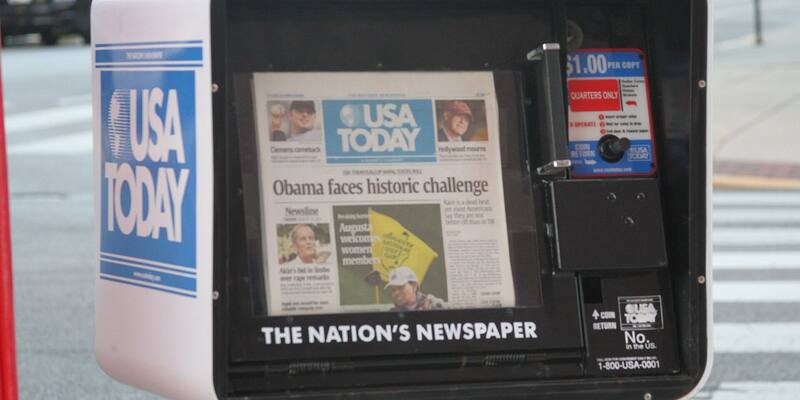
A USA Today newspaper box (illustrative; the front page shown dates from 2012). Image: Twzink / Wikimedia Commons, CC0 1.0, cropped

USA Today Co. and 13 of its newspaper companies have sued OpenAI in federal court in New York, claiming it copied “hundreds of thousands” of their articles to train and run ChatGPT without permission or payment. The complaint, filed on Thursday, seeks damages of more than $250 million.
The suit covers 19 publications: USA Today plus local papers including the Detroit Free Press, The Arizona Republic, the Milwaukee Journal Sentinel, The Tennessean, The Columbus Dispatch, The Oklahoman, The Des Moines Register, The Palm Beach Post and Indy Star. Seven OpenAI entities are named as defendants, from the OpenAI Foundation to OpenAI Group PBC. Microsoft, a co-defendant in several earlier newspaper suits, is not.
How they get to $250 million
The figure comes from US copyright law’s statutory damages. The complaint says the papers can recover up to $150,000 for each wilful infringement, plus up to $25,000 per violation for stripping out copyright management information such as bylines and copyright notices.
To show how much of their work went in, the papers point to WebText, an internal dataset OpenAI built from links shared on Reddit to train GPT-2 and later models. They count more than 160,000 entries from their sites, including 83,266 from usatoday.com, 12,994 from freep.com and 9,814 from jsonline.com.
There are three claims: copyright infringement, vicarious infringement and removal of copyright management information under the Digital Millennium Copyright Act. Beyond damages, the papers ask the court to order the destruction of “all GPT or other LLM models and training sets” that contain their content, and to block further use.
‘Excellent at news’
Much of the complaint leans on evidence already surfaced in the consolidated copyright case against OpenAI in the same court. It quotes OpenAI president Greg Brockman telling colleagues the models were “particularly good at predicting text of news articles,” “excellent at news” and “very good at any news task.”
It also says that when an employee told Brockman about “a hack to get around nytimes paywall” to help scrape the site, he replied “ah nice.” OpenAI’s corporate representative, the filing says, testified that the company had no “method for detecting paywalled content” in its datasets.
The papers go further on OpenAI’s safeguards against reproducing articles word for word. They allege its output filters did not suppress content from any publisher that had not sued it, and quote a Microsoft executive who called the approach an “accidental cover up.” These are allegations; none has been tested in court.
ChatGPT search and lost readers
The complaint is not only about training. It targets ChatGPT search and other products that pull in live web pages, saying they serve up the papers’ latest reporting, sometimes with attribution, so that a reader “has less reason to visit the original source.” Because users want current information, it argues, OpenAI must keep feeding its models fresh copyrighted material, making the infringement “not a past wrong but an ongoing one.”
The papers also say OpenAI knows a licence is needed because it has paid for one elsewhere, citing deals with the Associated Press, Axel Springer, The Atlantic and Vox Media. “OpenAI never asked permission. It never offered payment. It simply took” their work, the filing says.
OpenAI hasn’t commented on the suit. It has argued in the earlier cases that training on publicly available material is fair use.
The latest of many
USA Today Co. joins a long queue of publishers suing OpenAI, including The New York Times, the Daily News and its sister papers, The Intercept and Ziff Davis, many of whose cases now sit together before the Southern District of New York. The courts have so far given mixed signals: an appeals court recently rejected a fair use defence for AI training in the Thomson Reuters case, while Google beat the publishers suing over AI Overviews.
Why it matters
With USA Today and its local papers, the largest US newspaper group is now in the fight, and its $250 million figure puts a price on the per-article maths that every publisher suit relies on. The demand to destroy models trained on its work is unlikely to be granted, but it raises the stakes if OpenAI’s fair use defence fails.
Sources: USA Today Co. v. OpenAI complaint (S.D.N.Y., Case 1:26-cv-08892).
Latest OpenAI news