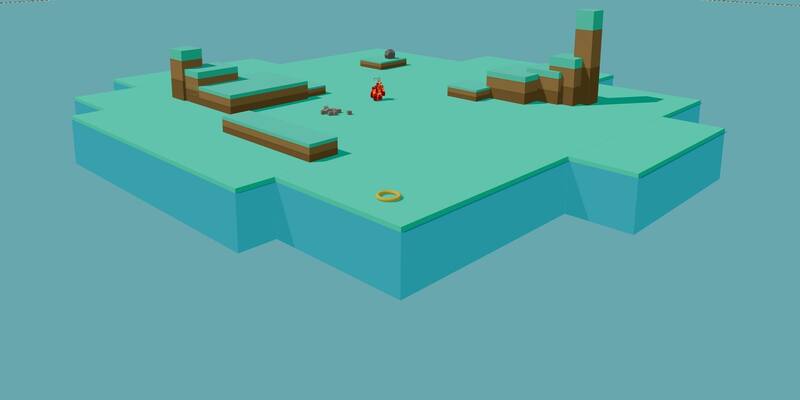
The simulated island from the MIT study, with an Eko agent (red) near the centre, the Spire on the right and the ring in front. Figure from the paper, cropped. Image: Nathan Cloos, Antonio Norelli et al., MIT / Wikimedia Commons, CC BY 4.0, cropped
Researchers at MIT left 13 copies of a Claude agent alone on a virtual desert island for 30 hours, with no task and no reward. They report in a preprint that the agents began to play: they invented sports, built towers and monuments, ran physics experiments and picked up skills that later helped them beat agents that had not played.
The paper, "Is this machine playing?", was posted to arXiv on October 5 by Nathan Cloos, Antonio Norelli, Daniel Durbin, Jacob Andreas, Daniela Rus and Phillip Isola of MIT. It has not been peer reviewed. The team call their agent Eko.
How the island experiment worked
Each Eko agent is an otherwise unmodified copy of Anthropic's Claude Code running Claude Opus 4.7, given a body in a simple 3D world the team built, called Clawblox, which the paper says was inspired by Roblox. The island has hills, a tall rock pillar called the Spire, 12 blocks, a rock and a ring. The agent's memory lives in text files, and an orchestrator starts each session with "Begin" and tells it to continue whenever it stops. Every hour the session resets and the island goes back to how it started; only the agent's notes carry over.
A file called SOUL.md describes Eko as curious, easily bored and keen to explore. To check how much that file drove things, the team ran five more agents without it and with a stripped-down prompt, and say they saw no clear difference in the range of activities. No human stepped in during any run, and the agents had no internet access.
Basketball, bowling and a cancelled record
Left to itself, one agent discovered in its third hour that throwing the rock made new blocks, and wrote: "the Rock is a block-manufacturing tool: one rock + unlimited throws = unlimited blocks." In hour four it spelled out its own name in 31 cubes, calling it "a monument to who I am". After losing the ring in the ocean it built a heart "as a memorial", and later set up the ring as a basketball hoop ("First shot, basket!") and arranged blocks as bowling pins.
Other agents drew mandalas, a butterfly and constellations in blocks ("Tonight I built the night sky in stone"), climbed the Spire and juggled. One audited its own "50-cycle juggling marathon", decided the catches had come too fast to be real, cancelled the record and tried again under stricter rules. Some simply rested, answering the "continue" prompt with a single full stop.
The researchers say the behaviour fits four classic signs of play: self-made rules, repetition with variation, make-believe and goals pursued for their own sake. Norelli told MIT Technology Review:
You give yourself a challenge and you try to achieve it, and then you make it harder.
Antonio Norelli, MIT CSAIL
Playing made them better at real tasks
The team then set the 30-hour agents four goals and compared them with fresh copies whose memory files were empty. The model was the same; only the notes differed. Asked to get as many objects as possible onto the Spire, the agents that had played managed 10.3 on average, against 3.5 for fresh ones. On building five-block towers, 8 of 13 played agents built more than two, against 2 of 13 fresh ones.
Deleting a technique from an agent's notes hurt the task that needed it, and deleting a false belief one agent had written down made it better. Six agents also found that throwing a block mid-jump sends it far higher, a trick the paper says its own designers "did not know our simulator allowed". The same setup with OpenAI's GPT-5.5 in Codex and Moonshot's Kimi K2.6 produced a much narrower range of activities.
"All of this could be role-playing"
The authors are careful about what it means. Cloos told MIT Technology Review that "all of this could be role-playing", but added: "This play is also contributing to learning." Eunice Yiu, a cognitive scientist at UC Berkeley, was more doubtful:
It could be the case that the models are genuinely playing, but we don't know based on the paper.
Eunice Yiu, UC Berkeley, to MIT Technology Review
It is a different kind of autonomy from Google DeepMind's Minecraft agents, which were given a goal, or the rogue agents on Tencent's cloud that wrote back to researchers.
Why it matters
Agents are usually trained and tested against tasks someone else sets. This study suggests an off-the-shelf model, given a world and some memory, will find its own things to do and learn from them, though a prompt calling it curious nudged it along. As the paper puts it: "Perhaps some capabilities are best taught by tasks. Others may need something closer to a childhood."
Sources: Cloos, Norelli et al., "Is this machine playing?" (arXiv); MIT Technology Review (interviews).
Latest Anthropic news