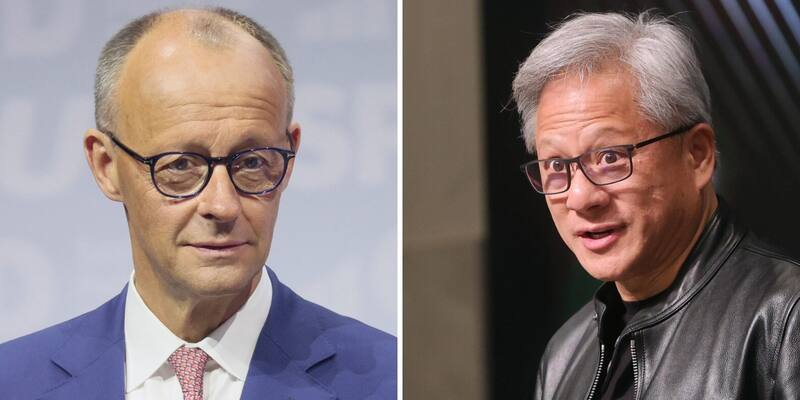
German Chancellor Friedrich Merz (left, in Berlin in May 2025) and Nvidia CEO Jensen Huang (right, in Taipei in November 2023). Image: Friedrich Merz: Sandro Halank (CC BY-SA 4.0, via Wikimedia Commons); Jensen Huang: Office of the President of Taiwan (CC BY 2.0, via Wikimedia Commons)
Germany has signed up Nvidia to help build AI models for its factories. On Monday the federal economy and research ministries signed a Joint Declaration of Intent with the chipmaker at the Invest in Germany Summit in Berlin, with Chancellor Friedrich Merz then sitting down on stage with Nvidia’s chief executive, Jensen Huang, to sell the plan to the country’s manufacturers.
The deal is a statement of intent, not a contract, and neither side has put a price on it. But it ties one of the world’s biggest industrial economies to Nvidia’s push into “physical AI”, the software that lets robots, machines and self-driving vehicles sense and act in the real world.
What Germany and Nvidia signed
According to Nvidia, the declaration commits both sides to a joint initiative “to advance cutting edge AI models for physical AI”. It formalises and expands Nvidia’s work with Plattform Industrie 4.0, the network of government, industry, research and trade bodies that steers Germany’s factory digitisation, in support of the government’s stated goal to “systematically bring industrial AI into widespread use and to establish a state-of-the-art industrial AI ecosystem in Europe”.
The government’s own statement, reported by ZDF, says the work will build on German industrial data, manufacturing know-how and engineering, and that Nvidia will open its models to small and medium-sized firms and research institutes as well as big industry. Other reports of the statement say the plan centres on specialised, open industrial models based on Nvidia’s Nemotron and Cosmos model families.
Berlin gave no figure for its own spending. Ahead of the summit, Handelsblatt reported that the government was ready to put in a sum in the hundreds of millions of euros, partly to rent computing power in Deutsche Telekom’s AI cloud, but that hasn’t been confirmed.
“Please open your doors for AI”
Merz used the session to make a direct appeal to the Mittelstand, the family-owned small and mid-sized manufacturers that make up much of German industry and hold years of production data:
The biggest advantage we have in Germany is our so-called Mittelstand. Please open your doors for AI to make use of your data.
Friedrich Merz, German Chancellor
He said Germany wanted to be “one of the leading, if not the leading, country in the world” for the spread of AI across manufacturers, machinery makers, carmakers and their suppliers, and suggested meeting Huang at least once a year to check on progress.
Huang pitched AI as a tool for skilled workers rather than a replacement for them:
That knowledge belongs to you. It cannot be replaced. AI can only augment your capability, it will not replace your capability.
Jensen Huang, Nvidia founder and CEO
Nvidia’s new German bets
Huang also announced planned investments in four German start-ups, part of what Nvidia calls a commitment of nearly $10 billion (about €8.6 billion) to companies, universities and research institutes across Europe:
- Agile Robots (Munich): robot arms and the Agile ONE humanoid for factories, logistics and healthcare.
- Avelios Medical (Munich): an AI-native hospital information system.
- Mirelo: AI models that generate sound effects, speech and music for video.
- Reflex Aerospace (Berlin): satellites built in about 12 months.
The same day, Siemens showed AI planning agents built with Nvidia at its electronics factory in Erlangen, and Nvidia said its researchers had used Jülich’s JUPITER supercomputer to run a record 104-qubit simulation of a fault-tolerant quantum computer. Huang gives the main GTC Berlin keynote on Wednesday, October 21, at 11:00 CEST (09:00 UTC).
What it means beyond Germany
Germany is the latest government to line up behind an American chipmaker’s models rather than build everything at home, a pattern MadRobot looked at in its piece on how most “sovereign AI” rests on US and Chinese models. It sits alongside home-grown efforts such as Aleph Alpha’s open-weight Kolibri model, and follows Nvidia’s $250 million computing donation to UK AI safety research last week. Open industrial models trained on German factory data could be used by manufacturers anywhere, if Nvidia and Berlin follow through.
Why it matters
Factories are where Nvidia sees the next wave of demand after chatbots, and Germany has the engineering firms and data it needs. The open questions are money and delivery: no budget, timetable or first model has been named yet.
Sources: Nvidia blog; Nvidia GTC Berlin news; Nvidia newsroom; ZDF.
Latest Chips news