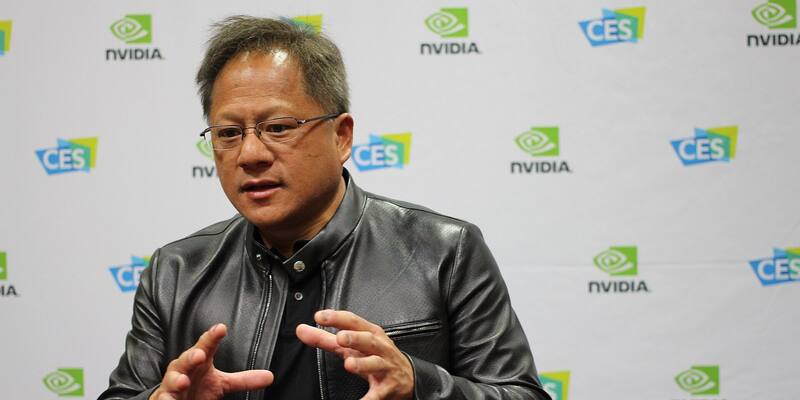
Nvidia founder and CEO Jensen Huang at CES in Las Vegas (file photo). Image: Maurizio Pesce / Wikimedia Commons, CC BY 2.0, cropped

Nvidia is putting $250 million into British research on keeping AI agents safe, but none of it arrives as cash. The chipmaker announced on October 13 a five-year donation of computing power, valued at $50 million a year, for UK research into “agentic safety and security”: making AI systems that act on their own harder to misuse, hijack or lose control of.
Most of the compute will go to the wider UK AI safety and security research community. A share is set aside for three named groups: the British Open-Ended Learning and Discovery Lab (BOLD), led by the University of Oxford; the Science of Fundamental AI Research Lab (SOFAIR), led by UCL; and Imperial College London, whose work will include safety engineering and robotics.
Computing time, not a cheque
The $250 million is Nvidia’s own valuation of the computing time it is giving away. Researchers will reach it through UK-based Nvidia Cloud Partners, the cloud firms that rent out Nvidia hardware, with the machines hosted in the UK. Nvidia says the deal will support the country’s compute industry and give researchers a domestic platform.
Much is still open. According to the release, “provider selection, technical architecture and commercial terms are to be agreed”, so it is not yet clear which cloud companies will run the hardware, what chips researchers will get or how the hours will be shared out between labs. Nvidia hasn’t said how researchers outside the three named groups will apply.
What the research will cover
Nvidia lists three areas: secure agents, the security of open models and defences against real-world threats. The work will include secure sandboxes for testing agents, reproducible research and benchmarks for safety assessments.
Some of it will run on Nvidia’s own safety tools: OpenShell, its open runtime for agents, and the Sentry reference design, the watchdog hardware it unveiled last month to sit next to AI agents and stop them going rogue. Nvidia says the findings are meant to inform safeguards “across the wider computing ecosystem”, not just in Britain.
Imperial’s part leans towards robots and other physical systems. “The next frontier of artificial intelligence is physical,” said Alessandra Russo, director of Imperial’s Frontier AI Research Lab.
“AI capability and safety must advance together”
Nvidia founder and CEO Jensen Huang, whom Pope Leo challenged over AI risks last month, framed the donation as a bet on British science:
AI capability and safety must advance together. The U.K. brings world-class scientific rigor to this essential engineering challenge.
Jensen Huang, founder and CEO, Nvidia
Jakob Foerster, BOLD’s founding director, said the timing mattered:
We are experiencing a critical moment where AI safety as an afterthought is no longer appropriate for the open-ended, evolving world.
Jakob Foerster, founding director, BOLD
UK AI Minister Kanishka Narayan, who recently told AI labs not to release what they can’t control, called the donation “a vote of confidence” in British AI safety research and said safe, secure AI would be central to the UK’s G20 presidency. Business Secretary Jonathan Reynolds said people “need to feel the technology is safe and secure” before the opportunities of AI can be realised.
What it means beyond the UK
Britain already hosts the government’s AI Security Institute, which tests frontier models before release and recently restarted its agent hacking tests with the internet cut off. Nvidia’s money goes to university researchers rather than the institute, but it adds to the same push to make Britain a testing ground for AI safety. The donation also builds on Nvidia’s work on Isambard-AI, the University of Bristol supercomputer built on its Grace Hopper chips.
For readers elsewhere, the interesting part is the model. Instead of grants, the world’s most valuable chipmaker is funding safety work in the currency it controls, through cloud partners that sell its hardware, with some of the research built on its own safety products. Nvidia hasn’t said whether it plans similar programmes in other countries.
Why it matters
Testing AI agents properly takes serious computing power, and university labs have far less of it than the companies building the models. Nvidia’s donation could ease that in Britain, but until the cloud providers and terms are agreed, the $250 million is a pledge rather than hardware researchers can use.
Sources: Nvidia newsroom; Nvidia blog.
Latest Chips news