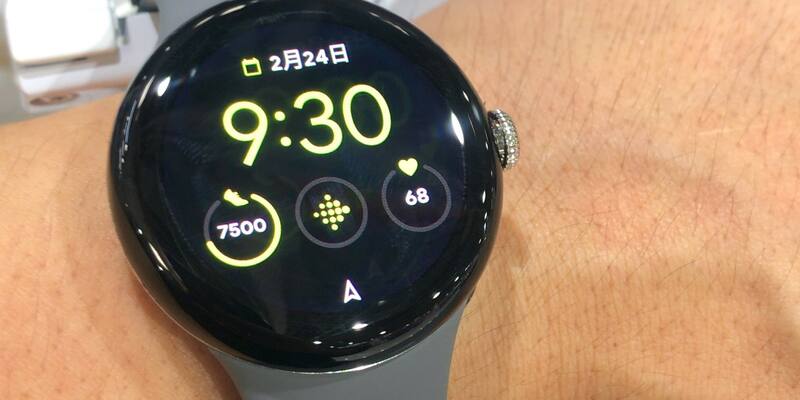
A first-generation Google Pixel Watch on a wrist at a shop display in Japan (illustrative: the Nature study does not name its watch). Image: KKPCW (Kyu3) / Wikimedia Commons, CC BY-SA 4.0, cropped

Google researchers say an ordinary smartwatch can pick up the signs of high blood pressure without ever being checked against an arm cuff. In a peer-reviewed study in Nature, published on November 5, their AI flagged 65.8% of people who had hypertension using only the watch’s light-based pulse sensor, its motion sensor and the wearer’s height.
The system, which Google calls AI-PPG-ACC-HTN, was tested on 196 adults at five US sites against 24-hour ambulatory blood pressure monitoring, the clinical gold standard. It did at least as well as a reading at the doctor’s office. The paper’s lead authors, Paolo Di Achille and Ming-Zher Poh of Google Research, set out the results in a blog post, and Google says the work helped shape a blood pressure feature already live on Pixel Watches.
A watch that never reads your blood pressure
The model does not try to produce systolic and diastolic numbers, which jump around with stress and movement. It asks a simpler question: does this person have persistently high blood pressure?
Two sensors already found on most smartwatches do the work. The optical photoplethysmography (PPG) sensor tracks the shape of each pulse wave at the wrist. The accelerometer spots moments of stillness and picks up the ballistocardiogram, the tiny vibrations of the wrist caused each time the heart pushes blood into the aorta.
Google first trained the model without medical labels on 492,347 hours of sensor data from 2,109 people. It then averages 15-second pulse and motion snippets over several days, adds the person’s height as a stand-in for artery length, and produces a hypertension probability score.
How accurate it is
Over seven days of everyday wear, the watch caught 65.8% of hypertension cases and correctly cleared 90.0% of people without it. When it did flag someone, it was right 80.6% of the time. The first office reading caught 55.3% of cases with the same 90.0% specificity.
That edge is smaller than it looks. With 196 people, the confidence ranges overlap heavily (54.0% to 76.3% for the watch, 43.4% to 66.7% for the office check), which is why the paper claims accuracy “comparable to” cuffs, not better. The researchers also left out anyone with known heart disease or already taking blood pressure pills.
For the 48 people whose first office reading was high, the watch confirmed sustained hypertension with 78.4% sensitivity and 90.9% specificity, ahead of return office visits (67.6% and 63.6%) but behind several days of home cuff readings, which caught 89.2%. Google ran the study with Beth Israel Deaconess Medical Center and Harvard Medical School.
Can Pixel Watch owners use it?
Partly. Google says the findings “helped inform” blood pressure trends, a Health Guardian feature in the Google Health app. It is free on the Pixel Watch 3, 4 and 5 and needs a Google Health Premium subscription on the Fitbit Edge and Fitbit Air, according to Google’s help page. It needs five days of continuous wear and sends one summary on the first of each month.
Google is careful about what that feature is. It markets blood pressure trends for “general wellness” and says it is “not a prescreener for hypertension”, gives no real-time readings and should not be used during pregnancy. The research blog goes further, calling the Nature system “early feasibility research” that does not point to any upcoming product.
Where it works is less clear. Google says availability “varies by region, country, and device” and publishes no country list; in Japan and Mexico the feature is called Vascular Stress Trend.
How it compares with Apple Watch
Apple got there first as a medical feature. Its Hypertension Notifications were cleared by the US Food and Drug Administration in September 2025 and launched in more than 150 countries and regions, including the US and the EU, on the Apple Watch Series 9 or later and Ultra 2 or later. Apple’s validation paper reports 41.2% sensitivity and 92.3% specificity.
The figures are not a like-for-like contest. Apple analyses 30-day windows and compared its alerts with home cuff readings, while Google’s study used seven days of data against 24-hour ambulatory monitoring in a much smaller group.
Why it matters
More than half of adults with high blood pressure don’t know they have it, and a watch that quietly nudges them towards a cuff could reach far more people than clinic screening does. The Nature study shows the science holds up in a small group; whether Google turns it into a real screening tool, with regulators’ approval and a clear country list, is still open.
Sources: Di Achille et al., Nature; Google Research; Google Health; Google Health Help Center; Apple.
Latest Google news