
Anthropic’s Claude spark logo and the AMD logo. Image: Claude logo: Anthropic; AMD logo via Simple Icons (CC0), trademark of AMD
Anthropic says its most powerful AI model did in about three days a job that used to take its engineers months: getting Claude to run on a new kind of chip. In the company’s IPO roadshow video, co-founder Tom Brown says Claude Mythos got Claude running on AMD’s GPUs “with basically no human intervention”, a claim that goes straight at Nvidia’s biggest advantage.
Three days instead of months
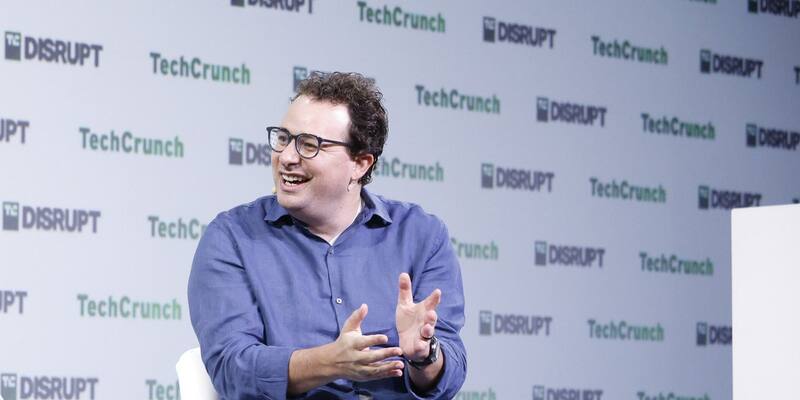
Brown, Anthropic’s Chief Compute Officer, makes the claim in the video’s “Approach to compute” chapter, posted on Anthropic’s IPO site as it markets its shares. The final price is expected on November 18, with trading on Nasdaq under ANT the next day. He says Anthropic only started using AMD GPUs this year, and that bringing up new chips used to be slow, manual work:
In the past, bringing on a new chip platform took dozens of engineers months of work. This time we had Mythos try it out. It got Claude running on AMD in just three days with basically no human intervention.
Tom Brown, co-founder and Chief Compute Officer, Anthropic
He adds that “Claude ported or wrote almost 100% of the kernels”. Kernels are the small, heavily tuned programs that do a model’s maths on a particular chip, and every chip family needs its own set. A chart on screen sets the three days against “~6-12 months with traditional approach”.
The fine print is narrower
A footnote in small type under that chart limits the claim. It says the three days reflects “the approximate time for Claude Mythos Preview to bring up prompt processing for one Anthropic model on AMD MI355X GPUs at a useful level of performance”. Prompt processing is the stage where a model reads its input before it starts writing an answer, so the footnote does not say a whole model, or training, moved to AMD in that time. The 6 to 12 months figure, it adds, “is based on the Company’s historical experience bringing up new accelerators using traditional engineering approaches”.
Both numbers are Anthropic’s own, from marketing for its share sale, with no technical details published that would let anyone check them. AMD hasn’t commented. The two firms announced a partnership in July under which Anthropic will deploy up to 2 gigawatts of AMD’s next MI450 chips from the first half of 2027 and AMD will invest up to $5 billion; it already included using Claude to speed up ROCm, AMD’s rival to Nvidia’s CUDA software. AMD is also buying $2.5 billion of shares alongside the IPO.
Why Nvidia should pay attention
Nvidia’s strongest defence is software. Most AI software is written for CUDA, its programming platform, and moving to rival hardware means rewriting and re-tuning the kernels underneath, a cost that keeps many labs on Nvidia. If an AI model can do most of that porting in days, switching chips gets far cheaper. Others are attacking the same lock-in: Google and Meta are building TorchTPU so PyTorch code written for Nvidia runs on Google’s chips, and DeepSeek gave Huawei’s Ascend chips open source software of their own.
The claim lands in a rough week for Nvidia, whose board is investigating Jensen Huang. Brown never names Nvidia or CUDA, and Nvidia is still one of Anthropic’s suppliers: it is buying $10 billion of Anthropic shares in the same placement as AMD.
“One fungible pool of compute”
Brown says Anthropic now trains and serves Claude “across all four major chip families”, which the video’s graphics show as Amazon’s Trainium, Google’s TPUs and GPUs from Nvidia and AMD. He calls it an early “unconventional bet”, made when many thought a separate software stack for each chip wasn’t worth the effort. The payoff, he says, is that Anthropic can match each chip to the job it does best and “treat all of our chips across providers, architectures and locations as one fungible pool of compute”.
He also says its researchers keep finding “compute multipliers”, ways to get a smarter model from the same hardware. Brown expects Claude to take over that work too, an idea that worries some leading researchers:
We believe that this can accelerate even further as we approach recursive self-improvement. Claude will be able to discover compute multipliers entirely by itself, allowing the number of compute multipliers to grow faster and faster.
Tom Brown, Anthropic roadshow video
Why it matters
If AI can do most of the work of moving models between chips, Nvidia’s software lead gets much easier to cross and labs gain leverage over their suppliers. But this is a three-day figure for one part of one model, from a company selling its shares, and it needs independent evidence before anyone calls the CUDA moat breached.
Sources: Anthropic IPO site: roadshow video, “Approach to compute” chapter (November 11, 2026); AMD and Anthropic partnership announcement (July 22, 2026).
Latest Anthropic news