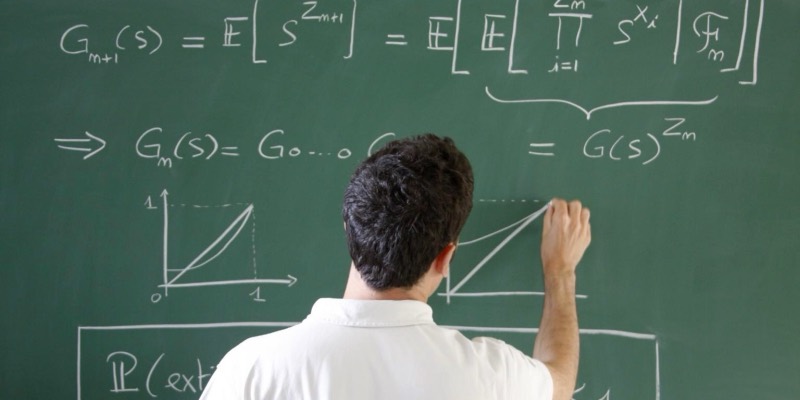
A researcher at the Centre for Applied Mathematics at École polytechnique in France. Image: Jérémy Barande / Wikimedia Commons, CC BY-SA 3.0

AI has become too useful for mathematicians to give up, even as many of them fear it’s taking their field away from them. That’s the picture painted by a new WIRED report, which spoke to researchers caught up in a bitter row with OpenAI who are still using the company’s tools every day.
The Navier-Stokes row
At the centre of it is NYU mathematician Tristan Buckmaster, who believes OpenAI used his work to beat him to a solution of the Navier-Stokes existence and smoothness problem, one of the famous million-dollar Millennium Prize problems. Buckmaster had been working on it using OpenAI’s Codex and Anthropic’s Claude, alongside Anthropic researcher Levent Alpöge, before OpenAI announced its own proof, reached by deploying tens of thousands of AI agents.
Buckmaster’s public accusation sparked a firestorm. OpenAI investigated and amended its announcement to say it had confirmed that his Codex prompts “could not have influenced the system in any way, including through training,” according to WIRED. The feud has been building for weeks, with TechCrunch reporting that Buckmaster also accused OpenAI of pressuring him not to credit his Anthropic collaborator.
And yet he hasn’t stopped using OpenAI’s tools. Since going public, he’s been using Codex to tidy up his papers.
With AI being so useful, it’s hard to completely prevent oneself from using it.
Tristan Buckmaster, NYU, to WIRED
“These companies have a monopoly, and there is not much choice,” he added.
“Who contributed what” is over
Buckmaster isn’t the only one. German mathematician Andreas Thom told WIRED that when OpenAI announced in August that its Astra model had proved a long-standing problem using techniques from his own niche field, he wondered how it had learned them. OpenAI amended its press release after he pointed out that it had overlooked his earlier work, and a researcher assured him his ChatGPT conversations hadn’t been used for training. Thom says he’ll probably never know for sure.
His conclusion is bleak for a field built on careful credit: AI, he told WIRED, “really kills this entire idea that you could trace back who contributed what.” Even so, he still uses ChatGPT, with training switched off, because it’s “extremely efficient.”
“What’s my purpose here?”
For others, the worry is existential. Humans still don’t fully understand every step OpenAI’s agents took to reach the Navier-Stokes result, which cuts against the whole point of a proof. Cornell mathematician Alex Townsend told WIRED he feels “excited and nervous simultaneously”: excited by what AI lets him do, and nervous because he’s asking himself what his purpose is.
The backlash is growing. Twenty-five Fields medalists signed an open letter saying AI companies and mathematicians are “severely misaligned,” more than 4,000 people have signed the Leiden Declaration on how the field should handle AI, and more than 2,000 people with ties to Caltech asked organisers to suspend an AI maths hackathon sponsored by Anthropic and OpenAI. OpenAI has since pulled out of it.
No way back
But even the critics doubt the brakes will hold. Thom told WIRED that any slowdown isn’t sustainable because of how much faster AI makes the work, and that early-career mathematicians who refuse to use it risk being left isolated. Buckmaster is calling for a truce while mathematicians and AI labs agree ground rules, starting with getting the references right.
It’s a preview of a fight that’s likely to spread well beyond mathematics: when AI is too useful to refuse, the people whose work it builds on have very little leverage.
Sources: WIRED, TechCrunch
Related