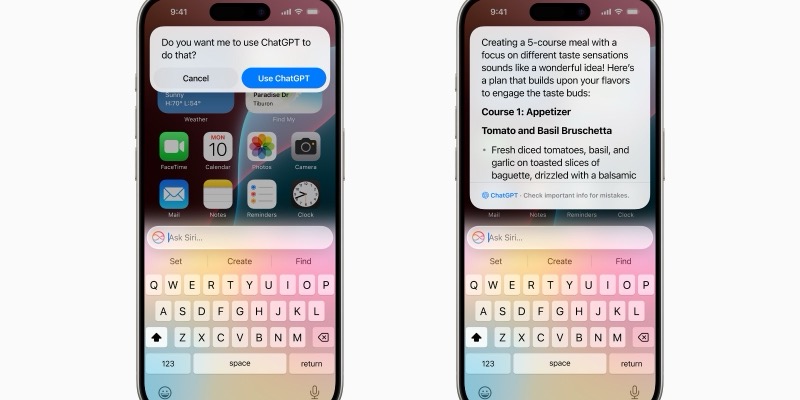
Siri handing a request to ChatGPT, as Apple showed it in 2024. Image: Apple
When Apple built ChatGPT into Siri, it looked like one of the biggest distribution deals in AI history. OpenAI now says it barely moved the needle. In a court filing in Elon Musk’s antitrust lawsuit, OpenAI says the integration was “dramatically underperforming” within months of launch, and reveals it had asked Apple for exclusivity, which Apple refused, as MacRumors and others have reported after the details were first picked up by the Financial Times.
A ‘slow start’, then worse
The details come from OpenAI’s motion for summary judgment, filed on September 22 in federal court in Texas. According to the filing:
- ChatGPT went live inside Apple Intelligence on December 11, 2024. It’s turned off by default, and users have to go through a multistep process to opt in.
- By January 2025, the integration “appeared to be off to a slow start,” and OpenAI cut its forecast for the number of extra logged-in weekly users it expected to gain from it.
- OpenAI had also hoped for a “halo effect,” with the Apple partnership boosting its brand and sign-ups elsewhere. Its analysis suggested that disappointed too.
- By the time Musk’s companies sued in August 2025, “it was clear that Apple’s integration of ChatGPT was dramatically underperforming.”
- In March 2026, “with the Apple integration persistently underperforming,” OpenAI told Apple something about the deal. What exactly is redacted.
Many of the most interesting details, including the actual user numbers and what OpenAI told Apple in March, are blacked out in the public version of the filing.
OpenAI wanted exclusivity. Apple said no
The filing also shows that OpenAI tried to lock rivals out. During negotiations, OpenAI “initially sought a mutual two-year exclusivity period,” but Apple refused. Apple’s term sheet struck out the request and added: “This agreement is non-exclusive by Apple. Apple may integrate other models.”
The final agreement, signed on May 4, 2024, says Apple “may integrate products or services that provide the same or similar functionality” as ChatGPT, and may build its own. Apple has since done exactly that, announcing in January that the next generation of Apple’s AI models, including a more personal Siri, will be based on Google’s Gemini.
Why OpenAI is saying this now
It’s not every day a company tells a court that its own big partnership disappointed. But that’s the point of OpenAI’s defense. Musk’s X and SpaceXAI sued Apple and OpenAI in August 2025, claiming the deal was an illegal exclusive arrangement that locked Grok out of the iPhone. Musk had posted that Apple was making it “impossible for any AI company besides OpenAI to reach #1 in the App Store.”
OpenAI’s argument is that a deal that was non-exclusive and barely used can’t have shut anyone out. It says the number of new users the deal brought in was a tiny share of the chatbot market, far below the 40% level courts have found raises antitrust concerns, and it accuses Musk of “misusing the antitrust laws to disrupt a competitor.”
OpenAI also points to Musk’s own words. SpaceX’s IPO filing, signed by Musk, described Grok as “one of the world’s most advanced frontier models” with “a formidable competitive advantage,” which OpenAI says contradicts the claim that Grok couldn’t compete.
What happens next
Musk’s companies dropped their claims against Apple earlier this month, leaving OpenAI as the only defendant. OpenAI is asking Judge Mark Pittman to rule in its favor without a trial. If he doesn’t, the case is scheduled to go to trial in January 2027.
Why it matters
The filing offers a rare look at how big AI partnerships actually perform, and it’s a reality check for the idea that simply being built into the iPhone guarantees success. An AI feature that’s switched off by default and buried behind a few taps loses out to the app people already have on their home screen. With Apple now betting on Google’s Gemini for Siri, the ChatGPT partnership looks less like a turning point and more like a stopgap.
Sources: OpenAI’s motion for summary judgment (X Corp. and SpaceXAI v. Apple and OpenAI), MacRumors, 9to5Mac, AppleInsider
Related