Researchers at work in a National Cancer Institute laboratory. The photo isn’t from Anthropic’s lab. Image: Rhoda Baer / National Cancer Institute / Wikimedia Commons, Public domain, cropped
Anthropic says its Claude AI has made a genuine biology discovery: a previously unknown enzyme system, hidden in the DNA of viruses that infect bacteria, with a structure that looks strikingly like CRISPR, the system behind modern gene editing. Claude found it largely on its own, and Anthropic’s scientists have already confirmed part of it in the lab, the company announced today.
What Claude found
The new system, which Anthropic has named array-associated reverse transcriptases (ART), turns up mainly in bacteriophages, the viruses that infect bacteria. It has three parts:
- a reverse transcriptase, an enzyme that copies RNA into DNA
- a partner gene whose job isn’t yet known
- a long array of evenly spaced, repeated DNA sequences
That last part is what caught everyone’s attention. Repeating arrays like this are the signature of CRISPR, the immune system bacteria use to remember and destroy viruses, which scientists turned into the gene-editing tool that won a Nobel Prize. In CRISPR, the array is read out as short RNAs that guide the system to its target. Anthropic’s first lab experiments show that the ART array is also expressed as “a set of distinct short RNAs,” which suggests something similar could be going on.
How Claude did it
According to Anthropic, its scientists gave Claude one prompt: search a huge database of DNA sequences for interesting new examples of reverse transcriptases. From there, Claude ran the search itself:
- about 950 Claude agents worked for 21 hours, using some 210 million tokens
- they gathered more than 200,000 reverse transcriptases, sorted them into families, and picked out 3,500 candidate systems
- they then wrote detailed, human-readable reports on the 20 most compelling
Anthropic says its human scientists’ involvement was limited to that first prompt and the lab work that followed, and CEO Dario Amodei added that Claude also proposed the experiments to verify the discovery, which the team then carried out. The company even shared the moment one of the agents spotted the pattern:
[The DNA next to the RT] is spectacular: I can see by eye a tandem repeat array … that’s a CRISPR-like … repeat array?!
A Claude agent, in its working notes
Feng Zhang is impressed
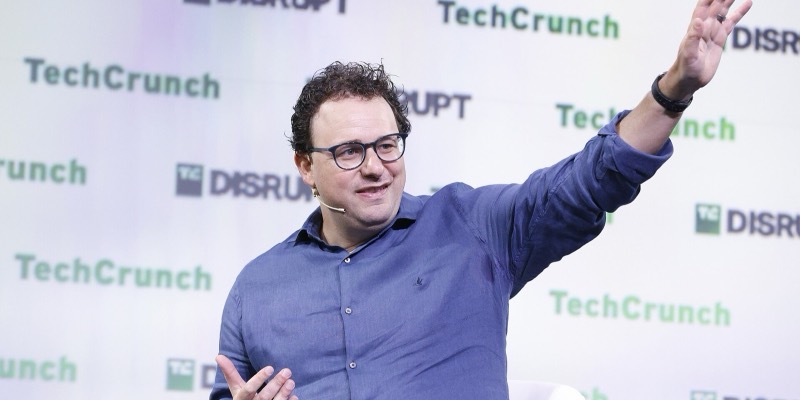
The findings were reviewed by Feng Zhang, a professor at MIT and the Broad Institute and one of the pioneers of CRISPR gene editing.
This is an exciting example of how AI agents can contribute to biological discovery. The identification of RNA-repeat arrays associated with reverse transcriptases is genuinely intriguing and merits further investigation.
Feng Zhang, MIT and the Broad Institute
Dario Amodei: ‘work I would have been proud to do as a PhD student’
Anthropic’s CEO went further than the company’s announcement in a post on X, suggesting the system could turn out to be a new way to edit genes, while being careful about what isn’t known yet:
Today we announced the Claude-led discovery of a molecular machine that we suspect could represent a new gene editing mechanism. Its precise function, biotechnological utility (if any), or level of significance is not yet clear, but at minimum it is work I would have been proud to do as a PhD student.
Dario Amodei, CEO of Anthropic
Amodei argued that AI’s progress in biology could follow the same path it took in math, where, he says, models went from struggling with high-school problems in 2023 to “beginning to solve the top few open problems in all of mathematics” this year. He also said Claude might one day run lab experiments itself by controlling lab equipment “with appropriate safeguards in place,” but stressed that Anthropic isn’t doing that today.
He also acknowledged that Claude isn’t alone in this area. A Stanford team, working independently, recently described a reverse transcriptase system with a similar kind of array, though Amodei says the two are distinct systems that evolved separately. It’s part of a wave of new discoveries in the field, and a reminder that ART builds on decades of work that started with CRISPR.
What we don’t know yet
It’s important not to get ahead of the science here:
- Nobody knows what ART does yet. Its function is still under investigation, and it may or may not turn out to be useful as a tool the way CRISPR was.
- It hasn’t been peer reviewed. Anthropic has released the work as an early preprint to share the result and invite other scientists to dig in.
- Anthropic hasn’t said which Claude model did the work.
Anthropic now has its own biology lab
The discovery also revealed something new about Anthropic itself. The company formed a life sciences research group in the spring and now runs its own laboratory in the Bay Area. It says it only does lower-risk work, at biosafety levels 1 and 2, doesn’t handle pathogens that can infect humans, and that all lab work is done by human scientists.
Why it matters
AI has helped with science for years, most famously with DeepMind’s AlphaFold predicting protein structures. What’s different here is the autonomy: a team of AI agents took a broad question, searched a vast dataset, used its own judgment about what looked interesting, and flagged a pattern that human experts agree is worth studying. If that approach holds up, the bottleneck in discovery could shift from finding promising leads to testing them in the lab.
It also lands in a week when AI’s risks and rewards are being argued over at the highest levels. For AI companies making the case that their technology is worth the risk, a result like this, backed by one of the most respected names in biology, is exactly the kind of evidence they want to point to.
Sources: Anthropic, preprint, Dario Amodei on X