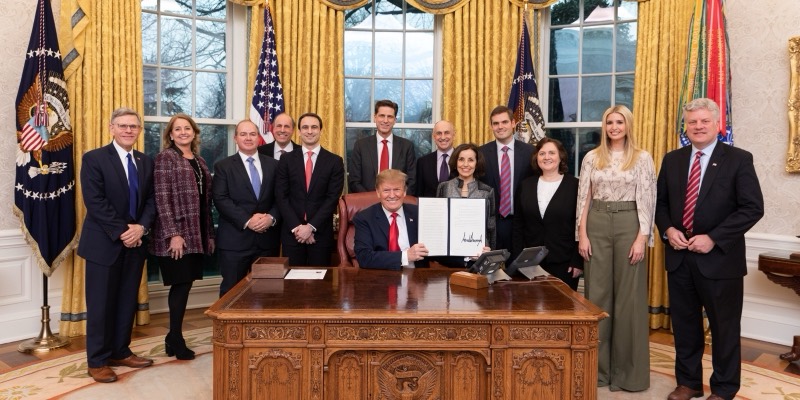
Trump holds up his first executive order on artificial intelligence in the Oval Office in February 2019. Image: The White House / Wikimedia Commons, Public domain, cropped
.jpg)
In the space of ten days, Donald Trump has called fears about AI a “HOAX,” promised to create an “AI Force,” told the United Nations that artificial intelligence will now be called “superintelligence,” and prepared to ask China’s Xi Jinping for an emergency hotline in case AI goes badly wrong. If that sounds contradictory, that’s because it is. But look closely at what his administration has actually done over the past 20 months and a clear pattern emerges. Trump doesn’t have an AI policy so much as an AI doctrine: win the race against China, and treat everything else, from safety rules to chip sales to individual companies, as something to be negotiated, one deal at a time.
Here’s how that doctrine works, where it’s succeeding, and where it’s starting to crack.
The week Trump went all-in
The latest round started with a rare show of caution from the industry itself. Over the weekend of September 12–13, Anthropic CEO Dario Amodei published a blog post urging AI developers to “pace the frontier” and calling for regulation that applies to every US frontier AI company. Early on Monday, September 14, OpenAI’s Sam Altman warned that safety needed to advance ahead of capability to avoid “dystopian” outcomes, Nextgov reported.
Trump’s answer came the same day on Truth Social. AI didn’t need new guardrails, he wrote; it needed “a STRONG AND SMART (High IQ!) PRESIDENT.” The country already had enough “CRIMINAL and REGULATORY power” to keep companies in line, the warnings were a “HOAX,” and the only thing that mattered was the race with China: “WHOEVER WINS AI, WINS!”
A week later, on September 21, he went further, announcing plans for an “AI Force” and a new AI czar, Defense One reported. The message to the industry was unambiguous:
We will not in any way hinder or stifle the Growth of this incredible Industry. We will cherish it, help it, and watch over it, as it grows!
President Donald Trump, on Truth Social
Nobody, including experts Defense One spoke to, seems sure what the AI Force would actually do, or what legal authority it would have. Trump compared it to the Space Force he created in his first term, but Space Force was set up by Congress. He also said the Justice Department would rein in AI companies “if we have to,” which suggests the watching-over part would be done by prosecutors rather than regulators.
Then, on September 22, Trump took the argument to the UN General Assembly. He renamed AI “superintelligence”, rejected any “globalist scheme” to control it, and mocked the idea that AI might “kill us all,” comparing those warnings to climate predictions he says never came true. “I’m not going to stifle growth of something that will be bigger than the Industrial Revolution,” he said.
The doctrine: win first, ask questions later
None of this is new. It’s the loudest version yet of a position Trump has held since his first day back in office.
On January 20, 2025, he revoked Joe Biden’s 2023 executive order on AI safety, which had required the biggest AI developers to share safety test results with the government. The next day he stood in the White House beside OpenAI’s Sam Altman, SoftBank’s Masayoshi Son and Oracle’s Larry Ellison to announce Stargate, a planned $500 billion data center venture.
In July 2025 came Winning the Race: America’s AI Action Plan, a list of more than 90 federal actions built around three pillars: speeding up innovation, building AI infrastructure, and leading internationally. It came with executive orders to fast-track data center permitting, promote exports of American AI, and bar federal agencies from buying what the administration called “woke AI.” In November 2025, Trump followed up with the Genesis Mission, which puts the Energy Department’s 17 national laboratories to work building AI for scientific research.
The logic is consistent and, on its own terms, coherent. AI is a strategic race. America wins by building faster than China: more chips, more data centers, more power, fewer rules. Anything that slows that down, whether it’s a safety law in Colorado or a nervous CEO’s blog post, is a risk to national security.
Round one: the war on state AI laws
With Congress unwilling to write national AI rules, states started writing their own. California passed SB 53, which requires the largest AI developers to publish safety frameworks and report serious incidents. Colorado passed a broad law aimed at algorithmic discrimination. Hundreds more bills followed.
The administration’s first attempt to stop them failed badly. A proposed 10-year ban on enforcing state AI laws was stripped from Trump’s “One Big Beautiful Bill” in July 2025 after the Senate voted 99–1 to remove it.
So Trump tried another route. On December 11, 2025, he signed an executive order to establish a national AI policy framework and push back against “onerous” state laws, naming Colorado’s as an example. In January, Attorney General Pam Bondi set up an AI Litigation Task Force to challenge state laws in federal court. Even that order, though, exempted state laws on child safety, data center infrastructure and government use of AI, a sign of how politically toxic a total ban would be.
In Congress, a bipartisan group of House members released a draft “Great American AI Act” in June that would pause state laws on how AI models are developed for three years. It has made little progress since, and House Speaker Mike Johnson has sounded unconvinced that Congress should take the lead on AI safety at all. Meanwhile, Colorado has rewritten its law rather than repealing it, and California’s is still in force. Twenty months in, the states are still regulating AI, and Washington still has no national rulebook to replace them.
Round two: Trump vs. Anthropic
If the fight with the states showed the limits of Trump’s approach, his fight with Anthropic showed what it looks like when it gets personal.
The dispute began over a Pentagon contract. The Defense Department wanted to use Anthropic’s Claude for “all lawful purposes.” Anthropic refused to drop two conditions: no fully autonomous weapons, and no mass surveillance of Americans. On February 27, 2026, Trump ordered every federal agency to “IMMEDIATELY CEASE all use of Anthropic’s technology,” Al Jazeera reported, and Defense Secretary Pete Hegseth moved to brand the company a “supply chain risk” to national security, a label normally used for foreign adversaries. Around the same time, the Pentagon was bringing Elon Musk’s Grok into its systems, with Hegseth denouncing “woke AI.”
Anthropic sued. A federal judge in San Francisco blocked the government’s actions, and the administration appealed. The case is still working its way through the courts.
Then the story flipped. In April, Anthropic unveiled Claude Mythos, a model so good at finding security holes that it’s only available to vetted organizations. Suddenly the company the government had tried to rip out of every agency had something the government wanted. By April 21, Trump was telling reporters that Anthropic was “shaping up” and a deal was “possible.”
Round three: the 18 days that show the doctrine isn’t really about deregulation
The Mythos saga also produced the clearest evidence that the Trump administration is willing to regulate AI, hard, when it decides it wants to.
On June 12, the Commerce Department ordered Anthropic to cut off access to its new Mythos 5 and Fable 5 models for any foreign national, including its own staff overseas. Anthropic responded by switching both models off worldwide. On June 26, Commerce Secretary Howard Lutnick allowed Mythos 5 to be released to a select group of companies and federal agencies. And on June 30, the administration lifted the controls altogether after Anthropic agreed to “proactively detect and address security risks associated with the models,” CNBC reported.
Think about what happened there. An administration that calls AI safety fears a hoax shut down a frontier AI model worldwide for 18 days on national security grounds, then reopened it once the company made safety commitments. That’s not the absence of AI regulation. It’s AI regulation without the rules written down: decided case by case, by whoever is in the room.
Round four: chips are for sale, at the right price
The same deal-by-deal approach runs through Trump’s chip policy. Under Biden, the most advanced AI chips were simply banned from China. Trump has turned that ban into a negotiation.
- In August 2025, Nvidia and AMD agreed to hand the US government 15% of their revenue from selling their cut-down H20 and MI308 chips to China, in exchange for export licenses.
- In December 2025, Trump said Nvidia could sell its more powerful H200 chips to approved customers in China, with 25% of the revenue going to the US government. The rules were formalized in January.
- Nvidia’s newest Blackwell chips are still off-limits, and even allies don’t get everything: Trump has said South Korea will get “a lot of the chips,” but not Blackwell.
Supporters call it smart business: China gets yesterday’s chips, America gets paid, and Nvidia keeps Chinese customers from switching to Huawei. Critics, including national security hawks in Trump’s own party, point out that a government taking a cut of chip sales to its main rival has blurred the line between export control and revenue stream. Either way, it’s hard to square with the idea that AI is an existential race China must not win.
Round five: the power bill
The most successful part of Trump’s AI agenda may be the least flashy. As we’ve covered, the data center boom is straining power grids and pushing up electricity bills, and it’s turned local communities against new projects.
Trump announced a Ratepayer Protection Pledge in his State of the Union address in February. On March 4, Amazon, Google, Meta, Microsoft, OpenAI, Oracle and xAI signed it, promising to build, bring or buy all the energy their data centers need and pay the full cost, so households don’t. In July, the White House said more than 200 more utilities, developers and states had joined, covering 80% of the power delivered to US homes and businesses.
The catch is that it’s voluntary. There’s no penalty for breaking it, and it relies on the goodwill of the same companies racing to build as fast as possible. Still, it’s a rare case of the administration recognizing that AI’s costs land on ordinary people, and doing something about it.
The contradiction at the center: the China hotline
That brings us to this week. As Xi Jinping arrives in Washington for Thursday’s summit, the administration’s most concrete AI proposal isn’t about speed at all. It’s about safety.
Treasury Secretary Scott Bessent has set out plans for a formal US–China channel to warn each other when an AI incident becomes serious enough to threaten national security, and analysts say it could be the summit’s most meaningful outcome. It’s modeled on the Cold War “red telephone” between Washington and Moscow.
You don’t set up a crisis hotline for a technology you think is harmless. The hotline is a tacit admission, from inside Trump’s own cabinet, that AI could produce the kind of emergency his Truth Social posts dismiss. The difference is that the administration is willing to take AI risk seriously when China is involved, and not when American companies are.
Who’s actually running AI policy?
Part of the unpredictability comes down to people. David Sacks, the venture capitalist who served as Trump’s AI and crypto czar and once accused Anthropic of “fear-mongering” to win favorable regulation, stepped down in March after hitting the 130-day limit for special government employees. He now co-chairs the President’s Council of Advisors on Science and Technology, alongside tech leaders including Mark Zuckerberg, Larry Ellison and Jensen Huang, who dismissed “doomsday narratives” days after Trump’s “hoax” post.
Michael Kratsios, who runs the White House Office of Science and Technology Policy, remains the administration’s most prominent AI official. And Trump is looking for a new czar, “High I.Q.” required. In practice, AI policy is set by a small circle of advisers, many from the industry it oversees, and the final call rests with one man and his phone.
What Americans think
The public isn’t convinced. In a University of Massachusetts Amherst poll taken August 21–26, just 23% said Trump was handling AI well, while 57% said he was handling it badly, Newsweek reported. Even Republicans were only lukewarm: 51% approved, 24% disapproved. Young people are the most critical: in polling reported by Newsweek, only one in ten 18-to-29-year-olds said he was handling AI well.
A YouGov survey from mid-September found that 67% of Americans think AI is advancing too quickly, 73% are worried about mass unemployment, and half worry it could cause the end of the human race. That’s not a public asking for less oversight.
Jobs are the biggest gap in Trump’s message. He talks constantly about data centers, construction and blue-collar work building AI infrastructure, but he’s said little about what happens to the office workers AI is starting to replace. Some on his own side have noticed: Steve Bannon has predicted that AI job losses will be a defining issue in the 2028 election.
None of this has slowed the money. The two biggest AI political action committees, including Leading the Future, which is backed by Andreessen Horowitz and OpenAI president Greg Brockman, had put at least $44 million into 40 House and Senate candidates by the end of June, and plan to spend more than $200 million before November’s midterms, Built In reports.
MadRobot’s take
There’s a serious argument buried under the capital letters. China is racing to build AI, as we saw in Inner Mongolia this week. America’s lead does depend on chips, power and speed. And parts of Trump’s record are real achievements: the Ratepayer Protection Pledge, the Genesis Mission, a China hotline that nobody managed before.
But the claim that Trump is “deregulating” AI doesn’t match what his government actually does. It shut down Anthropic’s models worldwide for 18 days. It tried to blacklist an American company for refusing to build autonomous weapons, then offered it a deal once it had something the Pentagon wanted. It sells chip access to China for a cut of the revenue. It sues states for writing safety rules, while telling China that AI incidents are serious enough to need a hotline.
That isn’t a free market. It’s regulation by personal discretion: rules that change depending on who’s asking, what they’re offering and what the president posted that morning. For an industry making trillion-dollar bets, that uncertainty is its own kind of risk. For the public, it means the decisions that matter most about the most powerful technology of our time are being made by a handful of people, without the rules written down.
Trump says the only guardrail AI needs is a strong and smart president. The trouble with that system is that it only works as long as you trust the president, and whoever comes next. If America really believes it’s in a race it can’t afford to lose, it needs rules that outlast any one administration. Right now, it has Truth Social posts.
Sources: Nextgov/FCW, Defense One, The White House, Roll Call, Al Jazeera, CNBC, Axios, Newsweek, Built In
Related