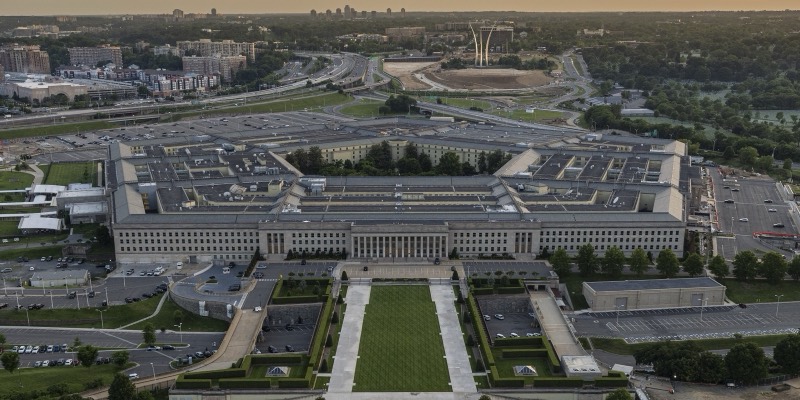
An aerial view of the Pentagon, pictured in May 2023. Image: U.S. Navy Petty Officer 2nd Class Alexander Kubitza / U.S. Department of Defense / Wikimedia Commons, Public domain, cropped
Anthropic has lost a big round in its fight with the Pentagon. A federal appeals court in Washington ruled 2-1 on Friday that the Defense Department can keep labelling the Claude maker a “supply chain risk,” which bars the military and its contractors from using Claude, ABC News and the Associated Press report.
What the court decided
The US Court of Appeals for the DC Circuit rejected Anthropic’s argument that the ban was arbitrary, unauthorized and unconstitutional. Judges Gregory Katsas and Neomi Rao, both nominated by President Trump, formed the majority. Writing for the court, Katsas said the Pentagon had “ample support” for its decision:
The Department reasonably feared that Anthropic might manipulate Claude’s design to prevent it from performing national-security functions.
Judge Gregory Katsas, DC Circuit
Anthropic argued the label was retaliation for refusing to let Claude be used for lethal autonomous weapons or mass surveillance of Americans. The majority said that didn’t matter: the designation turns “on what Anthropic does, not why Anthropic does it.” And it left the final call to the executive branch, writing that “in our Republic, it is the President and the Secretary of War who must determine how best to balance the competing risks.”
A sharp dissent
Judge Karen LeCraft Henderson, nominated by President George H.W. Bush, disagreed. She argued the 2018 security law the Pentagon relied on is meant to stop deliberate sabotage, and doesn’t allow the government to blacklist a company for what she called “a contractor’s honest and upfront enforcement of restrictions.”
The court has paused its decision so Anthropic can ask the same panel, or the full DC Circuit, to rehear the case. It could also go to the Supreme Court.
Two courts, two answers
The ruling leaves Anthropic with conflicting results. The Pentagon issued two parallel designations, and in August a federal judge in San Francisco, Rita Lin, struck down the other one. She found the government’s actions “were based on a desire to make a public example out of Anthropic for its ‘arrogance’ in criticizing the government.”
Anthropic leaned on that in its response. “We respectfully disagree with the court’s decision. Another federal court has already held the government’s parallel designation unlawful,” the company said, adding that it is “considering all options, including further review.” Pentagon spokesman Sean Parnell said the ruling “completely validates the Department’s position.”
How we got here
The dispute started over a Pentagon contract. The Defense Department wanted to use Claude for “all lawful purposes,” and Anthropic refused to drop two conditions: no fully autonomous weapons and no mass surveillance of Americans. In February, President Trump ordered federal agencies to stop using Anthropic’s technology, and Defense Secretary Pete Hegseth moved to brand the company a supply chain risk. We looked at how the fight fits Trump’s wider approach to AI in our analysis earlier this week.
Why it matters
It’s the first appeals court ruling on whether the government can shut an AI company out of defense work over the limits it puts on its own models. For now, the answer is yes, which puts pressure on every AI lab that wants government contracts and its own red lines at the same time.
Sources: ABC News, Associated Press via KSAT, The Next Web, CNBC.