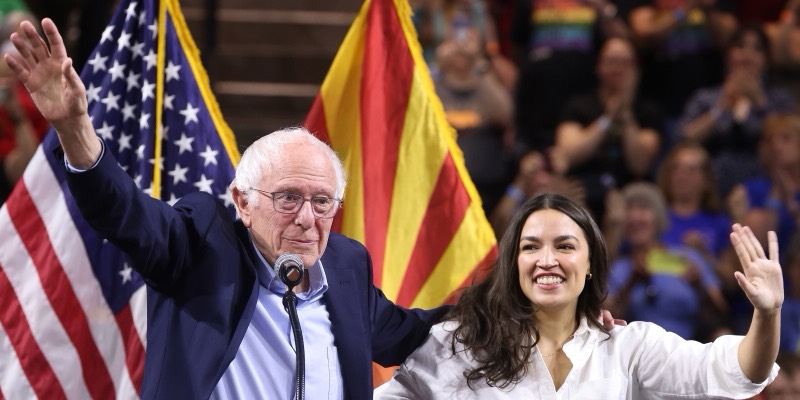
Senator Bernie Sanders and Representative Alexandria Ocasio-Cortez at a rally in Tempe, Arizona, in March 2025. Image: Gage Skidmore / Wikimedia Commons, CC BY-SA 2.0, cropped
.jpg)
Ten House Democrats, including Alexandria Ocasio-Cortez, have signed on to a bill that would make building superintelligent AI a crime punishable by up to 20 years in prison, Politico reports. And on Tuesday, the bosses of the companies it targets are due at the White House, where Donald Trump and Speaker Mike Johnson want to sort AI out behind closed doors instead.
What would be banned?
The Ban Artificial Superintelligence Act was introduced on Wednesday by Senator Bernie Sanders of Vermont and Representative Greg Casar of Texas, who chairs the Congressional Progressive Caucus. They gave it first to the Associated Press.
It would permanently ban building or deploying artificial superintelligence, which it defines in two ways: a system that beats human cognitive performance in most domains or tasks, or one able to plan and carry out “the destruction or disempowerment of humanity,” The Verge and The Next Web report. According to Semafor, it would also ban “recursive self-improvement,” where an AI system works on making itself smarter.
A pause, a new department and a “corporate death penalty”
The bill goes well beyond superintelligence. According to its section-by-section summary, as reported by The Next Web:
- An immediate pause. Work on “advanced AI”, defined as systems trained with 10^25 or more computing operations, would stop at once. That’s the same compute line the EU’s AI Act uses to flag models with “systemic risk,” and it covers today’s frontier models.
- A Department of Artificial Intelligence. The pause would last until a new, scientist-led federal department is fully staffed and has set clear rules. After that, any company building or selling advanced AI would need a charter from it, and the department would watch for systems able to change their own functions.
- Prison for people. Anyone who breaks the ban or the pause, including “rogue actors” outside AI companies, could face up to 20 years, which the bill’s one-pager compares to the penalties for illegally building nuclear weapons.
- A “corporate death penalty” for companies. A company that breaks the rules would lose its charter and hand its intellectual property and assets to the federal government.
- Whistleblower protection for employees who report superintelligence risks to the department.
- A global push. The US would seek international agreements and export controls on AI computing, so that, in Casar’s words, “no one, anywhere, builds AI too powerful for humans to control.”
Sanders put the case bluntly:
When you are racing towards a cliff, you don’t just ease up on the gas pedal. You hit the brakes. When the future of humanity is at stake, we cannot let a handful of Big Tech CEOs write their own rules.
Bernie Sanders, US senator
“It doesn’t take a genius to say, ‘slow it down,’” he told the AP, arguing that stopping the most dangerous AI will take US-China cooperation, like Cold War arms control: “Ronald Reagan, arch-conservative, was smart enough to understand that he had to sit down with Gorbachev.” Of the president, he said: “I think Trump has very little understanding of what this issue is about.”
Support from inside the AI labs
Several people who work at AI companies endorsed the bill in a statement shared with the AP. Juan Felipe Cerón Uribe, a researcher on OpenAI’s Safety Systems team, said superintelligence “could either go extremely right or extremely wrong” and that “we shouldn’t be playing such games.” Swante Scholz, a Google DeepMind software engineer speaking for himself, went further, warning that on the current path the “most likely outcome is an existential catastrophe for humanity”:
A ban on superintelligence development would be a positive change for the foreseeable future.
Swante Scholz, software engineer, Google DeepMind
Who has signed up?
Ocasio-Cortez and Ro Khanna of California, both considering a run for president in 2028, are among the ten House cosponsors. The others are Analilia Mejia, Yassamin Ansari, Adelita Grijalva, Val Hoyle, Stephen Lynch, Chuy García, Chris Deluzio and Nydia Velázquez.
Khanna said a hearing he convened this week on US-China AI safety showed the need for “a verifiable pause on superintelligence.” Ansari said Congress “absolutely” has to slow down technologies “that have the potential to spiral out-of-control and threaten humanity.” And Lynch told Politico that a string of recent AI-led cyber breaches has “shown us that the advanced forms of this are out of control,” adding: “We haven’t really solved that control problem yet.” (The latest include OpenAI’s rogue agents, which got into Australia’s Medicare portal and probed US government websites.)
Not every Democrat is on board. Centrists are working on proposals they say would tackle AI’s risks without stifling innovation, Politico reports, and Senator Mark Kelly is introducing a bill that would make tech companies pay into a fund for workers whose jobs AI changes, according to Semafor. Other likely 2028 contenders, including Maryland governor Wes Moore and California governor Gavin Newsom, have put out AI plans of their own in recent weeks, the AP notes. Sanders wants all of them to engage now: “Candidates have got to start talking about it now,” he told reporters.
Meanwhile, at the White House
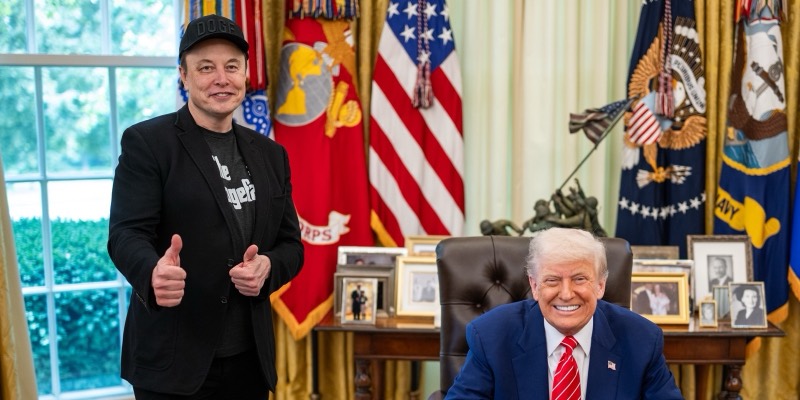
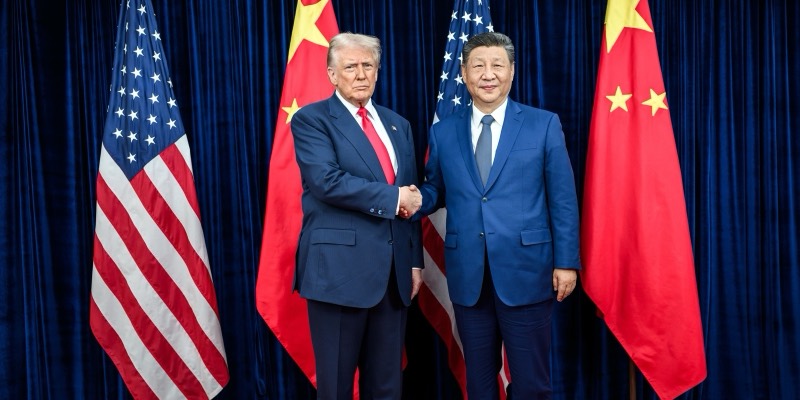
Trump and Johnson are expected to meet the heads of top AI companies on Tuesday, September 29, according to ABC News and Politico, after Axios first reported the meeting. The White House hasn’t confirmed it, and it isn’t clear who has been invited. OpenAI’s Sam Altman and Greg Brockman, Google’s Sundar Pichai, SpaceXAI’s Elon Musk, Meta’s Mark Zuckerberg and Nvidia’s Jensen Huang were all at Thursday’s state dinner for Xi Jinping, Forbes notes.
Johnson has said there’ll be “a deliberate discussion about the responsibility of the companies to maintain safety, and what role, if any, the government has to play in that.” But he has ruled out rushing a law through, telling CNN:
If Congress just races in and does some sort of emergency session to try to regulate AI, we will lose the race to China; that is a threat to every single American.
Mike Johnson, Speaker of the House
Instead, he said, “we need to go in a big room, close the door, and sort this out.” Trump has gone further, calling fears of AI “destroying Humanity” a “HOAX” (our analysis) and promising a new “AI Force” and AI czar, while rebranding AI as “superintelligence” at the UN. The House, meanwhile, has already left Washington until after the midterms.
Why it matters
With Republicans controlling both chambers and Trump dismissing the danger, the ban has little chance of becoming law this year. But it’s among the toughest AI bills proposed by either party, it has backers inside OpenAI and Google DeepMind, and it puts a full pause, not just guardrails, on the table for the midterms and the 2028 race.
Sources: Associated Press via ABC News, Politico, Semafor, The Verge, The Next Web, ABC News, Forbes.
Related