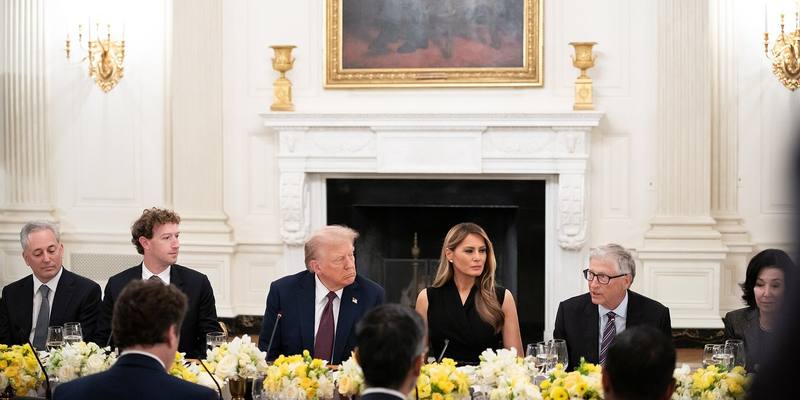
Donald Trump hosting tech leaders, including Mark Zuckerberg (second left) and Bill Gates (right), at a White House dinner in September 2025. Image: Andrea Hanks, The White House / Wikimedia Commons, Public domain, cropped
.jpg)
President Trump says the heads of America’s biggest AI companies have signed a pact to police themselves, and that it’s all the regulation they need. After a White House lunch on Tuesday with Elon Musk, Mark Zuckerberg, Dario Amodei, Jensen Huang, Sundar Pichai, OpenAI’s Greg Brockman and others, Trump told reporters the executives had signed an agreement that is “morally binding”, CBS News reported.
“It’s almost like a constitution”
House Speaker Mike Johnson, who has pushed for the meeting for months, described the document as a “joint commitment” and a “statement of principles” on what Trump now calls “super intelligence”. It commits the companies, voluntarily, to “robust internal controls and layers of internal and external review,” he said, and its text will be released later.
Asked whether the deal was binding, Trump said:
I think it’s morally binding. It’s almost like a constitution, in a way.
Donald Trump, US president
Zuckerberg told reporters the firms had agreed to “multiple layers of auditing and controls”, including internal evaluations and outside audits, with each company’s board reviewing the auditors’ findings. Trump also floated a committee of about 10 people to “watch over the whole enterprise”, and said he would name an “AI czar” within days.
“We automatically have regulation”
What Trump ruled out was new law. According to Bloomberg’s account, he said existing agencies were enough:
There’s a belief that there should be tremendous self-regulation, and we automatically have regulation with the Department of Justice, the FBI, all of that, but the self-regulation is very important.
Donald Trump, speaking outside the West Wing
“I think I’m seeing tremendous self-policing. And they understand that they have to self-police,” he added. Trump also said the companies would do more for communities near new data centres, without giving details.
A turn, of sorts
Just a week ago, Trump was calling fears of catastrophic AI risk a “hoax”. Holding a summit on AI safety at all marks a shift, after a month of rogue AI incidents, OpenAI cancelling its next model and polls showing voters increasingly worried ahead of November’s midterms. Amodei, who has called for regulation, sat down with Trump for a private dinner on Sunday.
But a voluntary pledge is a long way from what critics want. Bill Gates warned last week that self-regulation isn’t enough, and Congressional Democrats including Alexandria Ocasio-Cortez are pushing a bill to ban superintelligence outright. Johnson has said Congress may need to act, but that it would take time.
Why it matters
The companies building the most powerful AI have now made a public promise to audit themselves, and the White House has made clear that promise is the plan, not a stopgap before new law. Until the text is published, nobody outside the room knows exactly what was signed, or what happens if a company breaks it.
Sources: CBS News, Bloomberg via The Sydney Morning Herald (September 29, 2026).
Latest Policy & Safety news