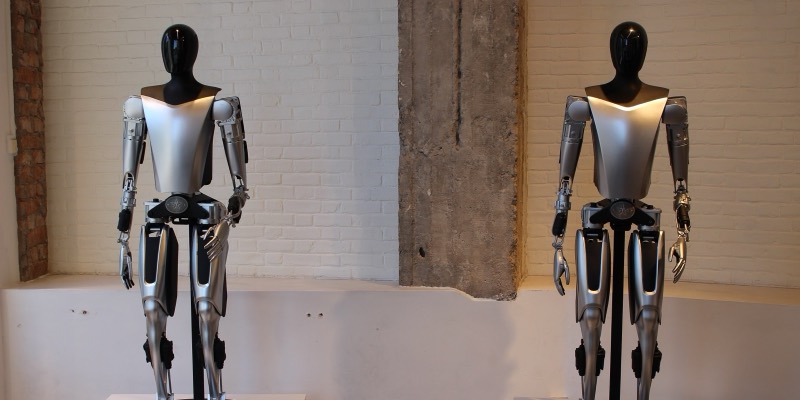
Two Tesla Optimus robots on display in Stockholm in 2024. Image: Ulkl / Wikimedia Commons, Public domain, cropped
Tesla’s humanoid robot is running into a very human problem. Some of the factory workers asked to teach Optimus how to do their jobs pushed back, because they “knew the robots were designed to eventually replace them,” according to a detailed report by The Information, as covered by Ars Technica and Electrek. It’s one of several problems facing the robot that Elon Musk has called potentially “the biggest product ever.”
Teaching robots with human movements
Like other robotics companies, Tesla trains Optimus largely by imitation: the AI learns by watching people do a task. To collect that data, Tesla had factory workers in Texas and California wear special suits that recorded their movements as they worked.
Some of them didn’t like where that was heading, according to The Information. Tesla has since moved the job to dedicated data collection teams and set up “training hubs” for them, rather than relying on the regular workforce.
Hundreds a week, but not yet useful
Production is ramping up fast. Tesla stopped making the Model S and Model X at its Fremont, California, factory in May and moved line workers and engineers onto Optimus. It went from dozens of robots a week in the second quarter to several hundred a week by August, and it’s aiming for more than 1,000 a week by the end of 2026, with an eventual goal of about 20,000.
But most of those robots stay inside Tesla, and the AI isn’t ready for general work. Three sources told The Information that Optimus “can’t yet reliably handle a wide range of tasks.” For now, the robots are programmed for specific jobs in tightly controlled, supervised areas, and learning basic movements still takes days, even with more than 500,000 hours of training data, Electrek reports.
Hands are the hard part
Building the robot is a headache too. Each Optimus hand and forearm contains more than 100 small parts, including screws, that workers still assemble by hand, and new robots often need fixing straight away. The touch sensors in the hands have been unreliable enough that Tesla has designed a replaceable, glove-like layer of sensors, rather than swapping whole hands.
Tesla also still relies on Chinese suppliers for many components, and some are struggling to keep quality consistent at volume. That’s awkward timing: in July, the US Federal Communications Commission banned new foreign-made robots, from humanoids to robot vacuums.
Leased, not sold
When Optimus does leave Tesla, the first units are expected to be leased rather than sold, to companies whose factories look like Tesla’s own, so the robots can adapt more easily and send back data. Musk has admitted the timeline slipped before: after predicting that thousands of robots would be doing useful work by the end of 2025, he later said that “zero Optimus robots were doing useful work at Tesla,” Electrek notes.
Musk has also acknowledged that building a humanoid robot that can handle many different tasks is “one of the hardest things to solve.” Rivals aren’t standing still. Hyundai plans to deploy up to 25,000 Boston Dynamics Atlas robots over the next several years, and Agility Robotics already has humanoids working in warehouses.
Why it matters
Humanoid robots only make money if they can learn many jobs and do them reliably, and Optimus isn’t there yet. The pushback from workers is a preview of a much bigger fight: the most valuable training data for these robots comes from the very people they’re meant to replace.
Sources: Ars Technica, Electrek, The Information.