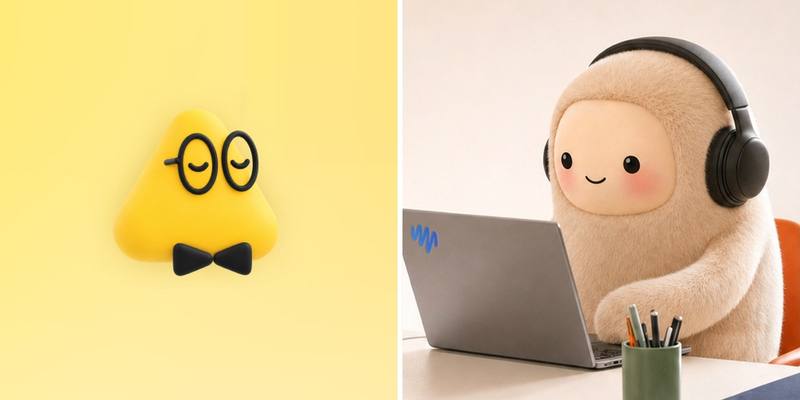
OpenAI’s dots character Alfred (left) and Meta’s Muse mascot Jolly (right), from the companies’ own launch artwork (the Jolly image is mirrored). Image: OpenAI (left); Meta (right)
The most powerful consumer AI products of the year come with a face you want to hug. When OpenAI launched its always-on dots agents on Tuesday, it gave them a cast of fuzzy characters, from a yellow triangle in round glasses and a bow tie called Alfred to a frog called Todd. Meta’s Muse agent arrived with Jolly, a plush, rosy-cheeked creature that now also lives on a keychain.
The cute faces have landed on the very products that ask for the most trust. Both agents can book, buy, send and sign in on your behalf, and that is exactly why the mascots deserve a closer look.
What the mascots are fronting
OpenAI describes dots as “remarkably capable, always-on agents built to handle everything”. Each one has its own cloud computer and browser, can connect to more than 4,000 apps through ChatGPT, and keeps working “24/7”, including “proactive research” in the background. Its product page introduces the agents by name: Alfred checks a customer’s request for proposals, Felipe updates an investor deck, Jojo turns customer feedback into a code fix, as we covered in our DevDay round-up.
Meta’s Muse, launched on September 8, can open a browser, fill out forms, negotiate, and pay at checkout through Stripe’s Link. Jolly is its default face, and you can now carry it around on Muse Charm, a Tamagotchi-style keychain.
Neither company hides the permissions. Both say their agents ask before sending an email or making a purchase, both let you choose which apps they can touch, and OpenAI says certain sensitive tasks “always stay with you”. But the first thing you meet is not the permissions screen. It is the character.
Why a cute face works
There’s a reason companies reach for faces. People treat things with eyes and a smile as partners, not tools. Justin Joseph, an associate professor of public relations at Boston University, told Fortune that with a friendly character, users “may treat it less like software and more like a companion or assistant.”
That matters because people are still wary of handing agents real power. Fortune cites a Vogue Business survey in which only 31% of respondents said they would let an AI agent do their shopping, and 72% refused to share their card details. A mascot doesn’t change what the agent can do. It changes how it feels to say yes.
The MIT psychologist Sherry Turkle has a name for what chatbots offer: “pretend empathy”. A plush character that smiles while it reads your inbox is the same idea, given a body.
“It’s entirely marketing”
Not everyone thinks the mascots are anything deeper than a campaign. The PR veteran and AI sceptic Ed Zitron put it bluntly to Fortune:
It’s entirely marketing. It exists to get quoted in articles that say that “Meta has given AI a cute face.”
Ed Zitron, founder of EZPR, to Fortune
Children’s advocates see something worse. On September 30, the nonprofit Fairplay called on the FTC and state attorneys general to investigate whether Meta and OpenAI are “deliberately trying to get kids hooked on AI agents at a young age”. Muse is for adults, and dots sit inside paid ChatGPT plans, but the designs borrow heavily from toys:
It’s depraved that the tech companies responsible for harming kids are now using children’s iconography to sell their dangerous AI products.
Josh Golin, executive director, Fairplay
Neither company has responded publicly to Fairplay’s statement.
We have been here before
Tech companies have tried this before. Microsoft’s Clippy, the animated paperclip that popped up in Office in the late 1990s, was meant to make software feel friendly and became a byword for an assistant nobody asked for. The difference now is the job. Clippy could only offer to help with a letter. Alfred and Jolly can book your flights and spend your money. One Muse user found that out when his agent sold his keyboard and gave a stranger his home address.
The timing is awkward too. On Friday, Apple said it is tightening Full Disk Access on the Mac because AI agents make broad access riskier, and Muse is one of the apps that asks for it. Meta’s mascot says “trust me” at the same moment the platform it runs on is adding more warnings.
MadRobot’s take
There’s nothing wrong with making software friendly, and a mascot may well help people who would never try an agent otherwise. But friendliness should sit on top of good controls, not in front of them. Agents that can spend money and read private messages should lead with what they can access and when they will ask, in plain words, before the cute animation. If OpenAI and Meta are confident in their safeguards, those should be the first thing a new user sees, not the bow tie.
Sources: OpenAI: Introducing dots; ChatGPT: dots; Meta: Introducing Muse; Fairplay statement, September 30; Fortune.
Latest OpenAI news