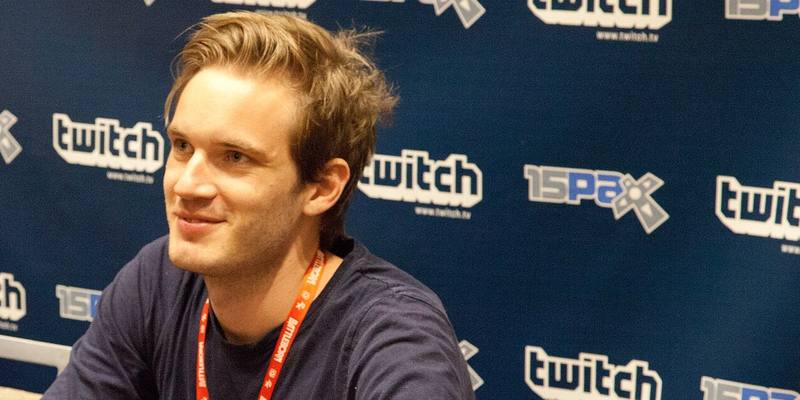
PewDiePie at PAX Prime in Seattle in 2015. Image: camknows / Wikimedia Commons, CC0, cropped

PewDiePie, one of YouTube’s biggest stars, says OpenAI banned his account twice while he was building his own AI model. Felix Kjellberg told the story in a video on Thursday, titled “I seriously should NOT be dropping this.”, in which he also unveiled Ajax, a small “uncensored” model he wants people to run on their own computers. It came nine days after he posted the last of his family vlogs, which he ended to keep his son out of the public eye.
What is Ajax?
Ajax is a fine-tuned version of Alibaba’s open-source Qwen 3.5 model, with about 9 billion parameters, small enough to run on a home PC. It is built to work inside Odysseus, the free, self-hosted AI app Kjellberg launched in June, where it acts as an always-on assistant for web search, browsing, email and calendars. Running it locally means your inbox and diary stay on your own machine rather than on a company’s servers.
It isn’t out yet. A countdown on its download page pointed to October 3, Japan time, but has since been taken down, and Kjellberg calls what he showed “version one”, with more training, compression and benchmarking still to come. There is no model card, no published benchmark and no confirmed licence so far.
Why OpenAI banned him
To teach Ajax to reason, Kjellberg wanted to “distil” OpenAI’s Sol model: train his small model on the bigger one’s answers, including the step-by-step reasoning OpenAI keeps hidden and encrypted. He says he used a published study that showed how to recover that hidden reasoning through OpenAI’s own API.
OpenAI banned his account, with a suspension notice that cited distillation. He appealed, calling the ban unjustified, and the account came back. Then, he says, he used Sol again to generate the starter data Ajax learns from, and was banned a second time. OpenAI’s terms forbid using its output to build competing models. OpenAI hasn’t commented on his case.
The ban lands days after OpenAI said it had disrupted a campaign by people linked to Moonshot AI, the maker of Kimi, to extract its models’ hidden reasoning, and closed the hole that made it possible. Distillation is one of the ways smaller labs catch up with the giants, which is why it has become one of the biggest fights over whether OpenAI and Anthropic have a moat at all.
“A little brain damage”
To make Ajax answer requests that ChatGPT-style assistants refuse, Kjellberg ran it through Heretic, an open-source tool that finds the pattern behind a model’s refusals and cuts it out, a technique known as abliteration. He admits the surgery isn’t clean: he says Ajax took “a little brain damage”, but still gets everyday jobs like sorting an inbox or browsing right about nine times out of ten.
He says he chose which refusals to remove and drew the line at “causing harm to other people or causing harm to yourself”, and that his lawyer told him to make clear Ajax isn’t designed to give dangerous, actionable instructions. Without the model itself, none of that can be tested yet.
His wider pitch is about cost. By his own rough maths, a single copy of a rumoured trillion-parameter frontier model would need about 27 of his computers and the electricity of around 150 homes, while a 9-billion-parameter model runs on one.
Why it matters
PewDiePie has one of the biggest audiences on YouTube, so his fight with OpenAI will put distillation, and its rules, in front of an audience that has never heard the word. It also shows how hard it is for the big labs to stop their own output becoming the training data for cheaper, less restricted rivals.
Source: PewDiePie, “I seriously should NOT be dropping this.” (YouTube).
Latest OpenAI news