

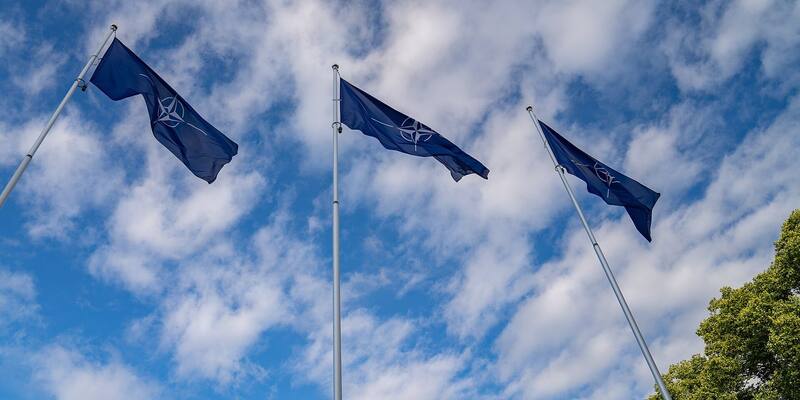
NATO flags flying outside Riga Castle, the residence of the President of Latvia, in July 2024 (illustrative). Image: Tony Webster / Wikimedia Commons, CC BY 2.0, cropped

NATO has used up to 300 billion tokens a month of OpenAI’s cyber defence models to protect allied networks, OpenAI said on Tuesday. The NATO Communications and Information Agency (NCIA) now gives the alliance’s core institutions access to the models through Daybreak, OpenAI’s programme for vetted defenders, putting a frontier AI lab inside NATO’s cyber defences.
What NATO is using OpenAI’s models for
Daybreak is the programme OpenAI uses to hand its most capable cyber models to checked and approved defenders for authorised security work: reviewing software, investigating suspicious activity, validating vulnerabilities and building and testing fixes. Ukraine’s Ministry of Digital Transformation already uses it to protect civilian infrastructure, after OpenAI opened it to Ukraine in September.
OpenAI said NATO’s usage reached up to 300 billion raw input and output tokens a month, and that the early work also helped build AI skills across the multinational teams that guard allied networks around the clock. Neither OpenAI nor the NCIA gave a price or contract value. The announcement came as NATO Edge 26, the NCIA’s yearly conference with industry, opened in İzmir, Türkiye.
“A generational leap in cyber security”
Dr Dylan Browne, the NCIA’s General Manager, was enthusiastic about the technology:
AI-powered cyber defence models represent a generational leap in cyber security. They accelerate vulnerability discovery, detect emerging threats at machine speed and enable defenders to stay ahead of adversaries.
Dr Dylan Browne, General Manager, NATO Communications and Information Agency
He was also clear that OpenAI is not guaranteed the business. NATO will watch how many tokens it burns and what they cost as it scales up, he said:
This insight will help us optimise costs, evaluate competing solutions and make informed procurement decisions.
Dr Dylan Browne, NCIA
AI agents at NATO’s Crossed Swords exercise
OpenAI also supported Crossed Swords 2026, the cyber exercise run by the NATO Cooperative Cyber Defence Centre of Excellence (CCDCOE) in Tallinn from November 2 to 6. More than 250 participants from over 40 NATO and non-NATO countries took part, and this year the exercise added a new training stream in which they designed, deployed and evaluated AI agents for cyber operations, working alongside them as operators.
The CCDCOE said the technical environment used on-premises AI and, for the first time, OpenAI Daybreak. Exercise director Jozef Kostelansky said timing cyber effects to support military action gets harder “because AI is now in the loop on both sides”: Google warned only on Monday that attackers have built AI that turns security patches into working exploits.
What the EU’s cyber agency found
OpenAI said it has also given access to the EU cyber agency ENISA and to national cyber agencies in France (ANSSI), Germany and Poland. It said ENISA used its models to find four vulnerabilities in software used across EU institutions, with fixes published for all four, and that CERT Polska used them to help find six flaws in MikroTik’s RouterOS router software.
ENISA’s own joint advisory with CERT-EU, published on November 12, gives a fuller picture. The agency scanned 27 codebases maintained by EU institutions, using OpenAI’s GPT-5.5, GPT-5.6 and Astra models through Daybreak, and also Anthropic’s Mythos 5 through Project Glasswing. The report does not say which model found which flaw.
- Findings: the models flagged 220 potential issues across the 27 codebases.
- Accuracy: code owners had assessed 88 of them by publication, and confirmed 95% as real; four new CVE IDs were assigned.
- Cost: about 611 million tokens and an estimated €6,649 in total, although ENISA got the models free under the companies’ access programmes.
- Catch: the models tended to overrate how severe their findings were, and checking them took expert time ENISA says is scarce.
“AI can help accelerate code review but cannot replace human judgement,” the report concludes.
Why it matters
A frontier AI lab is now part of the toolkit NATO uses to defend its own networks, at a time when some AI researchers are quitting over military work. NATO is treating it as a trial it can take elsewhere, and Europe’s own test shows the models find real flaws faster than humans can check them.
Sources: OpenAI, ENISA and CERT-EU, NATO CCDCOE.
Latest OpenAI news