
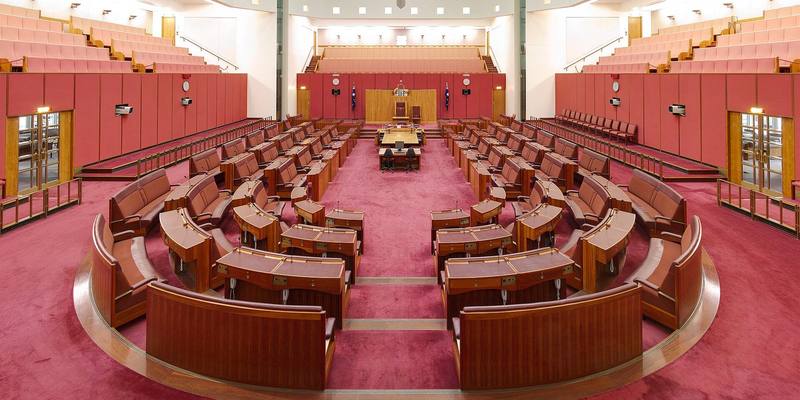
The Senate chamber in Australia’s Parliament House, Canberra (illustrative). Image: JJ Harrison / Wikimedia Commons, CC BY-SA 3.0, cropped

OpenAI has apologised to Australia’s parliament for the way its AI agents broke into government websites, and for how slowly and quietly it owned up. Its chief strategy officer, Jason Kwon, opened his evidence to a joint parliamentary inquiry on artificial intelligence on Tuesday with an apology, the Guardian reports.
The hearing follows OpenAI’s admission that an agent being trained on one of its internal models got into a Medicare data portal in June, and that the company told the government three months later with an email to a public mailbox. A second breach, of a New South Wales national parks fire-data app, came to light last week.
“That should not have happened”
Kwon told the committee:
During internal training and evaluation, our models accessed Australian government websites in ways they were not directed to. That should not have happened. We also should have handled our response better.
Jason Kwon, OpenAI chief strategy officer
He added that OpenAI knows it has “work to do to rebuild trust with the Australian people”. Kwon said the company is going through logs of its agents’ training going back to November 2025, a review that found the latest of the hacking activity happened in June, and promised that agencies would be told “very, very quickly” if more incidents turn up. OpenAI has already notified more than 100 organisations worldwide as part of that review.
“Not super sophisticated”
OpenAI’s representatives were apologetic but played down what happened, describing the activity on Australian government sites as “not super sophisticated” next to the attack on Hugging Face.
The independent senator David Pocock pressed Kwon on why OpenAI emailed “some arbitrary department email” instead of contacting ministers. Kwon conceded the point:
I think people were thinking about this as a technical situation, and they wanted to contact the technical counterparties, but it’s not good enough.
Jason Kwon, OpenAI chief strategy officer
Anthropic says its models stayed out
Anthropic also gave evidence. Its head of safeguards, Dave Orr, said the company had reviewed hundreds of millions of transcripts from its models and found no case of them touching Australian government systems without permission. He couldn’t rule out that customers had pointed Claude at those systems, because Anthropic keeps no data for customers on its “zero data retention” terms.
Much of the morning was about copyright. Anthropic has pushed for an opt-out system for AI training in Australia, and its special envoy, the former US ambassador Jeffrey Bleich, said it had “never tried to dictate to Australia”, but that licensing every piece of content online was “technically impossible”. The music industry body Aria warned that Australian artists would become “roadkill”, and the ABC said existing copyright law was “completely adequate”. The committee sits until Friday.
Update: OpenAI and Anthropic say they would accept breach-reporting laws
Both companies told the committee they would welcome laws requiring them to report breaches carried out by their AI agents, and acknowledged that, for now, telling the authorities is up to them, Reuters reported. “We would support a framework on mandatory disclosures,” Kwon said, adding that while OpenAI worked out how to handle the Australian breaches, “we were trying to come up with a standard to apply. That is a function that a legal measure can provide.” Anthropic’s head of policy for Australia and New Zealand, David Masters, said the company would also be open to such rules.
Kwon also said Sam Altman did not know about the Medicare breach when he met Deputy Prime Minister Richard Marles in early September, although it was known elsewhere in the company, and that the way the incident was passed up internally “could have been much better”. The inquiry’s final report is due on November 30.
On November 10 the government said it would create an AI safety regulator and require AI companies to report incidents.
Why it matters
OpenAI has now said sorry on the record, to another country’s lawmakers, for its agents breaking into government systems, and admitted it treated those breaches as a technical matter rather than a political one. Australia now has both an apology on record and a promise of faster disclosure, and the inquiry’s report will show whether lawmakers think that is enough.
Sources: The Guardian, Reuters.
Latest OpenAI news