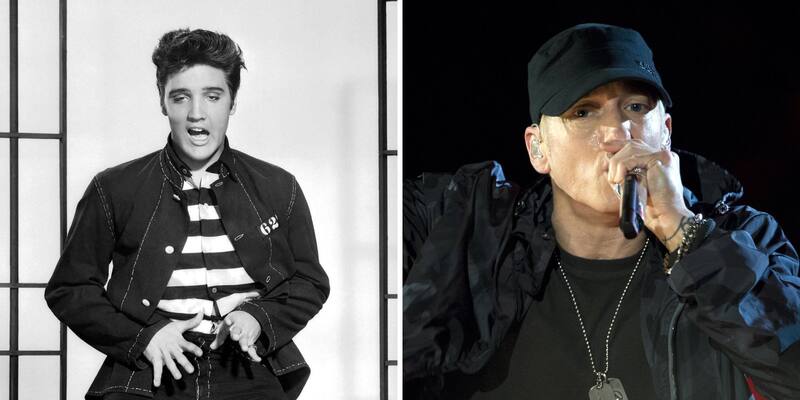
Elvis Presley in a 1957 publicity photo for Jailhouse Rock (left) and Eminem performing at the Concert for Valor in Washington, DC, in 2014. File photos. Image: Elvis Presley: Metro-Goldwyn-Mayer (public domain); Eminem: EJ Hersom, DoD News (public domain); both via Wikimedia Commons
Elvis Presley’s voice and Eminem’s songs are the latest weapons in the music industry’s fight with Suno. The company that owns Presley’s name and likeness, joined by the owners of hundreds of his and other artists’ songs, sued Suno in San Francisco federal court on Friday, November 6, saying its AI music generator clones the King’s voice. The same day, Eminem’s publisher Eight Mile Style filed its own suit over 269 of the rapper’s compositions.
Both cases were filed in the US District Court for the Northern District of California by Richard Busch of Adams & Reese, the lawyer behind the Presley owners’ suit against Anthropic two weeks ago and Reservoir Media’s case against Suno.
The ELVIS Act comes for Suno
The Presley complaint (case 3:26-cv-13398) goes further than the earlier publishers’ suits. Alongside copyright claims, Elvis Presley Enterprises, which owns Presley’s likeness rights, sues under Tennessee’s ELVIS Act, the 2024 law that protects artists’ voices and likenesses from AI imitation, and Tennessee’s common law right of publicity. The complaint says the state asked Presley’s rights holders for permission before naming the law after him, “something Defendant Suno, Inc., … does not know how to do.”
With ABG EPE IP, Aberbach family trusts, the Luigi Creatore trust, Abilene Music and Raleigh Music Publishing (owner of Chubby Checker’s ‘Let’s Twist Again’), it lists 859 songs, among them ‘Can’t Help Falling in Love’, ‘All Shook Up’, ‘Don’t Be Cruel’ and ‘If I Can Dream’.
The complaint says Suno will produce Presley’s voice without being asked for it. On October 7, it says, a prompt made only of lyrics (“I am rockin this rockabilly like E L V I S P R E S L E Y … He has left the building But he is still the King”) produced two tracks called ‘He Is Still The King’, each with “a copy of Elvis’ unmistakable and iconic voice”. It points to 33 recordings that use his voice, including ‘Elvis in The Jailhouse Rock’, which it says is still live on Suno with more than 125,000 plays.
Those examples are aimed at Suno’s own defence. In a November 3 motion to dismiss a suit brought by Jason Isbell and other musicians in Massachusetts, Suno told the court its outputs “do not replicate the auditory characteristics of any real artist’s voice to the point that someone would confuse a Suno creation with one actually sung by a particular famous musician”. The new complaint calls that “unequivocally false”.
The plaintiffs ask for up to $150,000 for each song wilfully infringed, which at the maximum would come to almost $129 million, plus treble and punitive damages under Tennessee law and more for getting round access controls and stripping copyright information. They also want Suno to destroy every unlicensed copy, including those in “training datasets, internal repositories, model weights, and server infrastructure”.
‘The next Elvis won’t pick up a guitar’
The complaint, signed by Busch, puts the stakes bluntly:
The next Elvis won’t pick up a guitar. Suno’s ravenous race to the bottom aims to make human creativity obsolete, coldly replicating without a license in seconds what takes years to learn, struggle with, maintain, and endlessly attempt to make better and perfect.
Richard Busch, lawyer for the Presley plaintiffs, in the complaint
Eminem’s publisher puts a price on it
Eight Mile Style’s complaint (3:26-cv-13399), filed with its affiliate Martin Affiliated, covers 269 Eminem compositions, including ‘Lose Yourself’, ‘Without Me’, ‘Till I Collapse’, ‘The Real Slim Shady’ and ‘Stan’. Eminem himself is not a plaintiff. It asks for $40.35 million in statutory damages at $150,000 a song, plus $672,500 for circumventing protection measures, just over $41 million, and a further $6.725 million for removing copyright management information: about $47.7 million in all.
Suno blocks some artist names in prompts, but the complaint says its guardrails “are easily circumvented”, pointing to a third-party app selling Eminem-style Suno prompts and to a Suno track called ‘Slim shady x Rosefalls’ with “a voice clearly derived from Eminem’s actual voice”. Both complaints quote Suno’s own admission that it trained on “essentially all music files of reasonable quality that are accessible on the open Internet”, and cite reports of leaked source code that they say shows Suno used Bright Data proxies to scrape YouTube Music, Deezer and Genius.
What Suno says
Suno has not yet answered either complaint in court. A spokesperson told the Detroit Free Press: “Suno exists to help people create new, original music, not to trade on anyone’s name or likeness, and we prohibit any unauthorized use of an artist’s work.” It added that it bars prompts naming specific artists or songs and has outside providers screen uploads.
Why it matters
Until now the independent publishers’ cases against Suno have been about copying songs. The Presley suit tests whether a state voice law named after Elvis can be used against an AI company, and it arrives days after Suno told another court that its music never sounds like a real singer.
Sources: Elvis Presley Enterprises v. Suno complaint, Eight Mile Style v. Suno complaint (N.D. Cal., via CourtListener); Detroit Free Press (Suno statement).
Latest More Labs news