
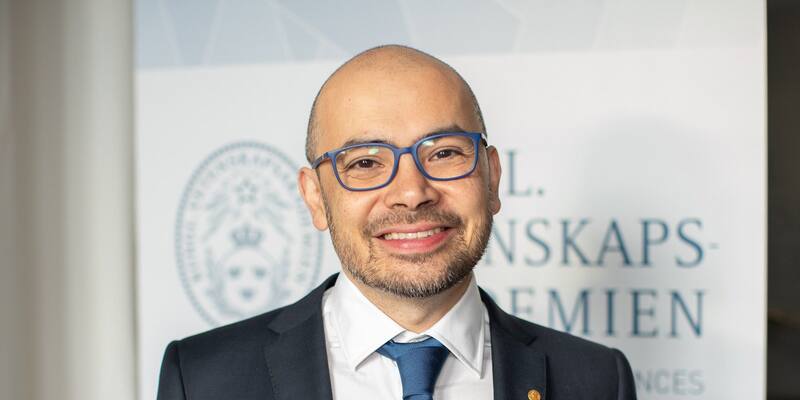
Demis Hassabis, founder and CEO of Isomorphic Labs, during Nobel Prize week in Stockholm in December 2024. Image: John Sears / Wikimedia Commons, CC BY-SA 4.0, cropped

Isomorphic Labs, the AI drug design company Demis Hassabis spun out of Google DeepMind, has raised $5 billion in a Series C round co-led by Greenoaks and Sequoia Capital, six months after raising $2.1 billion. None of its medicines has yet been tested in people. The London company says the money will push its first programmes towards clinical trials.
Who put in the money
Andreessen Horowitz (a16z) and “several other new investors” joined the round, Isomorphic said, with “continued significant investment” from its parent, Alphabet. Every existing backer came back: Thrive Capital, MGX, GV, CapitalG, Temasek and the UK Sovereign AI Fund. The company called the round oversubscribed.
Isomorphic didn’t disclose a valuation. Bloomberg reported earlier this month that the round would value it at about $50 billion. Its Series B in May, led by Thrive, raised $2.1 billion, and its first outside round, in March 2025, raised $600 million.
What the $5 billion is for
Everything at Isomorphic runs through IsoDDE, its in-house drug design engine, which combines several “foundational simulation AI models” meant to work across disease areas and types of drug. The company says those models, with “proprietary agents” that reason over biological systems, are “yielding positive preclinical results” in its own cancer and immunology programmes and with partners, “setting the stage for clinical entry”.
According to the release, the new money goes on:
- Models: maturing IsoDDE and expanding “deeper into new biology”.
- Partners: an ecosystem of partners to study how diseases work at the level of mechanism.
- Infrastructure: what it calls the “global infrastructure” for AI-led bioengineering.
- Trials: translational and clinical development capacity as its candidates head for human studies.
Hassabis told Bloomberg that Isomorphic has more than 20 programmes under way and wants “a platform to do hundreds of drugs a year”. He said it would move beyond small-molecule drugs into “pretty much all modalities”, including biologics. Its pharma partners include Eli Lilly, Novartis and Johnson & Johnson.
“Driving our first therapeutic programs towards clinical trials”
Hassabis, who shared the 2024 Nobel Prize in Chemistry for the protein structure model AlphaFold, said in the release:
Our drug design engine is generating molecules with unprecedented precision and speed. This round enables us to accelerate our progress: building foundational biology models, deepening our systemic disease understanding, and driving our first therapeutic programs towards clinical trials to deliver tangible impact for patients.
Sir Demis Hassabis, founder and CEO, Isomorphic Labs
Max Jaderberg, Isomorphic’s president, said its teams are “routinely solving complex biological problems that have stalled traditional research for decades”. Konstantine Buhler, a partner at Sequoia, told Bloomberg the firm backed Isomorphic because it has found scaling laws for its models: performance keeps improving with more computing power and data.
It is Isomorphic’s first round since Hassabis handed day-to-day control of Google DeepMind to Koray Kavukcuoglu in August; he is now DeepMind’s chair and Alphabet’s chief scientist, and still runs Isomorphic. Asked about chips after Jensen Huang quit Nvidia, he told Bloomberg: “We’ve got very secure compute pipelines.”
What isn’t proven yet
For all the money, Isomorphic is still a preclinical company. In January, Hassabis said he expected its first clinical trials by the end of 2026. He would not give Bloomberg a new date, saying only that its regulatory submissions are on track and there will be more to announce in 2027. Its claims about IsoDDE’s precision and results come from the company and have not been backed by published trial data, and no regulator has yet approved a drug designed by AI.
Isomorphic isn’t the only AI company chasing medicines. Anthropic is now developing its own drugs with Claude, and former OpenAI science chief Kevin Weil raised $215 million for a robot drug lab last month. Isomorphic is also one of the backers of the $1.8 billion Virtual Biology Initiative, which is building data for AI models of living cells.
Why it matters
Investors have now put $5 billion into a company with no drug in human trials, betting that AI can shorten the long, failure-heavy road to new medicines. The real test comes when Isomorphic’s first molecules reach patients, and this round doesn’t answer that yet.
Sources: Isomorphic Labs (Series C announcement and news release); Isomorphic Labs (Series B, May 2026); Bloomberg (Hassabis and Buhler interviews).
Latest Google news