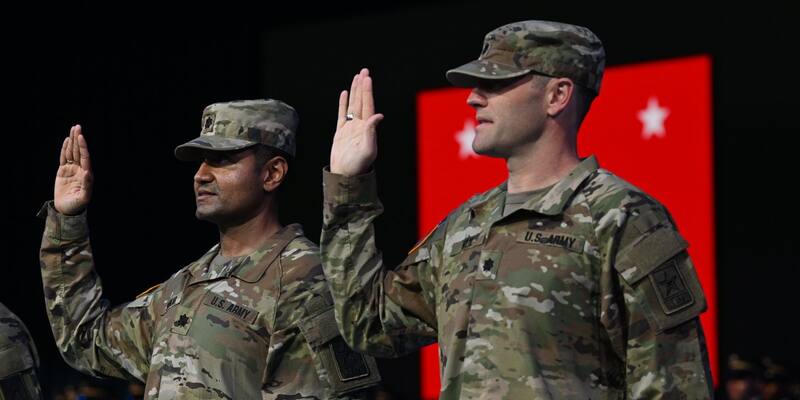
Kevin Weil (right) and Palantir’s Shyam Sankar, now a Warp Sciences investor, take the oath as Army Reserve officers in Detachment 201, June 2025. Image: U.S. Army photo by Leroy Council / Wikimedia Commons, Public domain, cropped
Kevin Weil, who ran OpenAI’s science push until April, has raised $215 million for a start-up that wants robots and AI to do drug chemistry work that drugmakers now mostly send to China. Warp Sciences came out of stealth on Thursday with a round led by Lightspeed Venture Partners, Bloomberg reported, and the company says the deal values it at $865 million including the new money.
Weil, Warp’s chief executive, said on X that the Series A will “bring frontier AI out of the browser and into the lab”. IVP, Premji Invest and Lux Capital also invested. The company hasn’t shipped a product yet.
What Warp wants to automate
Warp won’t try to discover drugs itself. It is going after the slog that comes after a promising molecule is found, when chemists make hundreds or thousands of variations of it to make it work better and cut side effects. Drugmakers have long outsourced much of that work to Chinese contract firms such as WuXi AppTec.
Warp plans to bring that step back to the US with a fully automated lab. Its team of about 20 has already bought robotic arms and AI chips, according to Bloomberg, and its chemists will wear cameras and pressure-sensing gloves during experiments so the company can collect the data it needs to train its own AI models. Warp hasn’t said where the lab will be or when it expects its first customers.
Relying on Chinese contractors has become politically awkward. In June the Pentagon added WuXi AppTec to its list of companies it says are linked to China’s military; a US judge blocked enforcement of that designation in August after WuXi sued.
“The models need to see that data”
Weil told Bloomberg that drug chemistry is “still an area where frontier AI models are not yet changing the world” the way they have changed coding and maths. His explanation:
That’s because the field is so much more experimentally driven. The models need to see that data.
Kevin Weil, chief executive, Warp Sciences, to Bloomberg
It is a bet that the next jump in AI for science will come from physical lab data rather than bigger models alone. OpenAI is chasing the same field from the software side: on Wednesday it showed thousands of GPT-Rosalind agents working through a mouse brain atlas in 32 minutes, while Anthropic’s Claude helped design scorpion antivenom proteins that two labs say work. Big funders are also paying for data: Zuckerberg’s Biohub, Google, Meta and the US government are pooling $1.8 billion for an AI “virtual cell”.
Who is behind Warp
Weil was OpenAI’s chief product officer before he moved to lead OpenAI for Science, the unit behind Prism, a workspace that brings frontier models into scientists’ writing and research. Earlier he was a product chief at Instagram and Twitter.
His co-founders are DJ Patil, the White House’s first chief data scientist under Barack Obama; Manohar Paluri, a former vice president at Meta Superintelligence Labs; and Solomon Reisberg, formerly of Terremoto Biosciences.
The angel investors are a who’s who of tech: OpenAI finance chief Sarah Friar and former OpenAI executive Fidji Simo, Coinbase chief executive Brian Armstrong, Palantir chief technology officer Shyam Sankar and LinkedIn co-founder Reid Hoffman.
The round is bigger than first planned. In August, Business Insider reported that Weil was trying to raise $150 million at a valuation of at least $750 million.
Why it matters
Warp is one of the biggest early bets yet that AI’s next leap in science needs robots and real experiments, not only chatbots. It also pitches AI as a way to pull a strategically sensitive part of drug development out of China, which is likely to win it friends in Washington. With no product yet, the $865 million price rests on Weil’s name and his team.
Sources: Bloomberg; Business Insider (August 2026).
Latest Business news