
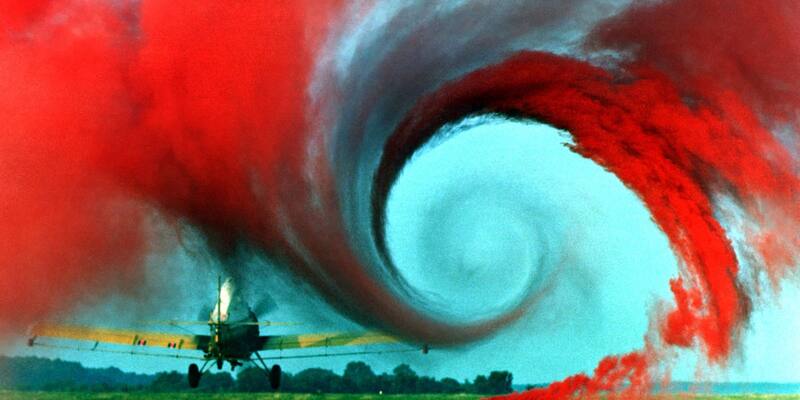
Coloured smoke shows the swirling wake vortex behind a crop-duster wing in a NASA wake vortex study at Wallops Island in 1990 (illustrative). Image: NASA Langley Research Center / Wikimedia Commons, Public domain, cropped

Two months after OpenAI beat them to a Navier-Stokes result, NYU mathematician Tristan Buckmaster and Anthropic researcher Levent Alpöge have posted a proof that the equations of flowing fluids can blow up in finite time with no outside force, the version of the $1 million Millennium Prize problem many mathematicians call the real one. They say Claude helped throughout. Nobody has checked it yet.
What the pair say they proved
The 79-page paper, dated November 20, says there are smooth starting flows, both in open space and in a box that wraps around on itself, whose solutions to the three-dimensional Navier-Stokes equations “without force blow up in finite time”: a measure of how sharply the fluid’s speed changes from point to point grows without limit. In the official wording of the Clay Mathematics Institute’s problem, written by Charles Fefferman, the authors say this disproves statements (A) and (B), which predict that smooth solutions always last, and so proves the breakdown statements (C) and (D).
The detail matters because of how OpenAI got there first. Its September proof relied on a finely tuned outside force that “stirs” the fluid, which Scientific American says many experts saw as a loophole in the problem’s wording. Clay’s breakdown statements allow such a force. The new paper claims blowup with none.
How it works, and what is still missing
The method follows what Terence Tao calls one of the expected paths to the result: compute an approximate, repeating, self-similar flow on a computer, then use rigorous estimates to show that a true solution sits nearby. That approximate solution, which the paper calls a certificate, is not public yet. The paper gives only a hash of it and says it “will be released soon”. Checking that it meets the paper’s conditions takes a separate 128-bit interval arithmetic calculation, which is neither in the repository nor part of the formal proof.
The main theorems have also been written in Lean, the proof-checking language, in a package of about 2,270 files and 600,000 lines. But the repository’s notes say a patch was applied on November 20 and “the patched package was not rebuilt” before release. Buckmaster explained the rush in a Mastodon post on Friday:
After last time, we couldn’t risk waiting, so the Navier–Stokes write-up is unpolished and heavily LLM-assisted. Fortunately, once the numerical profile is in hand, the proof follows a well-trodden computer-assisted path.
Tristan Buckmaster, NYU mathematician, on Mastodon
“Heavy AI usage”
The paper’s AI statement is blunt: “We used Anthropic models (Claude) throughout this work, and no others.” The authors say AI agents were given “a curated dossier of potential leads”, built on their own unreleased drafts about forced versions of the equations. A first draft of the paper was generated from an early Lean proof, then rewritten with Claude “under our direction” until it no longer followed that proof step by step. The acknowledgements thank Anthropic for supporting the collaboration.
A second paper, written with Matei Coiculescu, claims blowup for the unforced Euler equations, the friction-free cousin of Navier-Stokes. That one was written with both Claude and OpenAI’s Codex, and its README says its Lean proof has no unproved steps. A “provenance” section says Alpöge and Buckmaster already had an unreleased proof using “the same” amplification mechanism as OpenAI’s own unforced Euler paper before OpenAI published it.
Tao, a UCLA mathematician, listed both results on his blog and rated the Euler paper the more “digested” of the two. On Navier-Stokes he wrote:
the paper is technically human-readable and the general strategy of proof is broadly clear … but more work needs to be done to create a proper, professionally written proof.
Terence Tao, UCLA, on his blog
Two giant claims in one day
The papers landed hours after Alpöge claimed a Lean-only proof of the Riemann Hypothesis made with an internal AI model, also still being checked. They reopen Buckmaster’s row with OpenAI over credit: he has accused the company of racing to beat him after learning of his work, which OpenAI denies. OpenAI hasn’t commented on the new papers.
No independent mathematician has yet said publicly that the Navier-Stokes proof is correct, and even a correct proof would not bring a quick prize: Clay’s rules require publication and two years of general acceptance first. Checkers are already stretched by OpenAI’s 722 AI-written papers, and Fields medallists have asked labs to stop testing maths on models nobody else can use.
Why it matters
If it holds up, this settles one of the most famous problems in mathematics in its strongest form, with Claude credited as a working partner. But the key computation is still unpublished, so for now it is a claim that only the release of the certificate and weeks of expert checking can confirm.
Sources: Alpöge and Buckmaster, “Finite-time blow-up for the Navier–Stokes equations” and its GitHub repository; Alpöge, Buckmaster and Coiculescu, Euler blowup paper and Lean formalisation; Tristan Buckmaster on Mastodon; Terence Tao’s blog; Scientific American; Clay Mathematics Institute rules.
Latest Anthropic news