
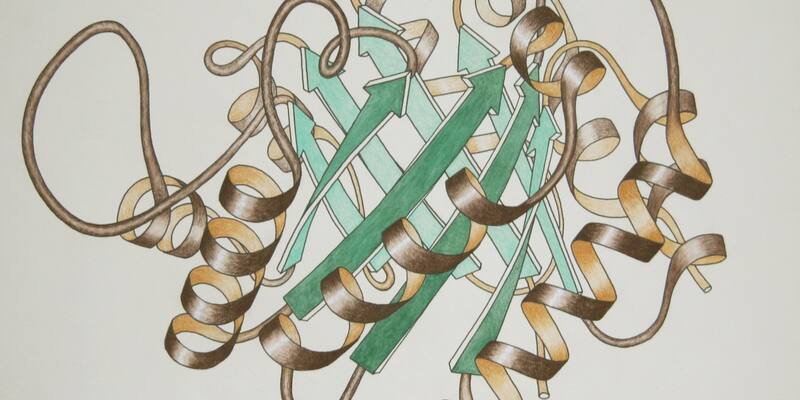
Jane Richardson's hand-drawn ribbon diagram of the protein triosephosphate isomerase, made in 1981 and still the standard way protein structures are shown. Illustrative: it is not one of the proteins in OpenAI's study. Image: Jane Richardson / Wikimedia Commons, CC BY 3.0, cropped

OpenAI says its general-purpose GPT-6 models can design new proteins without calling on specialist biology software, and a partner lab has made some of them. In a preprint announced on Tuesday, the company says 35 of 322 small proteins built from GPT-6.2’s designs stuck to their intended targets, among them a protein cancers use to hide from the immune system.
35 hits from 322 lab-made designs
OpenAI gave GPT-6.2, the model it launched last week, the three-dimensional structures of five target proteins and marked where a minibinder, a small protein designed to stick to something, should attach. The model wrote and ran code to work out the shapes, with no protein-specific AI involved at that step. Its research partner Onava, an AI drug discovery startup, made 322 of the resulting proteins and tested them.
Thirty-five of them, or 10.9%, tested positive for binding: 18 against IL-17A, eight against VEGF-A, five against PD-L1, three against IL-7Rα and one against TrkA. OpenAI notes that the original study behind RFdiffusion, the specialist tool researchers normally use for this step, reported higher hit rates, and says such rates depend heavily on how strictly designs are filtered before testing and on how binding is defined. Anthropic made a comparable claim in October, when a research firm said two labs had confirmed 17 of Claude’s designed binders against scorpion toxins.
Rewritten antibodies kept their grip
GPT-6.2 was also asked to write amino acid sequences itself. Given six small antibodies that bind IL-4Rα, with the three loops that do the gripping removed, 128 of 182 designs (70%) showed binding. For fragments of five therapeutic antibodies, where the model was told to change about half the amino acids in each loop, 179 of 272 (66%) still bound PD-1 or PD-L1.
Asked to produce fresh sequences for minibinder shapes whose originals were hidden from it, the model scored 75 of 88 for MDM2, 26 of 42 for VEGF-A and 8 of 59 for PD-1. The sequences often differed from the originals across roughly half their length, which OpenAI reads as evidence the model is not simply recalling what it has seen.
Specialist models still did part of the work
The claim is narrower than “no biology models”. A specialist model called SolubleMPNN supplied the amino acid sequences for GPT-6.2’s shapes in the first experiment, and Boltz-2, OpenDDE and ESMFold2 picked which candidates went to the bench. The results, the paper says, “do not yet establish that our models can generate de novo minibinders end-to-end in a zero-shot setting without help from specialized models”.
Predicting a whole protein’s structure from its sequence remains a weak spot: OpenAI’s best internal model averaged a TM-score of 0.38 against 0.93 for ESMFold2, where 1 is a perfect match. The company also warns that unusually high accuracy on some tests “may partly reflect memorization”. None of it has been peer reviewed or checked by an outside lab, the preprint itself has not been posted publicly, and the code repository the announcement links to is not reachable.
The biosecurity question
OpenAI says the capabilities that help design medicines “could also be misused”, and that its Preparedness Framework guides how it assesses the risk and tests safeguards. That is the live worry about moving protein design into a model anyone can prompt in plain English: specialist design tools sit behind lab accounts, ordering checks and DNA synthesis screening, while a chatbot sits behind a login. Google DeepMind has gone the other way, building a watermark that survives into the real molecule, and OpenAI and Anthropic have pledged £200 million of AI to Britain’s bioweapons and pandemic work.
Why it matters
Protein design has belonged to purpose-built models such as AlphaFold and RFdiffusion, run by people who know how to chain them together. A general model that does the shape-making step and takes its instructions in plain English would widen that field considerably, for good and for ill. It is also OpenAI’s second big science claim this week, after a preprint arguing there is a hard speed limit on multiplying matrices, and like that one it is waiting on anybody outside the company to check it.
Sources: OpenAI, GPT-6 models demonstrate intrinsic protein-design capabilities (November 24, 2026), reporting the preprint “GPT-6 as a Universal Foundation Model for Protein Biology: Beyond Specialized Models”; Onava.
Latest OpenAI news