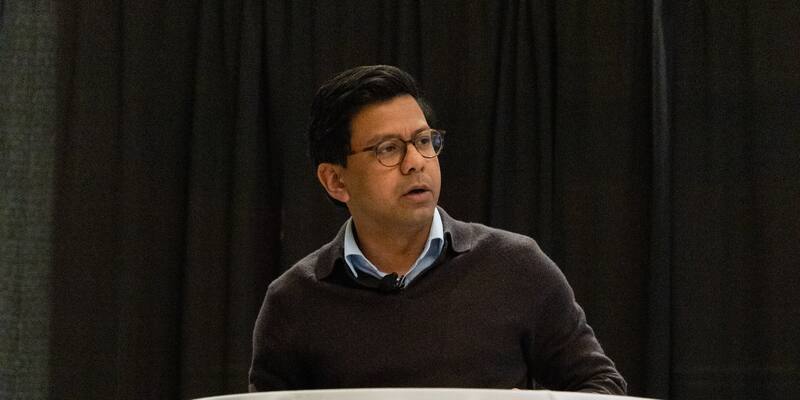
UK AI minister Kanishka Narayan, pictured speaking at SXSW in Austin, Texas, in March 2025, before he took the role. Image: Bea Phi / Wikimedia Commons, CC BY-SA 4.0, cropped

OpenAI and Anthropic have pledged up to £200 million (about $268 million) in AI to a new British lab built to spot biological threats early and speed up vaccines, against the kind of risk the government says more capable AI could itself create. The UK government unveiled the AI Biosecurity Lab just after midnight UK time on Saturday, calling it “the world’s first dedicated AI biosecurity organisation,” backed by £100 million of public money on top of the companies’ pledges.
The Cabinet Office says the lab, known as AIBL, will be an independent non-profit set up under a new National AI Biosecurity Initiative. Its mission is to harness frontier AI to help Britain “understand, prevent, detect and respond to biological threats,” including risks “enabled by advances in AI.”
What OpenAI, Anthropic and Google are giving
The £200 million is not cash. According to the government:
- OpenAI will provide £100 million in compute and model credits, plus trusted access to its most capable relevant models through Rosalind Biodefense, its programme that gives vetted biodefence developers its gated life sciences model, GPT-Rosalind.
- Anthropic will provide up to £100 million in model credits, trusted model access and dedicated technical support.
- Google DeepMind scientists and biosecurity experts will work with the lab on research, and Google “will look to provide” trusted access to its frontier Gemini models and specialised science models.
- Basecamp Research, a British AI biology company, will open up its models and technical expertise for “priority biosecurity challenges.”
The labs have been showing off what their science models can do. This week OpenAI ran thousands of GPT-Rosalind agents through a mouse brain atlas in 32 minutes, and Anthropic says Claude designed proteins that bind scorpion toxins, an early step towards new antivenoms.
What the lab will actually do
At first AIBL will focus on two jobs: catching emerging biological threats earlier, and speeding up the discovery, development and testing of vaccines, treatments and other medical countermeasures. It will work with the UK Health Security Agency (UKHSA), the Animal and Plant Health Agency and the Defence Science and Technology Laboratory (Dstl), as well as Britain’s national biosecurity centres and life sciences companies. It will also help the medicines regulator, the MHRA, prepare for health emergencies and “inform the regulation of AI-designed medicines.”
The government says the lab is modelled on the AI Security Institute, the state body that tests frontier models for dangerous behaviour: it will hire industry and academic talent and run with enough autonomy “to move with the speed and focus of a frontier AI-bio company.” A scientific advisory committee will follow “in due course.” The announcement names no director, location or opening date, and says the government wants philanthropists to fund the lab as well.
Part of a £600 million AI security push
The lab is the biggest piece of a wider package worth about £600 million ($800 million), Reuters reported, including £65 million to develop countermeasures against pathogens, an extra £120 million for the AI Security Institute and £130 million for cyber defence. More is due in next week’s Budget, PA Media reported.
AI minister Kanishka Narayan, who earlier this month told AI labs not to release systems they can’t control, said the aim was for the lab to become a major global institution “bringing together world-leading scientific expertise to protect people from emerging biological threats.”
The same companies on both sides of the risk
The deal puts the labs whose models raise the biological risk at the heart of the defence against it. The government’s own announcement warns that “increasingly capable AI systems also create new biological risks and could lower barriers to harmful activity.” OpenAI says it has treated its models as “High Capability” in biology since July 2025, with extra safeguards, and Google DeepMind has built a watermark into AI-designed proteins so DNA screeners can spot them.
It also comes a month after the White House asked OpenAI and Anthropic to keep new models from Britain’s AI Security Institute until the US tests them first. The new deal promises a British body trusted access to models from both companies, though the government has not said which models or how soon.
Why it matters
Britain is betting that the best defence against AI-enabled biological threats is to point the same frontier models at early warning and vaccines, with the companies covering much of the cost in credits rather than cash. Whether it works depends on details still missing: who runs the lab, where it sits and what “trusted access” to the most capable models really means.
Sources: UK government (Introducing the AI Biosecurity Lab), OpenAI (Rosalind Biodefense), Reuters, PA Media.
Latest Policy & Safety news