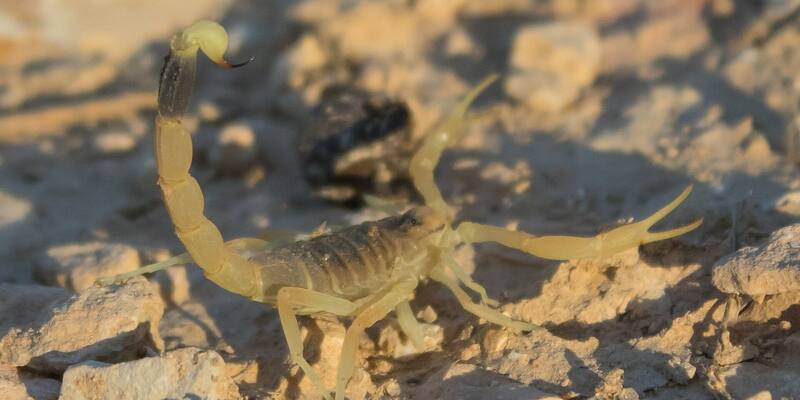
A deathstalker scorpion (Leiurus), the source of LqhIII, one of the five toxins Claude's designs targeted. Photographed in Israel in 2015. Image: מינוזיג (Minozig) / Wikimedia Commons, CC BY-SA 4.0, cropped

Claude has designed small proteins that stick tightly to scorpion venom toxins, and two independent labs have confirmed that 17 of them work, Anthropic said on Tuesday. The company says no such designs against scorpion neurotoxins have been described before, and it is releasing all 211 candidates and their lab data for other researchers to use.
The project began with a question from an unlikely source. Citrini Research, a financial investment research firm, asked whether AI could let a group of motivated non-experts take on a genuine problem in human health. Anthropic's life sciences team brainstormed with Claude and landed on antivenom.
Why scorpions
Scorpions sting at least 1.2 million people a year and kill more than 3,250, mostly children in regions with limited access to hospitals. Existing antivenoms are made by milking venom from thousands of scorpions, immunising horses with it and purifying the antibodies, a process that takes months. They work only against a small number of toxins, and in many of the places where stings happen they are expensive or simply unavailable. Scorpion envenomation is classed as a neglected tropical disease.
Anthropic picked five toxins known to be dangerous to people, from scorpions in Mexico, Brazil, North Africa and the Middle East. The goal was a binder, a small protein that latches onto the part of a toxin that attacks nerve cells, stopping it before it does damage. Unlike horse antibodies, designed binders can be engineered for stability and made at scale.
What Claude actually did
An unreleased internal research model, running inside Claude Science, worked largely on its own for 64 hours from a single prompt and four follow-ups. It chose which toxin structures to work from, picked the targets on each one, generated 318,484 candidate designs and narrowed them to 180. Anthropic's team added 31 more. Claude analysed the results, produced the figures and drafted the final report.
Adaptyv Bio and Twist Bioscience, two contract research organisations, made all 211 designs and measured whether they bound. Anthropic set a strict bar: a design had to show binding at both labs, in every repeat, and show nothing against an unrelated human protein. Seventeen cleared it. The two best, aimed at a toxin from the Mexican scorpion Centruroides noxius, bound in the single-digit nanomolar range and appear to attach at the same spot as an antibody already shown to protect mice.
The ambitious part failed. None of the 151 designs meant to grab two or more toxins at once met the bar for more than one. Among the designs aimed at a single toxin, 11 of 60 worked, about 18 percent, which Anthropic notes is in line with ordinary protein design campaigns rather than above it.
'Binding itself is no longer the main bottleneck'
Anthropic sent the work to two outside scientists, who called it a promising first step while being blunt about what is left:
Designing a binder against almost any target no longer seems unrealistic. We can now obtain very tight binders remarkably quickly, and binding itself is no longer the main bottleneck. The challenge is to use these extraordinary tools to develop molecules that can become real drugs, ones that are safe, affordable, and widely accessible.
Susana Vázquez Torres, postdoctoral researcher, Spanish National Cancer Research Centre
Anthropic is careful not to oversell it. The designs were tested against lab-grown copies of the toxins, not venom. Nobody has checked whether they stop a toxin working in cells, let alone whether they protect an animal. "We do not claim to have produced an antivenom," the company writes.
The safety classifier got in the way first
Citrini's own account of the collaboration contains a detail that says something about how AI biology work is now policed. Its first attempt was blocked by Anthropic's biosecurity filter, and the firm was sent a questionnaire with more than 60 questions about security measures it did not have. The fix was to do the prompting in person at Anthropic's offices, on the company's own machines and network. Anthropic has been tightening these controls as its models get better at biology, and it published a Claude-discovered CRISPR-like system last month under similar supervision. Google DeepMind has gone further still, building a watermark that survives inside AI-designed proteins.
Why it matters
This is the clearest case yet of an AI model being pointed at a disease the drug industry ignores because there is no money in it, and producing something a lab can verify in weeks. Whether any of it reaches a child stung in rural Mexico depends on the slow, expensive parts of medicine that no model can shortcut.
Sources: Anthropic, Anthropic technical report (PDF), Citrini Research
Latest Anthropic news