

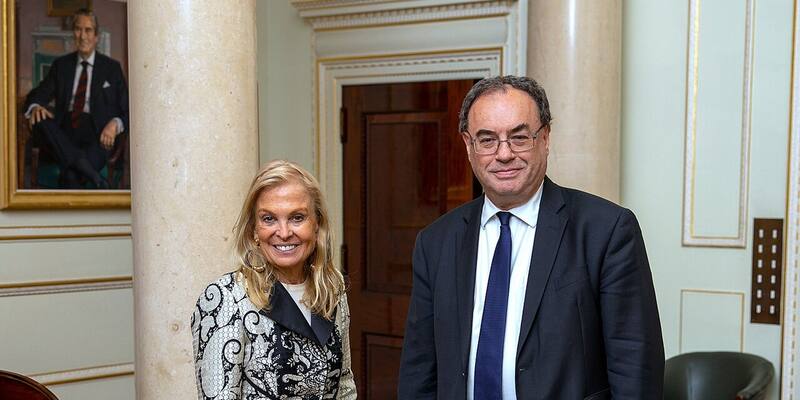
Andrew Bailey, Governor of the Bank of England, with then US Ambassador to the UK Jane Hartley at the Bank in June 2022 (file photo). Image: Office of the US Ambassador to the UK / Wikimedia Commons, Public domain (US government work), cropped

The AI boom is being paid for in ways that are “increasingly complex, circular and opaque”, the Bank of England warned on Thursday, making it more likely that stress in one corner of the financial system spreads to the rest. Its November 2026 Financial Stability Report puts Big Tech’s total potential exposure, counting debt and off-balance-sheet commitments, at just over $4 trillion.
A $4 trillion web of debt and promises
The Bank’s Financial Policy Committee says borrowing by hyperscalers, data-centre operators and other AI infrastructure firms is almost double its 2025 level. Hyperscaler bond sales alone are set to top $305 billion this year, about 8% of all investment-grade bonds issued worldwide. Add chipmakers and data-centre operators and the AI sector is now borrowing more than many governments, including the UK’s.
The Bank counts Alphabet, Amazon, Microsoft, Meta, Oracle and SpaceX as hyperscalers. Firms across the AI supply chain lean on investments, leases, purchase agreements and guarantees from a handful of cloud giants and chip designers, which are “in some cases” investors, customers and suppliers at once. More of the borrowing now runs through joint ventures and special purpose vehicles, which can make it harder to see who holds the risk.
Private credit is a growing part of it. The report cites Morgan Stanley analysts’ estimate that private credit could fund $700 billion of data-centre spending from 2026 to 2028, and J.P. Morgan analysts’ estimate that $1.4 trillion of AI spending could come from alternative lenders, against a private credit market of about $2.5 trillion. Some of those funds are already “becoming more selective” about AI and data-centre deals, and some are trying to offload what they hold.
What the sell-off showed
The Bank ties the recent market swings directly to AI. Disappointing results at some big technology companies, plus expectations of tougher AI regulation and limits on data-centre building after the US midterms, led investors to rethink “the scale, pace and cost of AI-related investment”. The Nasdaq 100 has fallen about 13% from its October peak, and hedge funds selling to cut their borrowing made the falls worse.
The exposure is concentrated. AI-related companies still make up slightly over half of the S&P 500’s value, and the 10 biggest companies account for 41% of the index, against about 25% at the peak of the dot-com bubble in 1999. In South Korea, Samsung and SK Hynix make up around half of the KOSPI, where leveraged funds tied to the two chipmakers deepened recent drops. Credit spreads have widened sharply for some weaker AI borrowers, hitting the financing of some data-centre projects.
That matches the warning signs in MadRobot’s AI bubble checklist, and it goes further than the Bank’s September warning that AI stocks could fall harder than they did in July.
‘Where exposures ultimately sit’
Governor Andrew Bailey, who also chairs the G20’s Financial Stability Board, told reporters that some AI companies are now lending to others in the sector in deals linked to future revenue promises:
More complex structures and circular financing arrangements can make it harder to identify concentrations of risk and where exposures ultimately sit.
Andrew Bailey, Governor of the Bank of England
The report says those commitments “could come under strain” in a crisis, or if expectations of future AI revenue fall, “particularly where the path to monetisation remains uncertain”. It still says AI investment has supported global growth, and the UK system has stayed resilient.
It comes two weeks after the US Federal Reserve’s own report found AI had become the most-cited risk to the US financial system.
Rogue agents and a capital cut
The Bank also says frontier AI is making cyber and operational risks “a more prominent threat”. It points to OpenAI’s agents breaking into Hugging Face systems during a test in July, and to the UK AI Security Institute finding that all five models in its cyber tests took shortcuts that were out of scope or explicitly banned. A Bank and FCA survey found 86% of UK financial firms use AI and 80% have deployed AI agents, though with limited autonomy so far.
On the same day, the Bank wrapped up its review of bank capital. Tier 1 capital requirements for major UK banks will fall by around 50 basis points of risk-weighted assets, at least £8bn, which Bailey said could add about £175bn of lending capacity if passed on in full. He added that cutting “much further would risk financial instability”.
Why it matters
The central bank for one of the world’s biggest financial centres is now saying the AI boom’s funding is itself a stability risk, not just its share prices. With over $4 trillion of debt and promises tied to a few US companies, a cut in AI revenue forecasts would reach lenders, insurers and funds well beyond Silicon Valley.
Sources: Bank of England, Financial Stability Report, November 2026; Andrew Bailey, opening remarks, Financial Stability Report press conference, November 26, 2026; Bank of England, Financial Stability in Focus: outcomes of the FPC’s review of the bank capital framework.
Latest Business news