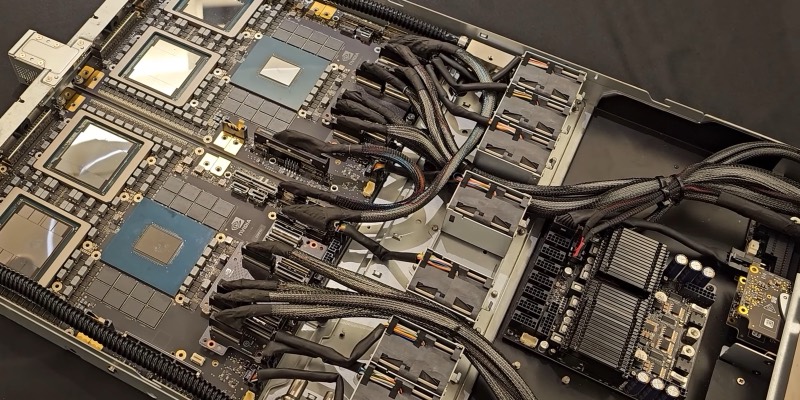
Illustration. Image: MadRobot
As of October 17, 2026, the AI bubble has not popped, but it is wobbling: AI chip and data centre stocks have had two sharp sell-offs this year, and the International Monetary Fund now names an AI market correction as one of the biggest risks to the global financial system in its October Global Financial Stability Report. What hasn't happened yet is the thing that ends a bubble: the money pouring in has not stopped.
Below: the signs to watch, where each stands now, and what stage the boom is at. We'll keep it updated.
Last checked: October 17, 2026, against the IMF's October 2026 Global Financial Stability Report, the Bank of England's September 2026 Financial Policy Committee record, the Federal Reserve's May 2026 Financial Stability Report, and Nvidia's, Alphabet's and Meta's latest results.
Is the AI bubble popping right now?
Not yet, on the evidence so far. A bubble pops when prices fall and keep falling because the buyers have run out, and that is not what 2026 looks like. Prices have dropped hard twice and then recovered, while spending has kept going up.
- July: AI company shares "fell sharply", and the fall was made worse by leveraged investors being forced to sell, according to the Bank of England's Financial Policy Committee record. Markets kept working and there was no wider crisis.
- October 14 and 15: AI stocks fell again after US inflation came in hotter than expected and traders bet on more interest rate rises. The pressure centred on heavy borrowers building data centres: CoreWeave fell 15% in a day and Oracle nearly 9%, and both companies' bond yields hit record highs. Even so, the Nasdaq was only about 3% below the record it set the week before.
The cracks are in the most indebted corners of the boom, not yet in demand for AI chips.
Signs the AI bubble is bursting: the checklist
These are the signs economists, central banks and investors watch most closely, with where each one stood on October 17, 2026.
| Sign | What to watch | Where it stands |
|---|---|---|
| Big Tech cuts AI spending | Alphabet, Amazon, Meta and Microsoft lowering their capital spending plans | Not happening Alphabet raised its 2026 range to $195 billion to $205 billion in July; Meta narrowed its range upwards to $130 billion to $145 billion |
| Nvidia's growth stalls | Chip sales slowing, or a weak forecast | Not happening Revenue up 106% to $96.2 billion last quarter, with $108 billion forecast for the next |
| AI stocks fall and stay down | Sell-offs that don't recover | Wobbling Sharp falls in July and mid-October, but the Nasdaq hit a record in between |
| Debt stress at weaker players | Rising bond yields and default insurance costs at data centre builders | Showing CoreWeave's and Oracle's bond yields hit records in October |
| Circular deals unwind | AI firms that fund each other cancelling or cutting deals | Building up The IMF counts $1.4 trillion of revenue promises tied to these deals; none has unwound yet |
| AI revenue doesn't show up | Paying customers failing to keep pace with spending | Mixed Revenue is growing fast at the big labs, but so are their losses and compute bills |
| IPOs and funding rounds get pulled | Big listings delayed or priced lower | Watch Anthropic's IPO has no date yet and has slipped once |
| Interest rates rise | Higher rates make borrowing to build data centres dearer | Showing Traders are betting on more US rate rises; the IMF warns government bond yields are climbing |
| Regulators sound the alarm | Central banks and the IMF warning about valuations | Showing The IMF, the Bank of England and the Federal Reserve have all flagged AI |
Green means no sign of trouble, amber means mixed, red means the warning sign is present.
The money is still flowing in
The biggest sign a bubble is ending is the spending stopping, and it hasn't. Meta's second-quarter results say it now expects 2026 capital spending of $130 billion to $145 billion, "narrowed from our prior outlook of $125-145 billion". Alphabet lifted its own 2026 range from $180 billion to $190 billion to $195 billion to $205 billion when it reported in July, and said spending would rise "significantly" again in 2027.
Nvidia's results for the quarter to July 26 showed data centre revenue of $89 billion, up 117% on a year earlier. Chief executive Jensen Huang said "demand is accelerating".
The debt is where the worry is
What has changed in 2026 is how the boom is paid for. Big Tech is increasingly borrowing to build. The Bank of England's committee cited Morgan Stanley estimates of about $450 billion of AI-related debt issued worldwide by early September, more than double the whole of 2025, and warned that "increasing leverage, opacity and, at times, 'circular arrangements'" could "amplify losses if expectations disappointed". We covered that warning in full.
The IMF went further. Its blog on the report says a review of 14 deals since 2023 between the cloud giants and AI firms "found about $300 billion in equity investments and $650 billion in debt" in exchange for "$1.4 trillion in future revenue commitments". If one of the key companies hit trouble, it warns, revenue forecasts and valuations would fall, "weakening the value of the accumulated debt in those deals". Anthropic's own IPO paperwork shows $518 billion of compute bills, around 80% of them non-cancellable, which is the kind of commitment the IMF means.
What stage is the AI bubble at?
Economists often describe bubbles in five stages, a model built on the work of Hyman Minsky and Charles Kindleberger:
- Displacement: a new technology changes what seems possible. For AI, that was ChatGPT in late 2022.
- Boom: money rushes in and prices climb steadily. Roughly 2023 to 2025.
- Euphoria: caution goes out of the window, borrowing soars.
- Profit-taking: early investors start selling, and prices get jumpy.
- Panic: prices fall, lenders pull back, and forced selling feeds on itself.
Measured against that, 2026 has features of stages three and four. Borrowing is surging and prices are high, the Federal Reserve's May Financial Stability Report says the ratio of S&P 500 share prices to earnings "stayed in the upper range of its historical distribution", and two sharp sell-offs show investors getting nervous. There is no sign of stage five: no lender has pulled out, and the biggest buyers of AI chips are still raising budgets. But a boom can sit in these stages for years, and it's only clear afterwards which wobble was the last.
AI bubble vs the dot-com bubble
The comparison everyone reaches for is 2000, when internet stocks collapsed. The two booms differ in one big way: profits. In 2000 many of the hottest companies had no earnings at all. Today the companies spending the most, Alphabet, Amazon, Meta and Microsoft, are among the most profitable businesses in history, and Nvidia keeps about 75 cents of every dollar of sales as gross profit.
The similarities are uncomfortable, though. Before 2000, telecoms equipment makers lent to their own customers so they could buy more kit, and were hit twice when those customers failed. The IMF's "circular financing" warning describes the same pattern: chip makers and cloud giants investing in AI labs that spend the money on their chips and cloud. And as in 2000, a handful of companies make up a large share of the US market.
Bank of England governor Andrew Bailey made the point in an interview with the BBC on October 1: the technology can be real and still produce losers, because "everybody is currently priced to be a winner". Looking back at the early internet, he said:
Nobody can remember Netscape today. It doesn’t exist. So not everybody always wins.
Andrew Bailey, Governor of the Bank of England, to the BBC
What happens if the AI bubble bursts?
The IMF's report says weaker AI investment or profits "could lead to a correction in AI-related asset prices", and that "corrections could be amplified by rising leverage and concentrated exposures". In practice, a burst would most likely mean:
- Pensions and savings fall: index funds, 401(k)s and workplace pensions hold large amounts of AI-linked shares.
- Lenders take losses: private credit funds and banks that lent to data centre builders would be hit first. The IMF's stress test found banks holding 22% of global banking assets would fall below their capital limits in its adverse scenario, up from 18% a year earlier.
- Government borrowing gets harder: the Bank of England warns that because growth forecasts lean on AI productivity gains, a rethink "could therefore affect not only AI-related asset valuations but also sovereign debt markets".
- Slower growth: data centre building has been propping up US growth, so jobs well beyond tech would feel it.
- Dearer or scarcer AI tools: if cheap money dries up, AI companies would be under pressure to cut free tiers, raise prices or shut weaker products.
AI itself wouldn't disappear, any more than the internet did after 2000.
Is the AI bubble bursting in the UK, Europe and Asia?
The boom is centred on US shares, but it isn't a US-only risk:
- South Korea: Samsung and SK Hynix make the high-bandwidth memory AI chips need, and they dominate the Kospi index, which is why Korean shares have swung hardest in each AI sell-off this year.
- Taiwan: TSMC makes almost every advanced AI chip, so any slowdown in orders lands there quickly.
- Japan: SoftBank is one of OpenAI's largest backers.
- UK: AI hyperscalers accounted for 47% of sterling corporate bond issuance this year, the Bank of England says, and British data centre firms such as Nscale are heading for the stock market.
- Europe, Canada and Australia: chip toolmakers such as the Netherlands' ASML depend on AI chip demand, and big pension funds hold large stakes in US tech.
The IMF says the risks could compound: an AI correction, rising government bond yields and a major cyberattack might each be manageable alone, but not all at once.
When will the AI bubble burst?
Nobody knows. Bubbles usually end when something forces the money to stop: rates rise, a big borrower fails, or the biggest spenders blink. What to watch next:
- Late October 2026: Alphabet, Amazon, Meta and Microsoft report third-quarter results. Any cut to spending plans would be the clearest sign yet.
- November 2026: Nvidia's next results, measured against its $108 billion forecast.
- US interest rate decisions: more rate rises would make the borrowing behind the boom dearer.
- Anthropic's IPO: a listing at or above its hoped-for $2 trillion valuation would suggest investors' appetite is intact; a delay or a cut price would not.
- Data centre debt: bond yields and default insurance costs at CoreWeave, Oracle and other heavy borrowers.
AI bubble FAQ
Frequently asked questions
Is the AI bubble popping?
Not yet. As of October 17, 2026, AI stocks have had sharp sell-offs in July and mid-October, and the most indebted data centre companies are under strain, but Big Tech is still raising its AI spending and Nvidia's sales are still growing fast.
Is the AI bubble real?
Central banks take the risk seriously. The IMF, the Bank of England and the US Federal Reserve have all warned that AI share prices rest on optimistic profit expectations and growing debt. Whether it is a bubble will only be clear afterwards: the technology is real, but valuations could still be too high.
What are the signs the AI bubble is about to burst?
The big ones are Big Tech cutting its data centre spending, Nvidia's sales growth stalling, sell-offs that don't recover, debt trouble at heavily borrowed data centre builders, and AI firms that fund each other cancelling deals. In October 2026 only the debt stress and rising interest rates were clearly showing.
When will the AI bubble burst?
No one can say. Watch Big Tech's results in late October 2026, Nvidia's results in November, US interest rate decisions and Anthropic's IPO. Bubbles usually end when the money stops flowing in, and so far it hasn't.
What stage of the AI bubble are we in?
Using the classic five-stage bubble model (displacement, boom, euphoria, profit-taking, panic), 2026 shows signs of euphoria and profit-taking: heavy borrowing, high valuations and nervous sell-offs. There is no sign yet of the panic stage.
Is the AI bubble like the dot-com bubble?
Partly. Unlike most dot-com stars, today's biggest AI spenders are hugely profitable. But the IMF's warning about circular financing, where chip and cloud firms invest in AI labs that then buy their products, echoes how telecoms suppliers lent to their own customers before 2000.
What happens if the AI bubble bursts?
Shares in AI-linked companies would fall, hitting pensions and index funds; lenders to data centre builders would take losses; and growth would slow. The Bank of England warns it could even unsettle government bond markets. AI itself would not disappear.
Should I sell my AI stocks?
MadRobot can't give financial advice. If you are worried, check how much of your pension or index fund is in a few big tech names, and speak to a regulated financial adviser before making changes.
Sources: IMF Global Financial Stability Report, October 2026, IMF blog (Oct 13), Bank of England Financial Policy Committee record (September 2026), Federal Reserve Financial Stability Report (May 2026), Nvidia (Aug 26), Meta (Jul 29), BBC (Andrew Bailey interview), Reuters (Oct 15 market report).
Latest Business news