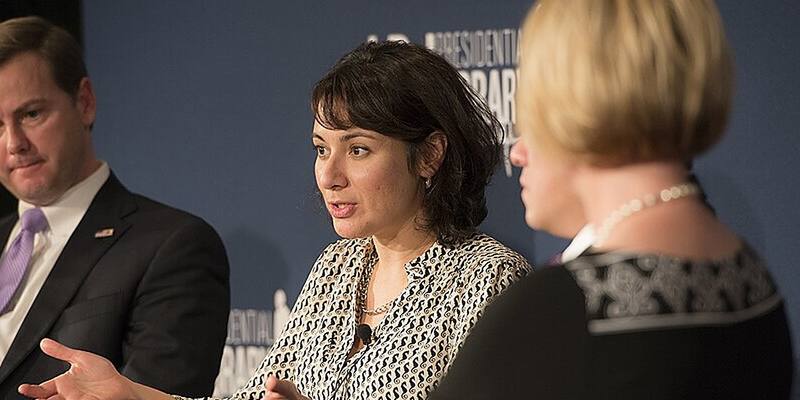
Gina Hinojosa, then a Texas state representative, at an LBJ Presidential Library forum in Austin in February 2017. She was elected governor of Texas on November 3, 2026. Image: Jay Godwin, LBJ Presidential Library / Wikimedia Commons, Public domain (US government work), cropped

American voters used Tuesday’s midterm elections to turn against the data centres that power artificial intelligence. By Wednesday, 33 local ballot measures restricting data centres had passed or were leading in counts still under way, Stateline reported, citing the tracker Data Centers on the Ballot. Only one measure, in North Dakota, went the way of the industry’s supporters.
The backlash reached the top of the ballot too. In Texas, the state with the most planned AI data-centre capacity, Democrat Gina Hinojosa beat Governor Greg Abbott after promising a moratorium on new data-centre construction. In Georgia, Keisha Lance Bottoms won the governor’s race after calling for a pause on new data centres.
Ohio led the local revolt
Voters in 10 states faced 41 data-centre measures on November 3, according to a Ballotpedia count published on election day. Ohio had 21 of them, more than any other state, followed by Illinois with seven, Maine with four and Kansas with three. A yes vote on 28 of the 41 would limit data centres, through bans, moratoriums, zoning rules or public votes on big projects. The other 13 would help them get built.
Around Columbus, voters went against data centres in Ashville, Pataskala, Grove City, Sunbury and Granville, according to unofficial counts reported by NBC4. Pataskala is set to change its charter to ban data centres with a monthly demand of 25 megawatts or more. In Ashville, voters appear to have overturned the village’s agreement with the data-centre developer EdgeConneX, though construction there is already under way and the vote won’t stop it.
Every data-centre measure decided earlier in 2026 also went for tighter limits, Ballotpedia found, including a ban in Monterey Park, California, that won 88.3% of the vote. Most of this week’s results are still unofficial.
“We need to pause”
The Associated Press called the Texas race for Hinojosa at 11:17pm Eastern time on Tuesday, and Abbott conceded, Yahoo Finance reported. With about 93.5% of the expected vote counted, she had 52.8% to Abbott’s 45.7%, according to NBC News. Hinojosa campaigned on a moratorium on new data centres, stricter rules on their water and power use and an end to tax breaks for the industry. Abbott, who once said he wanted Texas to be the “epicenter of AI development”, had since announced a moratorium of his own, which Hinojosa dismissed as an “election year pause”.
In Georgia, Bottoms led Republican Rick Jackson by 54.2% to 45.8% with 98.2% of the expected vote in, on NBC News’s count. She made a statewide pause part of her pitch on energy bills, saying in October:
Georgia is currently No. 1 in the country for data centers. We need to pause. We need consumers like you. We need experts in this field to sit around the table and give us guidance as to how the state of Georgia should move forward.
Keisha Lance Bottoms, Georgia’s governor-elect, quoted by WTOC
In Ohio, Democrat Amy Acton beat Vivek Ramaswamy by 52% to 44.7%, according to NBC News. Both had promised tougher conditions on new data centres, and Ohio’s governor appoints the five members of the utilities commission that sets electricity rates and the terms for data centres.
Wall Street took fright
Investors read the Texas result as a warning. Nasdaq-100 futures fell 0.8% overnight, and shares in the AI cloud company CoreWeave dropped 7% and Oracle 4% in overnight trading, CNBC reported. Wells Fargo puts 27% of the gigawatts of planned US data-centre capacity in Texas, 7% in Georgia and 5% each in Ohio and Pennsylvania. Before the vote, Wells Fargo strategist Ohsung Kwon had warned that a Democratic win could be “a left-tail event to the AI trade”, meaning a rare but painful shock.
A harder road for the AI build-out
Amazon Web Services boss Matt Garman warned in October that local moratoriums could cost America the AI race and offered $1 billion to win towns over. President Trump told AI companies they must make their own electricity and pay communities a “dividend”, and an October poll found 72% of Americans don’t want a data centre near them. The fight had already reached Trump’s home county of Palm Beach.
Governors can’t stop projects on their own: new state rules need lawmakers and regulators. But they shape the tax breaks, power deals and permits data centres depend on.
Why it matters
OpenAI, Anthropic, Google, Meta and xAI all need vast new data centres to train and run their models, and much of that capacity is planned in exactly the states that voted this week. Opposition to data centres has now proved a winning message from village ballots to governors’ races, which will make every new campus harder and slower to build.
Sources: Stateline, Ballotpedia, NBC4, NBC News results (Texas, Georgia, Ohio), Yahoo Finance, CNBC, WTOC, Ohio Capital Journal
Latest Policy & Safety news