
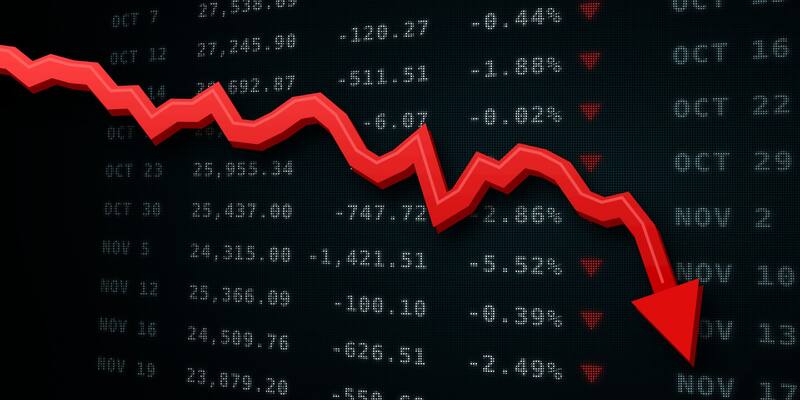
Illustrative: the red line traces the Nasdaq Composite’s daily closes from its October 6, 2026 record to November 20, an 18% fall, over a board of its real down days. Image: MadRobot graphic; data: Nasdaq OMX via FRED, Federal Reserve Bank of St. Louis
AI shares were up to 97% likely to be in a bubble in September, according to new research from London Business School and the University of Cambridge that used language models to read 170 years of The Economist. Its “bubble index” now sits at or above where it stood at the peak of the dot-com boom in March 2000.
How 170 years of The Economist became a bubble gauge
Marco Grotteria of London Business School and Afonso Monteiro and Constantine Yannelis of Cambridge set out to solve an old problem: bubbles are usually spotted only after they burst. Grotteria says the idea was to treat journalists’ words as a real-time reading of whether markets have run ahead of themselves:
We observe neither fundamentals nor investors’ expectations, so bubbles have historically been identified only ex post.
Marco Grotteria, Assistant Professor of Finance, London Business School
Language models read 795,964 Economist articles from the first issue in 1843 to 2013, and the team then extended the index with articles up to September 2026. About 486,000 of the articles were about markets. Each was scored for speculative stories, regulatory warnings, signs of speculation, worries about valuations and talk of a boom or euphoria, and the scores were combined into a monthly index.
The press cries wolf
The first finding is that financial journalists warn about bubbles all the time. Across 170 years, the articles implied an average 20% chance of a major market crash within six months, about 3.5 times the real rate of 5.7%. It echoes the economist Paul Samuelson’s old joke that Wall Street had “predicted nine out of the last five recessions”.
So the level of worry tells you little, Grotteria says. What counts is when it climbs well above its own history. In 74% of comparisons the index was higher in a bubble month than in a normal one, and he says that every time it went above 40% or 50%, a bubble and then a crash followed.
The authors say the index is most useful to central banks and regulators that see a missed bubble as far costlier than a false alarm: for them, it cuts expected losses by a fifth to a third compared with ignoring it. If both mistakes are weighed equally, Grotteria says, “you will not use our index”.
‘Sometimes, the wolf does come’
The September reading puts the chance that AI-related shares were in a bubble at up to 97%. By October 2002 the Nasdaq Composite had lost 78% from that March 2000 peak, according to St. Louis Fed data. Grotteria’s summary:
The press cries wolf all the time. But sometimes, the wolf does come. So, the question is not whether journalists are the warning, because they always are. It is whether they are warning louder than usual. Right now, they are.
Marco Grotteria, London Business School
The index stops in September, before the Nasdaq fell 18% from its October 6 record to its November 20 close, a slide tracked in MadRobot’s AI bubble checklist, and it measures the odds of a bubble, not when or whether prices will fall. Nor is it a verdict on the technology. “We never say that a bubble means AI technology is useless. The technology may be very productive, but investors are still learning what it is worth,” Grotteria said, and the paper says an AI bubble and a genuine technological revolution “are not mutually exclusive”.
Central banks are worried too
The research lands in a week of louder warnings. On Thursday the Bank of England said AI financing has become “complex, circular and opaque”, with Big Tech’s debts and commitments over $4 trillion, and this month the US Federal Reserve’s survey ranked AI as the No. 1 risk to the US financial system.
Why it matters
Most talk of an AI bubble is opinion. This is an attempt to measure it against 170 years of the financial press, and it says the alarm is now as loud as it was at the top of the dot-com boom. It can’t say when a fall would come, but it gives regulators a number to watch.
Sources: London Business School, “New research suggests AI bubble bursting and to expect major market collapse”, November 25, 2026; Marco Grotteria, Afonso Monteiro and Constantine Yannelis, paper on SSRN; Federal Reserve Bank of St. Louis (FRED), Nasdaq Composite Index.
Latest Business news