
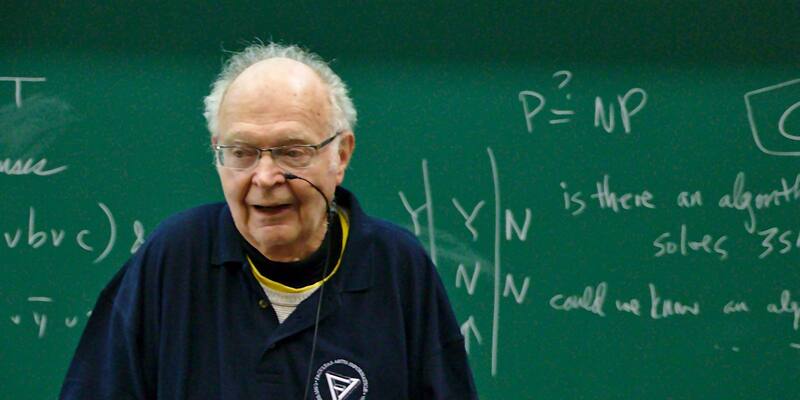
Donald Knuth at a public Q&A session at Masaryk University’s Faculty of Informatics in Brno, Czech Republic, in October 2019. Cropped. Image: Debarshi Ray / Wikimedia Commons, CC BY-SA 2.0, cropped
Donald Knuth, the Stanford computer scientist behind The Art of Computer Programming, has stopped reading new error reports about his books because AI has made his readers too productive. “The rise of LLMs has increased the productivity of my readers so greatly that error reports are now being submitted much faster than I can read them!” he wrote in a temporary moratorium on his Stanford website.
‘The amount of available time is now less than zero’
Knuth, 88, says he has welcomed reports of errors in his books for more than fifty years, so he can fix them before new copies are printed. He checks every one himself, and that is what has broken down. He explains why he won’t hand the job to anyone else:
This content is very important to me, and I wish to take personal responsibility for getting everything right. Therefore I insist on verifying everything carefully. That takes time. But the amount of available time is now less than zero.
Donald Knuth, on his Stanford website
He doesn’t say the new reports are wrong. His complaint is that most of them aren’t new: “Random sampling indicates that the vast majority of errors that have been reported in recent weeks are repeats of issues already submitted by others.” On his news page, under the heading “Help, I’m drowning!”, he thanks the “volunteers all over the world” who hunt for his mistakes, but says the rise of “AI” means he is now “receiving more reports than I can possibly handle.”
His famous $2.56 rewards are on hold
Under the new policy, Knuth won’t look at any error report submitted after 25 November 2026 until he has posted an updated list of the known errors in the book concerned. The page lists the books for which errata are welcome again, and for now that list is empty: “At the moment I’m swamped, but hoping to add items to this list soon.”
That pauses one of computing’s best-loved traditions. The first person to find any error in a Knuth book gets 0x$1.00, one “hexadecimal dollar”, or $2.56, with 0x$0.20 ($0.32) for significant suggestions. For decades he paid by personal cheque, and few were ever cashed: only 9 of the first 275 he sent from 2006, he once noted, adding that “the others have apparently been cached.” Fraud on his bank accounts made him switch in 2008 to certificates from the fictional Bank of San Serriffe, where finders now hold accounts as bragging rights.
He ends the notice with an apology: “I apologize for having made errors in the first place, and for having limited ability to cope with more than one thing at a time.” He promises to get through the existing pile “as soon as humanly possible.”
Open-source maintainers know the feeling
Knuth is the most famous name yet to be swamped by AI-assisted reports, but he isn’t the first. Daniel Stenberg, who leads the curl project, ended curl’s bug bounty on 31 January after what he called “an explosion in AI slop reports” in 2025. More than 15% of submissions used to turn out to be real vulnerabilities; from 2025 the rate fell below 5%. “Not even one in twenty was real,” he wrote.
Knuth’s problem is a little different: his readers seem to be finding real slips, just many of the same ones at once, faster than one careful person can check them.
Knuth is no AI sceptic
The same news page is full of AI. In February Knuth wrote “Claude’s Cycles” after Anthropic’s Claude Opus 4.6 solved an open problem about directed Hamiltonian cycles that he had been working on for weeks for a future volume of his books. “Shock! Shock!” the note begins. “It seems that I’ll have to revise my opinions about ‘generative AI’ one of these days.”
He also reports that GPT 5.4, coached by Filip Stappers and Tomas Rokicki, found three improvements to his 2020 note “Signed Skeletons”. AI has become a regular source of results for leading mathematicians too: Terence Tao says the labs treat the proofs their models produce as ‘toxic waste’, and OpenAI and Anthropic have both claimed AI solutions to famous problems.
Why it matters
AI has made finding errors cheap, but checking them still takes a human. When even Knuth, who has paid readers to find his mistakes for decades, has to close the door, every project that relies on outside reports, from open-source code to academic books, faces the same bottleneck.
Sources: Donald Knuth, Moratorium; Knuth, Recent News; Knuth, The Art of Computer Programming; Knuth, 2008 news; Knuth, Claude’s Cycles; Daniel Stenberg
Latest Anthropic news