
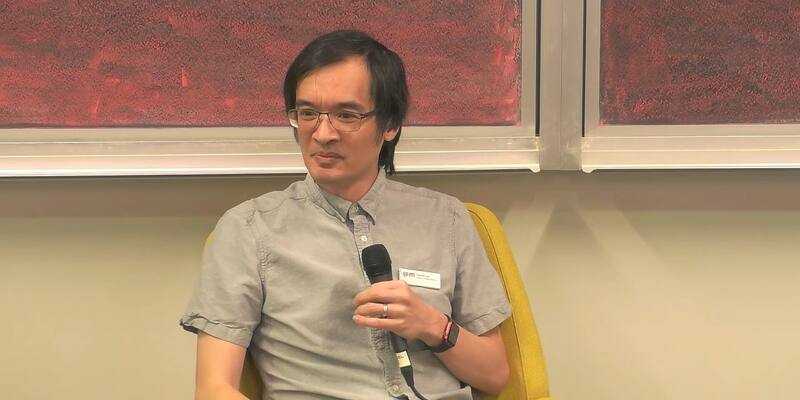
Terence Tao at a fireside chat during IPAM’s Accelerating Math and Theoretical Physics with AI workshop at UCLA in March 2026 (file photo). Image: Institute for Pure & Applied Mathematics (IPAM), UCLA / Wikimedia Commons, CC BY 4.0, cropped

Terence Tao, the Fields medallist often called the world’s greatest living mathematician, says the AI labs producing proofs of famous maths problems see them as a by-product of training, not the point. “They’re sitting on this pile of toxic waste that they need to deal with,” the UCLA professor said on Friday’s episode of The New York Times’ Hard Fork podcast.
Proofs as a by-product
Tao told the episode’s host, Max Read, that until last year the big tech companies worked with academics on a roughly equal footing, because their models could not yet solve problems on their own. Mathematicians supplied the problems, checked the output and wrote up the results.
That changed this year, he said. Now that the models can solve problems alone, the labs work “completely internally”, no longer collaborate with outside academics and usually make no attempt to put the AI-generated papers through peer review. Advisory groups of mathematicians have set out best practices, and the labs are following “some of these a little bit”, he said. He put the gap down to the race between the companies, several of which, he said, have closed, cut or reassigned their science teams:
One of the best ways to train a model is to give it lots and lots of math problems. And every so often they spit out math proofs, but this wasn’t somehow their main objective.
Terence Tao, on Hard Fork
The companies then do “some minimal cleanup”, he said. Early papers did “a very bad job with citing references”, often leaving out the human work they built on. That has improved, he said, “but still, there are suspicions”.
‘That could be a coincidence’
“Nothing’s been proven,” Tao said, but he described what he called “weird coincidences”. Researchers working on a problem upload some of their work to ChatGPT or another public model for help, he said, and “a month or so later, the company releases a big press release” saying it has solved the same problem. “Now, that could be a coincidence,” he said, adding that outsiders have little visibility into what actually happens.
He said the companies are “often very reluctant” to disclose how they produced a proof, how much computing power was used or how much data, which is “very different from academic norms”. OpenAI and Anthropic, the two labs the podcast named, haven’t commented on his remarks. Both have announced AI-made proofs this autumn, including three famous problems OpenAI says it solved and a 47-year-old cousin of P vs NP Anthropic credits to Claude.
Answers without understanding
The deeper problem, Tao said, is that AI has “given us answers without insight, without understanding”. The models can solve open problems, but “they can’t explain them to us” and leave mathematicians picking through 100-page solutions. He likened doing maths to hiking towards a distant waterfall, with dead ends and discoveries on the way, while today’s AI flies straight there by helicopter:
You land there, you take your Instagram shot, and then you go home. You’ve achieved your goal, but you’ve missed out on a lot of serendipity.
Terence Tao, on Hard Fork
Journals are being “overwhelmed” with AI-made papers that technically solve something new but often don’t suggest new directions, cite properly or explain things clearly, he said. Solving problems used to be a very good measure of how well mathematicians understood a field, but “we’ve optimized it too much”, he said. “We now have these machines that can solve problems but do not advance our understanding of our field.”
‘I can see big math emerging’
Tao, whose new book Six Math Essentials is out now, said he is “still positive about AI broadly” and called it “a wonderful tool”. But he said the current way of churning out output “with sort of no regard for what second-order impacts is reckless”, and that “the pace is more fast than is safe”.
He expects mathematicians to work in much larger teams. “I can see big math emerging, just like big science,” he said. A bright postdoc or even a graduate student could run a very ambitious project, he said, “mapping out thousands of problems and using AIs and humans to kind of systematically explore terrain”.
He also wants credit to shift from being first to explaining well. “We can have AIs get the first awful solution to a problem,” he said, with humans then organising it properly, so that mathematicians become more like chefs than the people who grow the food.
Why it matters
Tao has spent years encouraging mathematicians to use AI, so his criticism of how the labs release their results carries unusual weight. With claims as large as a Riemann Hypothesis proof now arriving faster than anyone can check them, his call for transparency, peer review and credit for explanation goes to the heart of how maths will be done.
Sources: Hard Fork, “Why One of the World’s Greatest Mathematicians Is Hopeful About the Future” (YouTube); Hard Fork, The New York Times
Latest OpenAI news