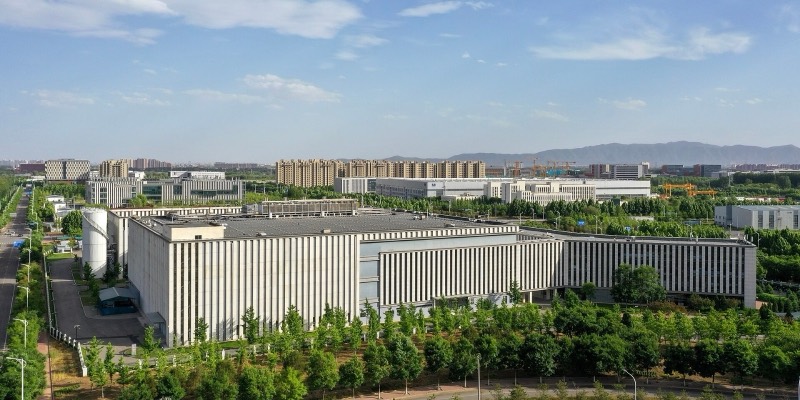
A data centre run by state oil company CNPC in Beijing’s Changping district, pictured in 2022. Image: Charlie fong / Wikimedia Commons, CC BY-SA 4.0

For years, Ulanqab in Inner Mongolia was best known as China’s official “potato capital.” Now its fields have a new crop: enormous data centres to power China’s AI ambitions, going up so fast that one construction worker laughingly described his country to the BBC as “an infrastructure maniac.”
“This is China speed,” the worker told BBC China correspondent Laura Bicker, who visited the sites as Xi Jinping prepared to meet Donald Trump in Washington. An electrical engineer said the site is building one phase a year, with “many more phases” to come.
Why the middle of nowhere
Ulanqab is one of several sparsely populated regions, alongside Ningxia and Gansu in the north and Guizhou in the south-west, where China is building hundreds of data centres for companies including Huawei, ByteDance and DeepSeek, the BBC reports. The logic is practical: these regions already have huge wind and solar capacity, land is cheap, and the cooler weather means less water is needed to keep servers cool.
Beijing sees the computing power inside them as critical to economic and national security, and to its goal of embedding AI across 90% of industries and society by 2030.
A different model of AI
China isn’t just trying to catch up with America. It’s pushing a different approach. Xi has encouraged Chinese firms to build cheaper open-source models that anyone can modify, in contrast to the closed models from OpenAI and Anthropic. Sharing the technology has helped Chinese labs move quickly despite being cut off from the most advanced chips. Beijing also wants a bigger say in writing the global rules for AI.
That’s a sharp contrast with Washington’s mood. “Whoever wins AI, wins,” Trump said last week, and Anthropic CEO Dario Amodei has called for keeping the ban on selling advanced chips to China, warning a Chinese lead would “pose grave danger for the US and the world.” China’s state-run Global Times dismissed those fears as a “Cold War playbook.”
Talent is heading home
China is also building a talent pipeline, producing around five million science and technology graduates a year, compared with roughly half a million in the U.S., according to the BBC. And with U.S. immigration restrictions and tensions souring the American dream, more of them are staying.
“Fewer students and researchers are heading to the US, and more are returning from the US to China. That is very clear,” Jack Zhang of the University of Science and Technology of China, who studied at Yale and Cambridge, told the BBC.
“What benefits has it brought us?”
Not everyone in Ulanqab is convinced. Entire villages have been relocated to make way for the data centres, though the BBC found it hard to establish how many people were moved or what they were paid. Some of the grid still runs on coal, and water remains a worry in the arid region.
“This big data has absolutely nothing to do with ordinary people,” one local told the BBC anonymously. “What benefits has it brought us?” Others said few locals had found jobs there, and feared losing their farmland.
Others are proud. A man named Zhang, whose children found jobs at the data centres, said “China is now at the forefront of the world.” But for one farmer checking on his sheep, with a cracked phone and a 40-yuan-a-month Wi-Fi dongle, the AI race might as well be happening on another planet: “Big data and all that… pretty good – but it has nothing to do with me.”
It’s a telling snapshot as Xi and Trump meet this week. Both leaders talk about AI as a race to be won. In the fields of Ulanqab, the race is already very physical, and not everyone living next to it feels part of it.
Source: BBC News
Related