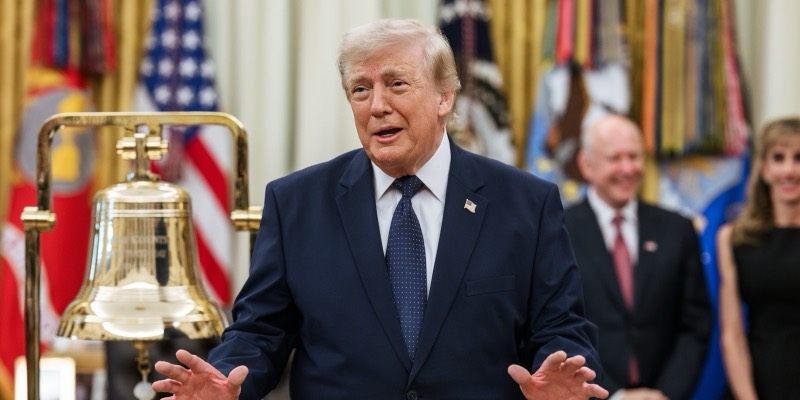
President Trump after ringing the New York Stock Exchange and Nasdaq opening bell from the Oval Office on July 6, 2026. Image: The White House / Wikimedia Commons, Public domain, cropped
.jpg)
President Trump has disclosed more than 1,000 stock trades made on his behalf in July, including big moves in some of the biggest names in AI. Between $6.5 million and $31 million of Microsoft stock was sold, and shares were bought and sold in Nvidia, Palantir, Tesla and Elon Musk’s SpaceX, the BBC reports, citing the official filing.
What the filing shows
The disclosure, signed on September 8 and published by the Office of Government Ethics, covers trading in July. Among the AI and tech trades:
- Microsoft: between $6.5 million and $31 million of shares sold, and between $165,000 and $400,000 bought, according to the BBC
- Nvidia and Palantir: shares bought and sold across the month. Palantir is a major contractor for the Defense Department and Immigration and Customs Enforcement.
- SpaceX: between $15,001 and $50,000 of shares bought on July 10, and between $1,001 and $15,000 sold on July 17, NBC News reports. Musk’s rocket, satellite and AI company went public on the Nasdaq in June.
- Tesla: shares also bought and sold
Filings like this only give value ranges, not exact amounts, which is why the figures are so wide.
The White House: ‘no conflicts of interest’
The White House says Trump has nothing to do with the trades. His stocks and bonds are managed independently by third-party financial institutions, and the portfolio mirrors broad market indexes such as the Schwab 1000, according to NBC News. That would explain the sheer number of trades: an index-tracking fund buys and sells whatever is in the index, including the biggest tech companies.
Neither President Trump nor any member of his family has any ability to direct, influence or provide input regarding how the portfolio is invested or when investments are bought or sold. There are no conflicts of interest.
White House spokesperson, to the BBC
Why it’s getting attention
The timing is awkward. The disclosure landed in the same week Trump told the UN General Assembly that AI should be rebranded as “superintelligence”, rejected calls to slow AI development down, and doubled down on his view that the U.S. must win the AI race against China at almost any cost.
His administration’s decisions directly affect the companies in his portfolio. It decides which Nvidia chips can be sold to China and on what terms, awards defense contracts to firms like Palantir and SpaceX, and has fought to stop states from regulating AI, as we explored in our look at Trump’s AI policy. Even with an independently managed, index-tracking portfolio, critics argue that a president holding shares in companies his policies can move is a problem in itself.
It’s not the first time. Trump has disclosed thousands of trades since returning to the White House in January 2025, and the size and frequency of them have drawn scrutiny before.
What happens next
The disclosure comes as Trump prepares to host China’s Xi Jinping in Washington this week, with AI and chips high on the agenda, including a proposed U.S.-China AI hotline. Any decisions on chip exports or AI rules will now be watched a little more closely by people checking the next filing.
Related