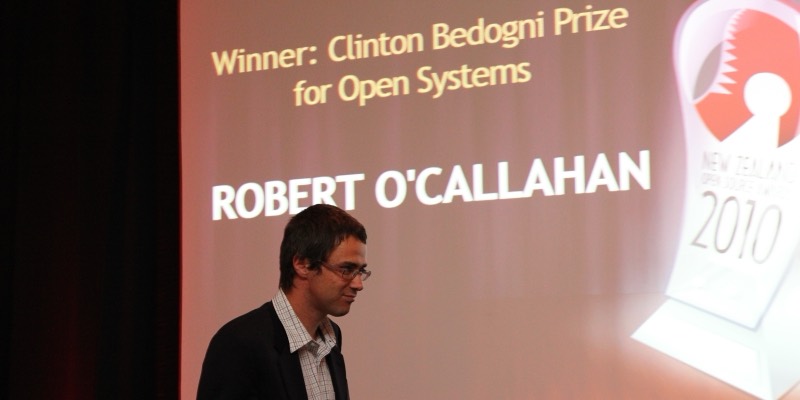
Robert O’Callahan receiving the Clinton Bedogni Prize for Open Systems at the New Zealand Open Source Awards in November 2010. Image: Kristina D.C. Hoeppner / Wikimedia Commons, CC BY-SA 2.0, cropped
.jpg)
A veteran Google DeepMind engineer has quit because his job was making AI faster. Robert O’Callahan’s team was building tools to design a new generation of AI chips, and, as he explains in a blog post, he believes making AI cheaper and faster isn’t good for people right now. He announced it on X:
I resigned from Google today.
— Robert O'Callahan (@rocallahan) September 25, 2026
I enjoyed my work and loved the people, but my GDM team was working on a new generation of chips to make AI much faster and cheaper, and I think AI is already progressing too fast, so I had to quit.
Why he quit
O’Callahan worked on improved tools for hardware chip design. It was interesting work, he writes, but its purpose was clear:
My team’s goal is ultimately to make AI much cheaper and lower-latency, and I don’t think that’s good for people right now.
Robert O’Callahan, in his blog post
His central argument is about pace. “I firmly believe AI progress is currently far too rapid,” he writes, adding that “AI is developing faster than humans can individually and collectively understand it.” He says he tried to “positively influence events from within GDM, but that effect does not seem to be strong.”
He doesn’t pretend his exit will change much. Millions of people are contributing to AI, and stepping away will have a very small impact, he writes, “but not no impact,” because some of his skills are rare. He’s also open that his Christian faith drove the decision, and he has nothing bad to say about Google: “I love my colleagues and my work environment.”
‘Not specific fears of AI doom’
The post hit the front page of Hacker News, where O’Callahan, posting as “roca,” answered critics directly. He said he was in DeepMind’s GenAI unit, “not exactly working on AI directly, or I would have quit earlier, but in the middle of it,” and clarified what worries him most:
The main reason I quit is not specific fears of AI doom (I’m uncertain about that), but my belief that AI is progressing too fast.
Robert O’Callahan, on Hacker News
He isn’t swearing off AI. He plans to keep maintaining the rr and Pernosco debugging tools, study how AI agents debug code and use AI on hobby projects, but says “there’s no chance I’ll work on anything that accelerates AI.” As he put it: “If I could Thanos-snap AI out of existence I would, but as long as it exists, it seems better on balance to make good use of it where possible.”
Who he is
O’Callahan isn’t a household name, but he’s well known among programmers. A New Zealander, he spent years as a senior engineer on Mozilla’s Firefox engine and created rr, a widely used debugging tool. In July, he signed the “Pacing the Frontier” petition, which backs slowing AI development so safety can keep up.
Part of a pattern at DeepMind
He isn’t the first to go this month. Research engineer Bilal Chughtai left DeepMind warning “AI has the potential to kill us all,” Bloomberg reported on September 15. Josh Engels, from DeepMind’s AGI safety team, joined the AI evaluation group METR, warning of “immense harm” within five years.
The exits come as DeepMind’s direction shifts. Demis Hassabis stepped down as CEO in August, and his successor, Koray Kavukcuoglu, said this week that he wants Gemini 4 out “as soon as possible.” Meanwhile, the bosses of OpenAI and Anthropic told the UN Security Council they would slow down if needed.
The pushback
Not everyone was impressed. The top comment on Hacker News reads: “The more people leaving ‘because AI’ just makes me sad that there have been so few leaving ‘because advertising.’” Others pointed out that he still plans to use AI tools himself, or questioned his religious reasoning. O’Callahan replied that he has long opposed Google’s “engagement optimization,” and admitted: “I am financially secure so it’s not a great sacrifice.”
Why it matters
One engineer leaving won’t slow Google down, and O’Callahan says as much. But his reason is new: he’s not quitting over a safety failure or a scary test result, just over the speed of progress, which is exactly what his team was built to increase. As frontier labs race to ship faster, more of the people doing the accelerating are asking whether they should.
Sources: Robert O’Callahan’s blog, O’Callahan on X, Hacker News, Bloomberg via Investing.com, Neoteo
Related