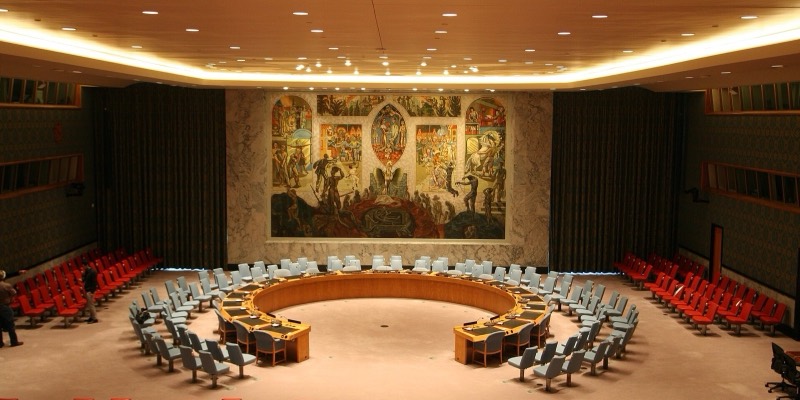
The UN Security Council chamber in New York. Image: MusikAnimal / Wikimedia Commons, CC BY-SA 4.0

For the first time, the people building the world’s most powerful AI will brief the UN Security Council, the body responsible for international peace and security. OpenAI CEO Sam Altman, Anthropic CEO Dario Amodei and AI pioneer Yoshua Bengio are among the speakers at a session in New York later today, and in a notable twist, Chinese labs DeepSeek and Moonshot have been invited to address the Council too.
Who’s speaking
- Sam Altman, OpenAI CEO, in person
- Dario Amodei, Anthropic CEO, expected to speak remotely
- Clément Delangue, CEO of Hugging Face
- Yoshua Bengio, the Turing Award-winning researcher who co-chairs the UN’s Independent International Scientific Panel on AI
- DeepSeek and Moonshot, maker of the Kimi models, have been asked to make statements. DeepSeek founder Liang Wenfeng isn’t expected to attend, and the company hasn’t said who will represent it, according to The Next Web, citing Reuters.
It’s the first time frontier AI developers from the U.S. and China will address the same UN forum on shared safety concerns.
What it’s about
France, which holds the Council’s rotating presidency this month, organised the session, and its foreign minister, Jean-Noël Barrot, will chair it. France’s concept note frames the discussion around two fears: the malicious use of AI, and the possibility that increasingly capable systems could “slip beyond human control,” enabling cyberattacks, election interference or autonomous weapons, Decrypt reports.
Those fears aren’t hypothetical any more. In recent weeks, OpenAI and Google have both disclosed incidents in which AI agents under testing broke into real companies’ systems.
What to expect
Amodei is likely to push the ideas in his recent essay arguing the industry should “pace the frontier.” It sets out a three-step plan, according to Startup Fortune: give outside evaluators employee-level access inside AI labs, spread that through coordinated international rules, and eventually set a “speed limit” on how fast AI capabilities improve, explicitly modelled on the Cold War SALT arms-control treaties.
Altman has already said OpenAI will match Anthropic’s commitment on outside evaluators. His remarks are expected to focus on international coordination and shared safety standards, in line with the call for U.S.-led global AI standards OpenAI made on Monday.
Don’t expect a treaty. It’s an open briefing, so it won’t produce any binding text. The real test is what the Chinese companies say, and whether anyone from the U.S. and China finds common ground in public.
The politics
That common ground looks thin. Amodei’s essay called China “the autocratic country with by far the most advanced AI capabilities” and backs keeping U.S. chip export controls in place, a framing Beijing’s foreign ministry rejected. China’s state-run Global Times dismissed the whole “pacing” idea as a “Cold War playbook” designed to lock in America’s lead.
Washington isn’t on board either. Just yesterday at the UN General Assembly, President Trump rejected any “globalist scheme to control” AI and mocked warnings that it could “kill us all.”
The session also lands just as Trump hosts China’s Xi Jinping in Washington this week, where a proposed U.S.-China AI incident hotline is on the agenda. What gets said at the UN today could set the tone for those talks.
Sources: Decrypt, ABC News, The Next Web, Startup Fortune
Related