
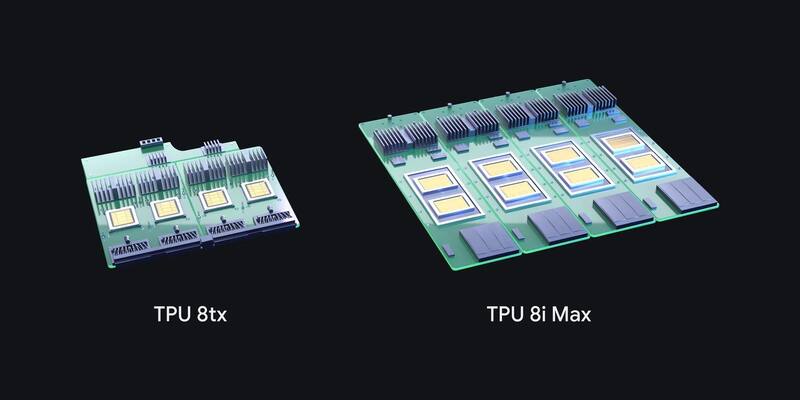
Google’s rendering of its new TPU 8tx and TPU 8i Max systems, from its November 9, 2026 announcement. Image: Google
Google has unveiled two more versions of its custom AI chip systems, the TPU 8tx and TPU 8i Max, bringing its tally of new TPU systems this year to four. Amin Vahdat, Google’s chief technologist for AI and infrastructure, wrote on Monday that it is “the first time we have introduced four TPU systems in a single year”.
TPUs (Tensor Processing Units) are Google’s answer to Nvidia’s graphics processors. Google trains and runs its Gemini models on them, rents them out through Google Cloud and now lets some customers install them in their own data centres. Vahdat says TPUs are “a rapidly growing business with nearly 100 customers”, from frontier AI labs to trading firms, retailers and universities.
New systems, not new chips
The eighth generation began at Google Cloud Next in April with two chips: the TPU 8t for training and the TPU 8i for reasoning. Google says they offer up to 2.7 times better training performance and 80% better inference price performance respectively than the previous generation.
Monday’s additions reuse that silicon. Vahdat draws a line between designing a chip, a “multi-year process bound by the laws of physics”, and building a system around it: the packaging, memory, networking and security. Google’s modular design, he writes, lets it “deliver specialized supercomputers in a matter of months rather than years.”
TPU 8tx: AI on data that never leaves its lockbox
The TPU 8tx is built for banks, governments and other regulated organisations that want to run AI models and agents on their most sensitive data. Data is normally encrypted when stored or sent over a network, but has to be unlocked in memory while a computer works on it. The 8tx, which uses the same silicon as the 8t paired with AMD processors as hosts, builds security into the hardware so that data and model weights stay “protected and isolated even while in active use”, Google says.
Borrowing the 8i’s low-latency Boardfly network, it gives up to two times lower latency than the 8t “with a near-zero performance penalty”, Google says. That means one system can both serve a model and customise it: teams can fine-tune on private data, distil large models into smaller ones and train agents with reinforcement learning without moving sensitive data between clusters.
TPU 8i Max: two chips on one package
The TPU 8i Max goes after what Google calls “the memory wall”. When dozens of AI agents work across an entire codebase or hours of video at once, memory bandwidth becomes the bottleneck. Google’s fix is to put two TPU 8i chips on a single package, doubling the compute, the on-chip SRAM and the HBM memory bandwidth of the 8i. TechTarget, citing Google, puts those at 768MB of SRAM and 17.2TB/s of HBM bandwidth.
Because twice the silicon fits in the same rack space, Google says data centres get “significantly more computing power per square foot and per watt”. It pitches the system at million-token context windows.
Google’s post gives no prices or availability dates for either system, and its performance figures are its own, not independent benchmarks.
A software push aimed at Nvidia’s grip
Chips alone won’t pull developers away from Nvidia, whose CUDA software is the habit most AI code is written in. Last month Google and Meta open-sourced TorchTPU, which lets PyTorch code written for Nvidia chips run natively on TPUs. Monday’s post adds an open-source TPU agent suite, in preview, that plugs into coding tools including Claude Code, Cursor and Google Antigravity to move workloads onto TPUs and tune them, plus TPU Sync, an open-source layer Google says cuts the delay before a model’s first output by more than 90% by shuttling memory off the chip.
“You can’t optimize that infrastructure just by focusing on the chip,” Mark Lohmeyer, who runs Google Cloud’s AI and computing infrastructure, told a press briefing, TechTarget reported. Patrick Moorhead, an analyst who has followed the TPU programme, told TechTarget the focus on running models rather than training them makes sense:
With roughly two-thirds of AI compute now going to inference, specializing [in] inference hardware is the right call
Patrick Moorhead, founder and chief analyst, Moor Insights & Strategy, to TechTarget
The launch lands as Nvidia deals with turmoil at the top: on Sunday its board opened an investigation into chief executive Jensen Huang, who admitted an affair.
Why it matters
Google is now turning out specialised TPU systems in months rather than years, each aimed at a job customers say they need, from confidential AI to agents that read millions of tokens at once. Paired with software that makes switching easier, that gives the biggest AI buyers another serious alternative to Nvidia, and a bit more leverage on price.
Sources: Google: Our newest TPUs: 8tx and 8i Max, built for the agentic era (Amin Vahdat, November 9, 2026); TechTarget, Google specializes TPUs for agentic, confidential computing (November 9, 2026, quotes from Mark Lohmeyer and Patrick Moorhead).
Latest Chips news