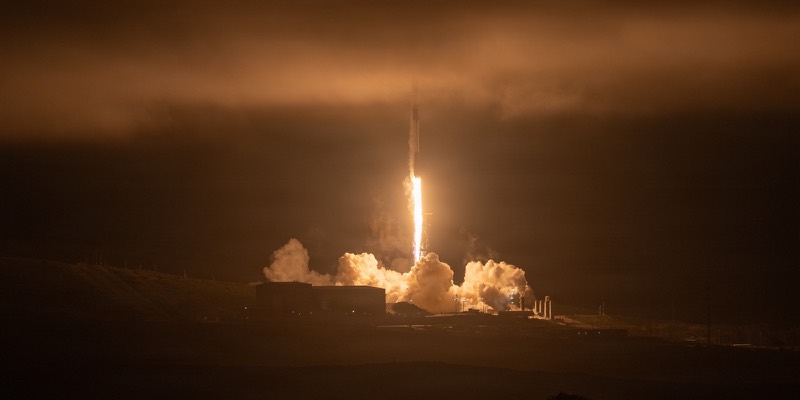
A SpaceX Falcon 9 launches the Transporter-17 rideshare mission from Vandenberg Space Force Base on July 7, 2026. Google’s first Suncatcher satellite flies on the next one, Transporter-18. Image: U.S. Space Force photo by Airman Enso Valle / Wikimedia Commons, Public domain, cropped
.jpg)
Orbital data centres are satellites that run AI in space, powered by near-constant sunlight instead of the electricity grid. The idea has gone from science fiction to a real race in less than a year. Google will launch its first test satellite carrying AI chips on October 1, SpaceX wants permission for up to a million AI satellites, and Elon Musk is predicting that, one day, almost all computing will happen off Earth. Here’s how orbital data centres work, who’s building them, what could go wrong and when, if ever, they’ll matter.
This guide is based on company announcements, regulatory filings, Google’s research paper and independent analysis, as of September 25, 2026. We’ll update it as the first missions fly.
What is an orbital data centre?
A data centre is a building full of computers. The biggest ones now run AI models like Gemini, ChatGPT and Claude, and they use huge amounts of electricity. An orbital data centre takes those computers and puts them on satellites instead.
Each satellite carries AI chips, solar panels to power them and radiators to get rid of their heat. On their own, satellites are small. The plan is to link many of them together with lasers so they work like one big computer, then beam the results back to Earth.
The key thing to know is that nobody has built one yet. What exists today are small experiments: single chips flown in space to see whether they survive. Everything else is plans, filings and prototypes.
Why put AI data centres in space?
In a word: power. AI’s appetite for electricity is straining grids on both sides of the Atlantic, as we covered in our look at who pays for the AI power crunch. New data centres can wait years for a grid connection, and local opposition over land, water and power bills is growing.
Space offers a way around all of that:
- Near-constant sunlight. In a “dawn–dusk” orbit, which follows the line between day and night, a satellite is almost always in sunshine. Google says a solar panel there can be up to eight times more productive than on Earth, with little need for batteries.
- No grid queue. A satellite brings its own power station.
- No land or water. There are no cooling towers or neighbours to object.
Google’s Travis Beals, who leads Project Suncatcher, summed up the pitch in comments reported by Open Magazine:
At the heart of it, Project Suncatcher is a simple idea. How can we efficiently scale AI infrastructure through orbital data centres by leveraging the abundant energy that we can get from the sun?
Travis Beals, Google senior director, Paradigms of Intelligence
What is Google’s Project Suncatcher?
Project Suncatcher is a research “moonshot” that Google announced in November 2025. It explores whether compact clusters of solar-powered satellites, carrying Google’s own TPU (Tensor Processing Unit) AI chips and linked by lasers, could eventually become a data centre in orbit. Google has published a research paper on the design, and it describes the project as long-term research, not a product.
Beals says the team started out trying to prove the idea wrong:
This idea, that’s crazy, there must be a reason it won’t work. And so the first thing we tried to do is to find that reason. It turns out that it is possible.
Travis Beals, Google
The October 1 launch
Google’s first test satellite launches on October 1 on SpaceX’s Transporter-18 rideshare mission, a Falcon 9 flying from Vandenberg Space Force Base in California. Built with Planet, the Earth-imaging company, the fridge-sized satellite carries four Trillium TPUs powered by solar arrays of around 1 kilowatt, Hardware Busters reports. That’s roughly the computing power of a single server.
It’s testing three things:
- Launch. Components can face forces of 50 to 100 times Earth’s gravity on the way up. Google says its hardware “held up to the force” in vibration tests.
- Radiation. Space is full of charged particles that can flip bits in memory or wear out chips over time.
- Heat. With no air, the chips must be cooled entirely by radiators and heat pipes. At first, the chips can only run for about 15 minutes before they have to shut down and cool off, according to the New York Times, as reported by Futurism.
The satellite could stay in orbit for up to six years before burning up in the atmosphere. In Google’s words, “this first launch is about seeing what works, identifying points of failure, and applying those findings to future missions.”
What Google has already tested on the ground
According to Google Research, the team fired a 67 MeV proton beam at Trillium chips to simulate years of space radiation. A five-year mission, with shielding, should expose a chip to about 750 rad. The chips took up to 15,000 rad without any hard failures. The weak spot was the chips’ high-bandwidth memory, which started showing errors at about 2,000 rad. Google says that rate is “likely acceptable for inference,” meaning running AI models, which suggests training new models in orbit is a much bigger challenge.
The lasers are the other big question. To act like one computer, the satellites need to swap data as fast as chips in a data centre do. In a bench test, Google’s team achieved 1.6 terabits per second in total (800 Gbps each way). That’s far beyond the 1–100 Gbps of today’s commercial satellite laser links, but still short of the roughly 10 Tbps Google is reported to need.
Google’s roadmap
- October 1, 2026: the first test satellite, with four TPUs.
- 2027: two more satellites with Planet, to test the high-bandwidth laser links between them.
- Later: an illustrative design of 81 satellites flying in a tight cluster just 1 km across, about 650 km up, with neighbouring satellites only 100 to 200 metres apart.
Google is being unusually frank about the timeline:
We don’t expect, to be perfectly frank, that we’ll have anything usefully operational in the next few years.
James Manyika, Google senior vice president for research, to the New York Times
Manyika compared the project to Google’s work on self-driving cars, which took about 15 years of research.
What is SpaceX planning with Starmind?
If Google is cautious, SpaceX is anything but. Since merging with Musk’s AI company xAI in February, SpaceX has made orbital computing central to its pitch.
- A million satellites. On January 30, SpaceX asked the US Federal Communications Commission (FCC) for permission to launch up to one million data centre satellites, in thin orbital “shells” between 500 and 2,000 km up, SatNews reports. SpaceX said the network would have “unprecedented computing capacity to power advanced artificial intelligence (AI) models.”
- Starmind and Nvidia. On August 4, SpaceX and Nvidia said they are designing the computer for the first satellite, Starmind AI1, using “NVIDIA Rubin GPUs and Vera CPUs for data center class space compute.” Each satellite would carry the equivalent of one server rack, about 72 Nvidia chips, with solar panels producing around 210 kilowatts and large liquid-cooled radiators, Engadget reports. That’s up from about 150 kW in the design Musk described in June.
- Starlink links. The satellites would send data through laser links to SpaceX’s Starlink network.
- A fast timeline. SpaceX is aiming to launch the first AI1 in late 2027. On September 13, Musk said on X he was “highly confident” SpaceX would launch Nvidia AI computers into space next year. His stated goal is to reach a gigawatt of new computing power a year by the end of 2027, then 10 GW, 100 GW and eventually a terawatt.
Musk insists the engineering is manageable. “There’s not some magic that’s necessary,” he said in a June interview, Light Reading reports, adding: “We don’t think of this as a super hard problem compared to things we already do.”
When news of Google’s launch went viral on X this week, Musk went further:
The amount of compute in space will obviously round up to 100% of all compute
— Elon Musk (@elonmusk) September 24, 2026
Google’s satellite is riding into orbit on a SpaceX rocket, so SpaceX wins either way: it is both Google’s launch provider and its biggest rival in orbital computing.
Who else is building data centres in space?
- Blue Origin. Jeff Bezos’s rocket company applied to the FCC on March 19 for Project Sunrise, up to 51,600 data centre satellites between 500 and 1,800 km, connected by its planned 5,408-satellite TeraWave network, GeekWire reports. Bezos has said “we will be able to beat the cost of terrestrial data centers in space in the next couple of decades,” but in May he called two-to-three-year timelines “a little ambitious.”
- Starcloud. The Nvidia-backed startup got there first. Its Starcloud-1 satellite launched in November 2025 with an Nvidia H100 GPU and became the first spacecraft to train an AI model in orbit, a small version of Andrej Karpathy’s nanoGPT.
- Nvidia. In March, Nvidia announced the Space-1 Vera Rubin Module, a space-ready computer it says delivers up to 25 times the AI computing power of an H100 for work in orbit. It’s supplying both SpaceX and Starcloud.
Google vs SpaceX vs Blue Origin: how the plans compare
Swipe the table sideways to see every column →
| Project | In orbit yet? | First launch | Planned scale | Chips | Power per satellite | Stated timeline |
|---|---|---|---|---|---|---|
| Google Project Suncatcher | Launching Oct 1 | October 1, 2026 (4 TPUs) | Clusters of ~81 satellites | Google Trillium TPUs | ~1 kW (test satellite) | Nothing “usefully operational” for several years; cost parity possible by mid-2030s |
| SpaceX Starmind | No | Late 2027 (AI1) | Up to 1,000,000 satellites | Nvidia Rubin GPUs, Vera CPUs | ~210 kW | 1 GW a year by end of 2027, rising to 1 TW |
| Blue Origin Project Sunrise | No | Not announced | Up to 51,600 satellites | Not announced | Not announced | Cheaper than Earth “in the next couple of decades” |
| Starcloud | Yes | November 2025 (1 H100) | Large constellation planned | Nvidia H100; Vera Rubin next | Not disclosed | Larger satellites in development |
Based on company announcements and filings as of September 25, 2026. Satellite counts are regulatory requests, not firm build plans.
What are the biggest problems with data centres in space?
1. Getting rid of the heat
This is the one engineers argue about most. On Earth, data centres use air and water to carry heat away. In a vacuum, the only option is to radiate it into space, which needs large radiator panels. Andrew Cavalier of ABI Research calculates in IEEE Spectrum that a single 700-watt Nvidia H100 needs about 1.4 square metres of radiator, and a modest 40-kilowatt rack about 80 square metres, roughly a pickleball court. He adds that sunlight and atomic oxygen degrade radiator coatings by about 40% over five years, so satellites must launch with extra.
Not everyone thinks it’s a deal-breaker. A detailed study by research group Forethought found modern lightweight radiators could be 13 to 28 times better than those on the International Space Station, and that cooling would make up only 2–5% of the total cost.
2. Radiation
Google’s tests are encouraging, but its memory results suggest orbital chips are better suited to running AI models than training them. Radiation damage also builds up over time.
3. No repairs
On Earth, technicians swap out failed parts every day. In orbit, a broken chip stays broken. Forethought estimates about 9% of computing capacity could be lost each year, meaning operators would need to overbuild by around 38% over a five-year life.
4. Bandwidth
Training the biggest AI models needs thousands of chips talking to each other constantly. Links between satellites, and down to Earth, are much slower than cables in a data centre. Forethought expects orbital data centres to handle mostly inference, answering users’ requests, rather than frontier training runs.
5. Crowded skies
A million satellites would dwarf even SpaceX’s own Starlink network, already the largest in orbit. Astronomers warn that tens of thousands could be visible as bright moving points at any moment. A group of astronomers has formally challenged SpaceX’s application, and most of around 1,000 public comments urged the FCC not to approve it, Space.com reports. Critics also point to the risk of debris and to pollution from thousands of launches and satellites burning up on re-entry, which some scientists fear could damage the ozone layer.
How much would an orbital data centre cost?
Everything depends on the price of launch, which today is roughly $1,500 per kilogram, according to Forethought. That has to fall a long way:
- Google says that if launch costs drop below $200/kg by the mid-2030s, launching and running a space data centre “could become roughly comparable” to the energy costs of an equivalent one on Earth.
- Forethought estimates overall cost parity at around $100/kg, and says orbital data centres are “unlikely to represent a meaningful share of compute before 2030.”
- ABI Research is far more sceptical: its analysis finds running a GPU in space for a year costs “at least an order of magnitude higher” than on Earth, even at optimistic launch prices of $44/kg.
All of these assume SpaceX’s giant Starship rocket becomes fully and routinely reusable. That’s why Musk is so bullish, and why rivals are, awkwardly, relying on him to make their plans work.
When could orbital data centres actually happen?
Put the claims side by side and the timelines spread across a decade or more:
- 2026–2027: test satellites from Google, Starcloud and SpaceX. Expect experiments, not useful computing capacity.
- Late 2020s: Musk’s target for serious capacity. Most experts, including those quoted by CNBC, think significant scale is more likely in the 2030s.
- Mid-2030s: when Google thinks the economics could start to make sense, if launch costs fall.
- 2040s: roughly when Bezos expects space to “beat the cost” of data centres on Earth.
Why it matters
The fact that Google, SpaceX and Blue Origin are all spending real money on this shows how desperate the AI industry is for power. Next week’s launch won’t answer whether orbital data centres make sense, but it will be the first real test of whether AI chips can survive and work up there. If they can, the argument moves from physics to price, and that depends on how cheap rockets get.
Frequently asked questions
What is an orbital data centre?
An orbital data centre is a satellite, or a cluster of satellites, carrying computer chips that run AI and other computing jobs in space. It gets its power from solar panels and gets rid of heat through radiators, then sends results back to Earth by laser or radio.
Why put data centres in space?
Mainly for power. In the right orbit, solar panels get sunlight almost all the time and can produce up to eight times more energy than the same panels on Earth, according to Google. Orbital data centres also wouldn’t need land, water for cooling or a connection to an overloaded power grid.
What is Google’s Project Suncatcher?
Project Suncatcher is a Google research project, announced in November 2025, exploring whether clusters of solar-powered satellites carrying Google’s TPU AI chips could one day form a data centre in orbit. Its first test satellite launches on October 1, 2026.
When does Google’s Suncatcher satellite launch?
October 1, 2026, on SpaceX’s Transporter-18 rideshare mission, a Falcon 9 launching from Vandenberg Space Force Base in California. The satellite was built with Planet and carries four Trillium TPUs.
What is SpaceX Starmind?
Starmind is SpaceX’s planned network of AI data centre satellites. SpaceX has asked US regulators for permission to launch up to one million of them. The first satellite, AI1, is being designed with Nvidia and is due to launch in late 2027.
Are there any data centres in space yet?
Only small experiments. Startup Starcloud flew an Nvidia H100 GPU in orbit in November 2025 and trained a small AI model on it. Google’s first test satellite launches on October 1, 2026. No company has a full-scale orbital data centre, and Google itself says nothing useful is expected for several years.
How do you cool computers in space?
Space has no air, so fans don’t work. Heat has to be carried to large radiator panels that shed it as infrared light. It’s one of the hardest parts of the design: one analysis estimates a 40-kilowatt rack of GPUs needs around 80 square metres of radiator.
Are orbital data centres cheaper than ones on Earth?
Not today. Launch currently costs around $1,500 per kilogram. Google estimates costs could become roughly comparable if launch prices fall below $200 per kilogram by the mid-2030s, and research group Forethought puts overall parity at around $100 per kilogram. That depends heavily on SpaceX’s Starship rocket.
Will orbital data centres harm astronomy?
Astronomers are worried. Tens of thousands of bright satellites could be visible at any moment if SpaceX builds its full network, and a group of astronomers has formally challenged SpaceX’s application with the US Federal Communications Commission. Scientists have also raised concerns about pollution from thousands of launches and re-entries.
Sources: Google Research, Google, Open Magazine, Elon Musk on X, Futurism (citing the New York Times), Hardware Busters, SatNews, Engadget, Light Reading, GeekWire, Starcloud, Nvidia, IEEE Spectrum, Forethought, Space.com, CNBC
Related