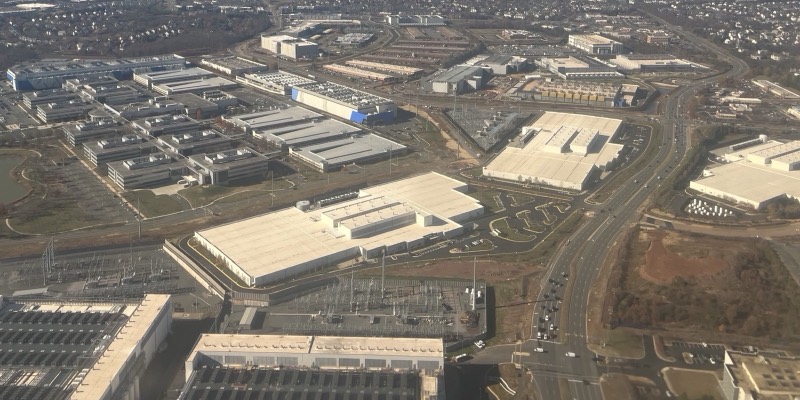
Data centres and substations near homes in Loudoun County, Virginia, near Ashburn, in November 2025 (illustrative). Image: Theodore Christopher / Wikimedia Commons, CC0, cropped
The fight over AI data centres has reached Donald Trump’s own doorstep. Palm Beach County, home to Mar-a-Lago, has voted unanimously to ban new hyperscale AI data centres for a year, WPTV reports, one of a growing number of places saying no to the buildings that power the AI boom.
“Hell no” in Palm Beach County
The moratorium, approved on Thursday, covers new data centres with a peak load of 50 megawatts or more and runs until September 24, 2027, according to The Real Deal. The county will use the time to write proper rules, with options including a paid consultant, quoted at between $200,000 and $2 million.
It follows the county’s rejection in July of Project Tango, a million-square-foot data centre planned near homes and Saddle View Elementary School. Its owner is appealing. Commissioner Gregg Weiss, a former tech executive, said the project’s noise study “didn’t hold up” because it missed “the low hum these facilities produce around the clock”:
Palm Beach County has a message loud and clear, and that was hell no on AI data centers near our neighborhoods. I believe the promise of AI, but embracing innovation doesn’t mean ignoring impact on our communities.
Gregg Weiss, Palm Beach County commissioner
Florida’s wider fight is heating up too. Neighbouring Martin County is considering its own pause, and data centres have become an issue in the race for governor: Democrat David Jolly wants a statewide one-year moratorium, while Republican Byron Donalds says he would regulate them without a ban.
Woken at 4:30am in Arizona
In Ahwatukee, a Phoenix suburb, neighbours protested this week against a huge data centre going up next to their homes, 12News reports. The developer, Menlo Digital, is building a five-building hyperscale campus with its own substation, according to the Arizona Republic, and construction has been starting before dawn under a 2025 state law that lets building work begin at 5am in the hottest months and stops cities enforcing noise rules that would delay it.
Ana Marshall, whose garden is about 150 feet from the site, says the noise wakes her seven-year-old son at night, and she measured up to 110 decibels in his room:
There’s no point measuring anymore, this is consistent, this is constant.
Ana Marshall, Ahwatukee resident
Phoenix officials say there’s little they can do. Because the project was already approved, it won’t have to meet the noise and distance rules the city brought in for data centres last year.
“A plane taking off and never leaving”
The backlash also has a name everyone knows. SpaceXAI powers its Colossus 2 supercomputer in Memphis with dozens of temporary gas turbines across the state line in Southaven, Mississippi. Regulators counted 69 there in July, and a $7 million sound wall does little to muffle what the magazine described as “a constant drone like a plane taking off and never leaving,” Scientific American reported this month. Memphis residents have now sued SpaceXAI over the noise, WREG reports.
The numbers behind the backlash
Local anger is showing up in national polls. An NBC News poll this month found 69% of Americans would oppose an AI data centre being built near them, including 81% of Democrats, 71% of independents and 57% of Republicans, Forbes reports. An AP-NORC poll found 53% are “extremely” or “very” concerned about AI’s environmental impact, up from 41% last year, according to the AP.
Trump isn’t backing down. He has argued that data centres bring “tremendous amounts of money” to towns, and told reporters this month that places which turn them down are choosing “poverty, crime and squalor,” Forbes reports. Other Republicans are more nervous: the Senate may vote as soon as next week on the Ratepayer Protection Act, a bill touted by Ohio senator Jon Husted that would encourage tech companies to cover the energy costs of their data centres, Politico reports.
It’s starting to cost money
The pushback is already hitting the biggest projects. Oracle has declared force majeure, a legal notice that events outside its control are stopping it meeting its obligations, on Project Jupiter, a giant data centre it’s building for Stargate in New Mexico, Semafor reports. Local officials have delayed permits needed to power the site, and Oracle may seek to delay lease payments. Semafor warns that the deals behind these projects are so tightly linked that “a single element falling out of place can expose financial backers and insurers to losses.”
Why it matters
AI companies need huge new data centres to keep growing, and they increasingly need permission from the people who live next to them. When even Trump’s home county votes unanimously for a pause, noise, power bills and water are no longer a side issue; they’re a limit on how fast AI can be built.
Sources: WPTV, The Real Deal, Arizona Republic via USA Today, 12News, Scientific American, WREG, Forbes, Associated Press, Politico, Semafor.