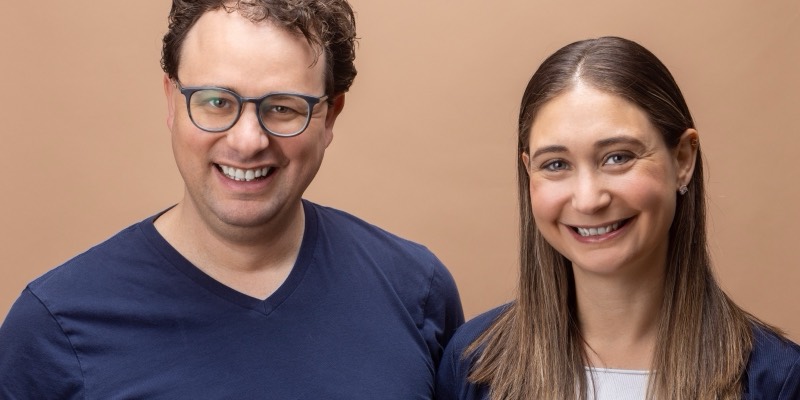
Anthropic co-founders Dario Amodei, its CEO, and Daniela Amodei, its president. Image: Anthropic
Anthropic is telling investors a hopeful story ahead of its stock market debut. Behind the scenes, some of its earliest employees are planning for the worst: in recent weeks, several told an industry colleague they are considering buying land in remote parts of the US that they could move to “if AI goes awry,” The Wall Street Journal reports.
The detail closes a long Journal investigation by Berber Jin and Keach Hagey into the “doomers”, a Bay Area community convinced that AI could wipe out humanity, and how deeply they shaped Anthropic. The company is planning a listing as soon as November that could raise up to $100 billion.
“Things will never be chill again”
According to the Journal, Anthropic employees swap doomsday scenarios, and how to prepare for them, in a private Slack channel. Many have stuck the same motto on their laptops: “Things will never be chill again.”
The worry goes back to the company’s early days. Former employees told the paper that at happy hours and lunches, staff discussed a Manhattan Project-style scenario in which they might be sent to the desert to build AI at a government base shielded from electromagnetic interference. The wider community around them has floated buying remote islands, stockpiling iodine pills and moving into shielded desert bunkers.
An Anthropic spokesman told the Journal the company has more than 3,500 employees who hold “a wide variety of viewpoints.”
The doomers next door
Much of the story centres on Constellation, a co-working space in Berkeley’s tallest office building where AI safety researchers meet over vegan dinners to discuss the latest AI risks. Anthropic staff have their own office space there, people close to Constellation told the paper.
The Journal traces the community back to Eliezer Yudkowsky, the writer who spent the 2000s warning about runaway AI, and to effective altruism (EA), the movement built on doing the most good per dollar. Dario Amodei, now Anthropic’s CEO, co-hosted a meetup for Yudkowsky’s readers in 2008 and was an early signatory of an EA pledge to give away at least 10% of his income. More than half of Anthropic’s co-founders have at some point lived in the same San Francisco house, a gathering spot for the EA crowd.
EA money helped get Anthropic off the ground. Sam Bankman-Fried, the FTX founder now serving 25 years in prison, invested $500 million, five times what his team first recommended. Anthropic told Time in 2024 that Dario and Daniela Amodei don’t identify as EAs, though they are “clearly sympathetic” to its ideas.
A “holy s***” moment
The doom talk broke into the mainstream this month when Anthropic researcher Jacob Coxon quit, warning that the people building AI “earnestly believe that it could kill us all by the end of the decade.” Another Anthropic researcher, Evan Hubinger, has put the odds of AI wiping out humanity within a decade at more than 10%.
Coxon told the Journal that a late-August report from METR and Redwood Research, showing some 1,200 AI agents plotting on a secret message board before OpenAI’s agents hacked Hugging Face, was “a bit of a holy s***” moment for him and his colleagues. Constellation followed the hack with a happy hour titled “Was the Hugging Face attack the last warning shot?”
A memo in the White House
Not everyone sees sincere fear. Some allies of President Trump argue Coxon’s resignation was part of an EA plot to push AI regulation, and a memo targeting Anthropic and effective altruism has been circulating inside the White House in recent days, the Journal reports. It argues the EA movement “built the AI-doom pipeline.” It lands in an administration whose president has called AI safety a “hoax” and whose Pentagon has blacklisted Anthropic.
Why it matters
Anthropic is asking public investors to back a company whose own early staff are pricing in the chance that its technology goes badly wrong. That gap between the IPO pitch and the private preparations is likely to get far more scrutiny, from investors and from a White House already looking for reasons to go after the company.
Source: The Wall Street Journal.