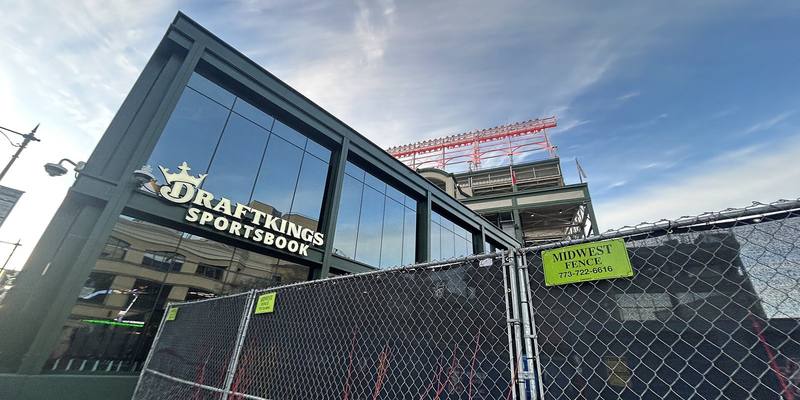
The DraftKings Sportsbook at Wrigley Field, Chicago, in January 2025. Image: SecretName101 / Wikimedia Commons, CC BY 4.0, cropped

A gambler who says he lost thousands of dollars on DraftKings has sued the company, claiming it used artificial intelligence to work out which customers were most likely to keep betting and losing, then bombarded them with offers.
Daniel Vest, from West Virginia, filed the proposed class action in federal court in Boston, where DraftKings is based, on Wednesday, September 30. He wants to represent every DraftKings user flagged by the same system, according to the Boston Globe, which first reported the case.
What the lawsuit says
The complaint says DraftKings built a machine-learning model that scored customers on how much more they were likely to gamble, and lose, in response to targeted promotions. Some users were classed as “elastic” and received extra messages and incentives. According to the suit, analytics and data science pushed up DraftKings’ margins on promotion-driven bets by 13 percent in 2025, and the system steered hundreds of millions of dollars in promotional spending.
The complaint does not hold back:
DK has weaponized AI to do just that, understand and exploit users’ vulnerabilities to financially benefit the company.
Vest v. DraftKings, complaint filed September 30, 2026
Vest says he received about 70 emails, texts and app notifications from DraftKings in the 30 days to September 25 alone, and was never told that AI was analysing his spending and losses. The suit also describes former staff who built tools to spot users trying to leave the platform and pull them back, and to boost promotions for people gambling “more aggressively than usual”.
Much of the complaint leans on a New York Times investigation published in September, which first described the model and the “elastic” label.
Why Massachusetts law matters
The case is built on Massachusetts rules that require licensed betting companies to disclose their use of AI to the state’s Gaming Commission and bar them from using customers’ personal information in AI-driven promotions. Vest argues DraftKings broke those rules by never telling users what the model was doing. He is asking for class certification, damages, the return of money he says was wrongly obtained, and a ban on using the model for gambling promotions.
The Massachusetts Gaming Commission has said it will look at how licensed operators use AI, which could lead to new requirements.
DraftKings denies it
DraftKings rejects the claims. “DraftKings does not use AI to target customers based on losses, nor do we use AI to target customers based on indicators of potential problem gaming,” a spokesperson told the Globe. “We intend to vigorously defend any potential lawsuits on the matter.”
None of the allegations has been tested in court. The case is at the very first stage, and a judge has yet to decide whether it can go ahead as a class action.
Why it matters
Personalised offers are nothing new, but this suit tests whether a company can be held liable for an AI that decides who gets them, when the people it picks out may be the ones least able to stop. It follows reports that McDonald’s uses AI to work out what customers will pay, and arrives as more money apps, like Robinhood with its new trading agents, put AI between people and their cash.
Sources: Boston Globe, Law360, Hoodline.
Latest Business news