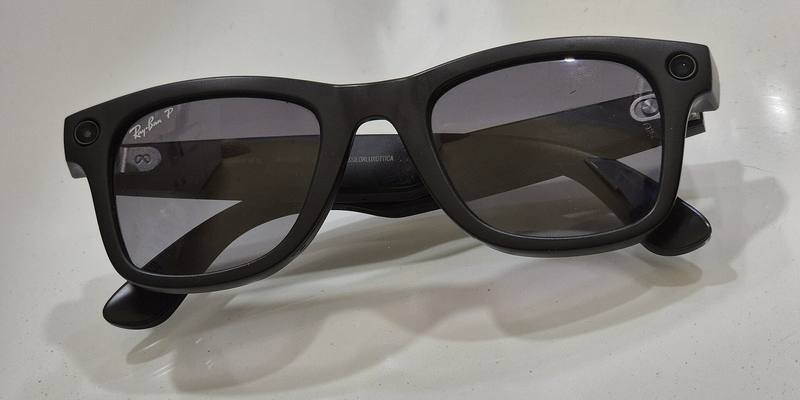
A pair of Ray-Ban Meta smart glasses, with a camera in each corner of the frame. Illustrative. Image: ItzANormalFioko / Wikimedia Commons, CC BY-SA 3.0, cropped

Norway’s government says it will propose a temporary ban on AI glasses in a long list of public places, from parks and beaches to schools, gyms and hospitals, because people nearby can be photographed, filmed or recorded without knowing it.
The plan, announced on Monday by digitalisation minister Torgeir Micaelsen, would not ban the glasses outright. People could still own and use them in private, and in places where nobody else risks being filmed without their consent. The government says it will put a bill to parliament “as soon as possible”.
Where the ban would apply
The proposal covers three kinds of place, according to the government’s announcement as reported by TV 2 and Reuters:
- Busy public spaces: parks, beaches, museums, shopping centres, amusement parks and public events.
- Places for children: schools, kindergartens, playgrounds, youth clubs and events for children.
- Privacy-sensitive places: health institutions, and gyms and pools with changing rooms and showers. Universities and colleges are also being considered.
There would be exemptions in limited cases, including for vulnerable groups and uses that benefit society. Norway’s Association of the Blind has argued that smart glasses make a real difference to blind and partially sighted people.
“We don’t want a society where people are worried about being watched”
Micaelsen, who took over the ministry about a month ago, said the worry is covert recording:
I am worried that new, powerful technology is being introduced where people risk being photographed, filmed or audio-recorded without knowing it.
Torgeir Micaelsen, Norway’s digitalisation minister, via Reuters
“We don’t want a society where people are worried about being watched,” he told NRK (our translation).
The ban is meant as a stopgap. The government will also set up an expert group to advise on permanent national rules for body-worn technology, which Micaelsen first floated in mid-September, when he told NRK the government was considering a ban.
A quick change of course
It is a sharp turn from his predecessor, Karianne Tung, who opposed a general ban and was open only to limits on facial recognition. Pressure had been building: according to TV 2, the education minister has asked councils to keep the glasses out of schools, Norway’s data protection authority Datatilsynet has urged parliament to stop sales until rules are in place, and companies including the bank DNB and the energy group Equinor have brought in their own restrictions.
The government’s announcement covers AI glasses in general, but the best-known are Meta’s Ray-Ban glasses, which have cameras in the frame and are due to get Meta’s Muse AI agent. Meta, which has also launched a camera-free Ray-Ban Meta Audio pair, hasn’t commented on Norway’s plan.
Why it matters
Norway would be one of the first countries to restrict where AI glasses can be worn, and its list of places is wide enough to cover most of daily life outside the home. If it works, other European governments worried about covert filming have a ready-made model to copy, just as Meta and its rivals are betting on glasses as the next home for their AI agents.
Sources: Government of Norway, TV 2, NRK, NRK (Sep 15), Reuters.
Latest Policy & Safety news